A solid — rather than liquid — electrolyte between the opposite electrodes of a battery should, in theory, enable a rechargeable lithium metal battery that is safer, packs much more energy, and charges considerably faster than the Li-ion batteries commercially available today. For decades, scientists and engineers have explored several paths to realize the great promise of lithium metal batteries. A major problem with the solid, crystalline electrolytes under study has been the formation of microscopic cracks that grow during use until the battery fails.
Stanford researchers, building on findings they published three years ago that identified how these tiny imperfections form and expand, have discovered that annealing an extremely thin silver coating on the solid electrolyte’s surface seems to largely solve the problem. As reported in Nature Materials, this coating toughens the surface of the electrolyte fivefold against fracturing from mechanical pressure. It also makes existing imperfections much less vulnerable to lithium burrowing inside, especially during fast recharging, which turns nano fissures into nano crevices and eventually renders the battery useless.
“The solid electrolyte that we and others are working on improving is a kind of ceramic that allows the Li-ions to shuttle back and forth easily, but it’s brittle,” said Senior Author Wendy Gu, Associate Professor, Mechanical Engineering. “On an incredibly small scale, it’s not unlike ceramic plates or bowls you have at home that have tiny cracks on their surfaces.”
“A real-world solid-state battery is made of layers of stacked cathode-electrolyte-anode sheets. Manufacturing these without even the tiniest imperfections would be nearly impossible and very expensive,” said Gu. “We decided a protective surface may be more realistic, and just a little bit of silver seems to do a pretty good job.”
Previous research by other scientists investigated the use of metallic Ag coatings on the same solid electrolyte material — known as “LLZO” for its mix of lithium, lanthanum, and zirconium atoms, as well as oxygen — with which the current study worked. While the earlier studies used metallic silver to improve battery performance, the new study used a dissolved form of silver that has lost an electron (Ag+). This dissolved, charged silver — unlike metallic, solid silver — is directly responsible for hardening the ceramics against crack formation.
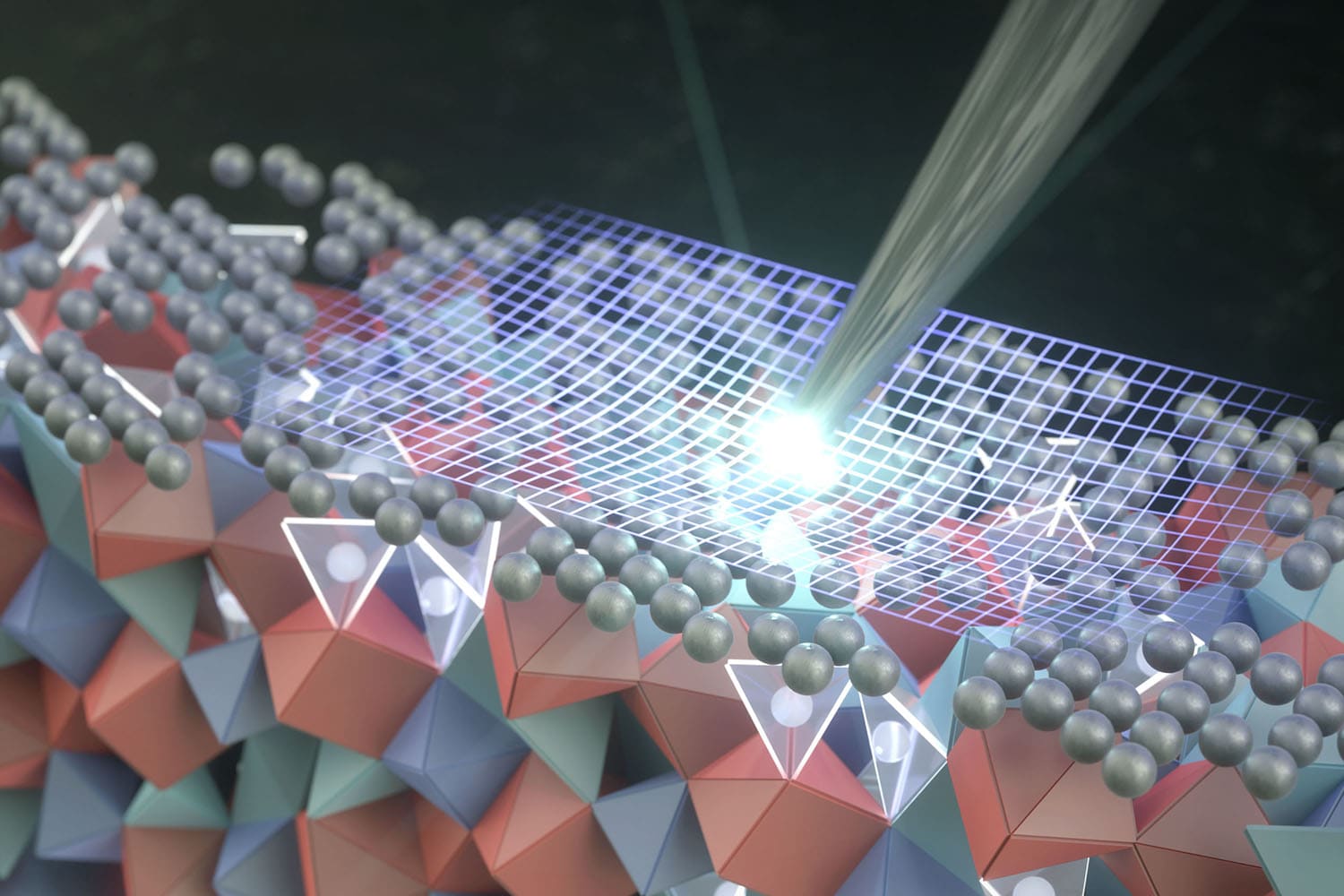
The researchers deposited a 3-nanometer-thick layer of silver onto LLZO surfaces, then heated the samples up to 300 °C (572 °F). During heating, the silver atoms diffused into the surface of the electrolyte, exchanging places with much smaller lithium atoms to a depth of 20 to 50 nanometers. The silver remained as positively charged ions rather than metallic silver, which the scientists think is key to preventing cracks from forming. Where imperfections exist, the presence of some positive silver ions also prevents lithium from intruding and growing destructive branches inside the electrolyte.
“Our study shows that nanoscale silver doping can fundamentally alter how cracks initiate and propagate at the electrolyte surface, producing durable, failure-resistant solid electrolytes for next-generation energy storage technologies,” said then-Research Lead Xin Xu, now an Assistant Professor, Engineering, Arizona State University.
Here is an exclusive Tech Briefs interview, edited for length and clarity, with Xu.
Tech Briefs: What was the biggest technical challenge you faced while annealing the coating?
Xu: Before I answer, I want to clarify that we are definitely not the first group to think about silver. Silver coatings have been used in solid-state batteries for a few years, mostly as an interlayer between lithium metal and a solid electrolyte. Obviously, they do work well. But we came at this with a slightly different idea. We started thinking of silver as a magic element. It's large and is highly polarizable.
This means that the silver arms are so flexible that they can squeeze materials into places where small ions cannot. Our hypothesis here is very simple: If silver could diffuse or squeeze the electrolyte into the cell, it might generate compressive stress and actually can toughen the material. This will make the material more resistant to cracking.
When we first had this idea, we thought, ‘How hard can it be? Just put silver there.’ It turned out so, so hard. The biggest technical challenge was: Solid electrolytes are extremely sensitive to air. Moisture reacts with CO2, and this will also form a contamination layer on the surface. Even in the lab, this happens so easily. Once this contamination on the surface of the electrolyte forms, silver just cannot do what we want it to do.
We eventually realized that the surface cleanness was just everything. So, if we createan ultra-clean surface, the silver could defuse into the material of the electrolyte and generate the compressive stress we were aiming for. Starting then, we became very obsessive with lab environment control. We started from the sample preparation, from the coating characterization to testing. Every step everything was done in tightly controlled air-free conditions. We even designed a very unique custom, air-free transfer vessel just for this project. We even sell this on Amazon. Once we did that, the results were very clear. Very exciting.
Tech Briefs: Do you have any plans for future work?
Xu: We do have several things in mind for the next steps. First, and I think this is probably my favorite part, we want to try other elements. These results suggest ionic size is a key factor.? If that's true, the silver isn't special because it’s silver; it’s special because it's big. This mean that cheaper but big elements could also work. For example, sodium, potassium, or copper. In fact, we already have had some very promising results with copper.