

The use of hybridized carbon/silicon carbide (C/SiC) fabric to reinforce ceramic matrix composite face sheets and the integration of such face sheets with a foam core creates a sandwich structure capable of withstanding high-heat-flux environments (150 W/cm2) in which the core provides a temperature drop of 1,000 °C between the surface and the back face without cracking or delamination of the structure. The composite face sheet exhibits a bilinear response, which results from the SiC matrix not being cracked on fabrication. In addition, the structure exhibits damage tolerance under impact with projectiles, showing no penetration to the back face sheet. These attributes make the composite ideal for leading-edge structures and control surfaces in aerospace vehicles, as well as for acreage thermal protection systems and in high-temperature, lightweight stiffened structures.
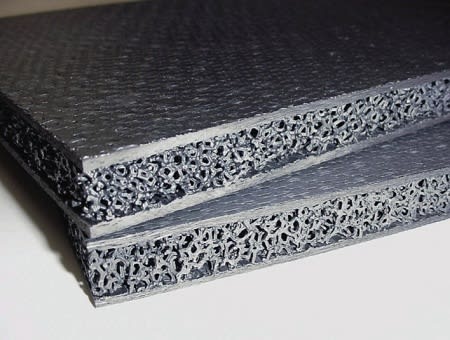
Fibers of two or more types are woven together on a loom. The carbon and ceramic fibers are pulled into the same “pick” location during the weaving process. Tow spacing may be varied to accommodate the increased volume of the combined fiber tows while maintaining a target fiber volume fraction in the composite. Foam pore size, strut thickness, and ratio of face sheet to core thickness can be used to tailor thermal and mechanical properties. The anticipated CTE for the hybridized composite is managed by the choice of constituents, varying fiber tow sizes and constituent part ratios.
This structural concept provides high strength and stiffness at low density — 1.06 g/cm3 in panels tested. Varieties of face sheet constructions are possible, including variations in fiber type and weave geometry. The integrated structures possible with this composite could eliminate the need for non-load-bearing thermal protection systems on top of a structural component. The back sheet can readily be integrated to substructures through the incorporation of ribs. This would eliminate weight and cost for aerospace missions.
This work was done by Frances I. Hurwitz of Glenn Research Center.
Inquiries concerning rights for the commercial use of this invention should be addressed to NASA Glenn Research Center, Innovative Partnerships Office, Attn: Steve Fedor, Mail Stop 4–8, 21000 Brookpark Road, Cleveland, Ohio 44135. Refer to LEW-18126-1.











