A Space Environment Monitor (SEM) subsystem architecture has been developed and demonstrated that can benefit future spacecraft by providing (1) real-time knowledge of the spacecraft state in terms of exposure to the environment; (2) critical, instantaneous information for anomaly resolution; and (3) invaluable environmental data for designing future missions. The SEM architecture consists of a network of plug-and-play (PnP) Sensor Interface Units (SIUs), each servicing one or more environmental sensors. The SEM architecture is influenced by the IEEE Smart Transducer Interface Bus standard (IEEE Std 1451) for its PnP functionality. A network of PnP Spacecraft SIUs is enabling technology for gathering continuous real-time information critical to validating spacecraft health in harsh space environments.
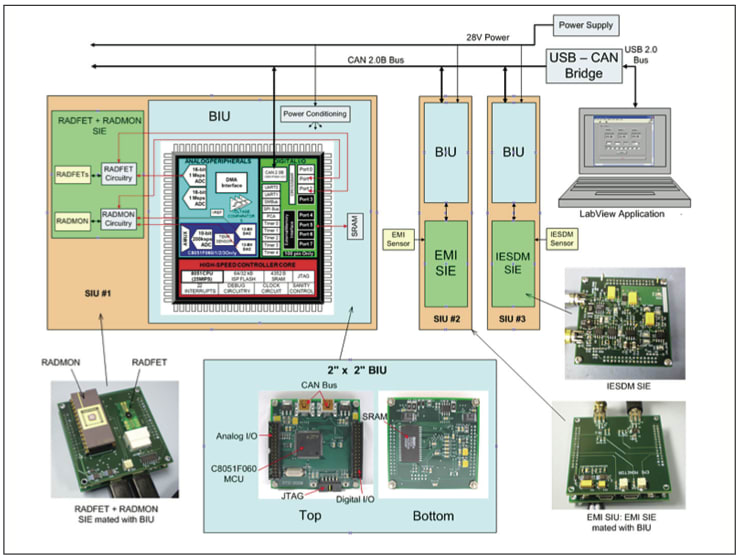
At the time of this reporting, follow-on work is needed to develop designs that use space-qualified parts, in developing a standard fault-tolerant spacecraft interface, which would spawn a multidrop backbone SIU bus (i.e. CAN), and in developing the PnP software that leverages off IEEE Std 1451.
This work was done by Jagdish Patel, David E. Brinza, Tuan A. Tran, and Brent R. Blaes of Caltech for NASA’s Jet Propulsion Laboratory. NPO-47340
This Brief includes a Technical Support Package (TSP).
Plug-and-Play Environmental Monitoring Spacecraft Subsystem
(reference NPO-47340) is currently available for download from the TSP library.
Don't have an account?
Overview
The document outlines the development of a Space Environmental Monitor (SEM) spacecraft avionics subsystem architecture aimed at enabling continuous monitoring of local space environments on spacecraft. The primary objective is to create a system that can interface with existing spacecraft with minimal impact on mass, power, and volume. This initiative is part of NASA's efforts to enhance spacecraft capabilities through innovative technology.
The project follows a structured approach divided into two main phases. The first phase involves requirements gathering through Technology Insertion Maturation Assessment (TIMA) sessions, which help define and prioritize the needs related to space environmental monitors and spacecraft sensor networks. This phase culminates in the development of specifications for the second phase.
In the second phase, the focus shifts to the design, fabrication, and testing of a breadboard system that serves as a proof-of-concept demonstration. The SEM architecture is designed to interface with standard power and data ports on existing spacecraft avionics systems via a SEM Power and Data bus Adapter (PDA). This adapter creates a multidrop backbone bus that supplies power and data paths to small Sensor Interface Units (SIUs), which are strategically placed throughout the spacecraft near environmental sensors. Each SIU provides the necessary interface for its connected sensors, functioning as a plug-and-play component within the SEM subsystem.
The PDA acts as a central hub, equipped with power switching, local memory, and a processor for command and data handling, ensuring a single-point interface to the spacecraft bus. The design includes fault containment features, preventing failures in the SEM sensor network from affecting other spacecraft systems.
The document also acknowledges the contributions of Dr. Henry B. Garrett and references prior work in the field of intelligent components and plug-and-play avionics. It emphasizes the importance of leveraging existing knowledge to meet the unique needs of the Jet Propulsion Laboratory (JPL).
Overall, the SEM project represents a significant advancement in the integration of environmental monitoring systems in spacecraft, aiming to enhance their operational capabilities while maintaining efficiency and reliability. The initiative is part of NASA's broader goal to innovate and improve aerospace technologies for future missions.