

In a proposed coding-and-modulation/ demodulation-and-decoding scheme for a free-space optical communication system, an error-correcting code of the low-density parity-check (LDPC) type would be concatenated with a modulation code that consists of a mapping of bits to pulse-position-modulation (PPM) symbols. Hence, the scheme is denoted LDPC-PPM. This scheme could be considered a competitor of a related prior scheme in which an outer convolutional error-correcting code is concatenated with an interleaving operation, a bit-accumulation operation, and a PPM inner code. Both the prior and present schemes can be characterized as serially concatenated pulse-position modulation (SCPPM) coding schemes.
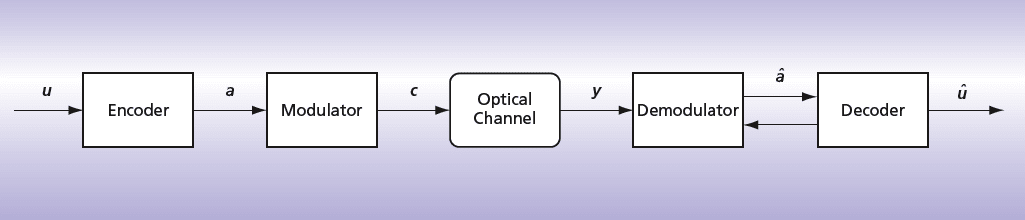
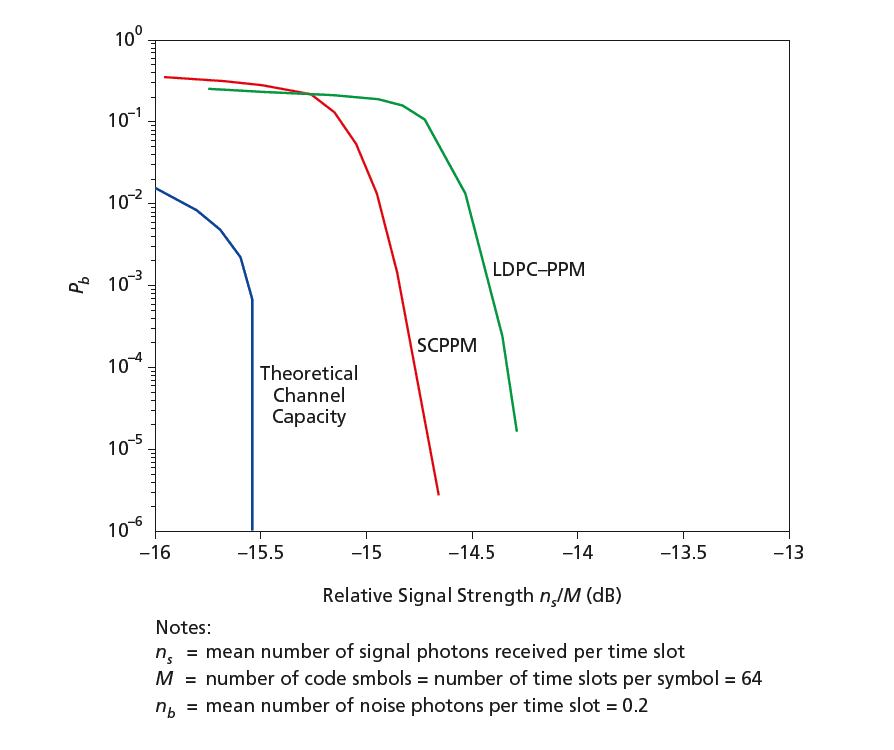
In comparison with non-iterative alternatives, both the present LDPC-PPM scheme and the prior SCPPM scheme offer better performance. In comparison with iterative alternatives, both schemes afford better performance with less complexity. In comparison of these schemes with each other, each is partly advantageous and partly disadvantageous: For example, computational simulations have shown that for a block length of about 8Kb, the performance of the prior SCPPM scheme is about 0.8 dB away from the theoretical channel capacity, while the performance of the LDPC-PPM scheme is expected to be about 1.2 dB away from the theoretical channel capacity at a bit-error rate of about 2 × 10⁻⁵ (see Figure 2); in other words, the performance of the LDPC-PPM scheme is expected to be about 0.4 dB below that of the prior SCPPM scheme. On the other hand, unlike the prior SCPPM scheme, the LDPC-PPM scheme is lends itself very well to low-latency parallel processing. Either scheme could serve as the basis of design of an optical communication system, depending on requirements pertaining to the PPM order, latency, and architecture of the system.
This work was done by Maged Barsoum, Bruce Moision, Dariush Divsalar, and Jon Hamkins of Caltech and Michael Fitz of UCLA for NASA’s Jet Propulsion Laboratory. NPO-44408
This Brief includes a Technical Support Package (TSP).
LDPC-PPM Coding Scheme for Optical Communication
(reference NPO-44408) is currently available for download from the TSP library.
Don't have an account?
Overview
The document titled "LDPC-PPM Coding Scheme for Optical Communication" (NPO-44408) presents a novel approach to error control coding and modulation specifically tailored for optical communications. Developed by researchers at NASA's Jet Propulsion Laboratory, this work addresses the need for power-efficient and computation-efficient solutions in the field of optical communication systems.
The core of the proposed solution is a Low-Density Parity-Check (LDPC) code that has been optimized for use with Pulse Position Modulation (PPM). The encoder integrates the LDPC encoder with PPM, while the decoder consists of an LDPC decoder and a PPM Soft Input Soft Output (SISO) component that iteratively interacts with each other. This iterative process enhances the decoding performance, making it particularly suitable for deep-space communication scenarios where reliability is paramount.
The document highlights the novelty of the approach, noting that while SCPPM (Soft Coded Pulse Position Modulation) has been previously explored for optical communications, the integration of LDPC codes offers significant advantages. The proposed LDPC-PPM scheme is designed to facilitate parallel processing, which can lead to improved computational efficiency and faster processing times, essential for high-speed communication systems.
The research is positioned within the broader context of aerospace-related developments, emphasizing its potential applications beyond just space communications. The document serves as part of NASA's Commercial Technology Program, aiming to disseminate advancements that could have wider technological, scientific, or commercial implications.
For those interested in further details, the document references a related paper presented at the IEEE Information Theory Workshop in September 2007, which discusses iterative coded PPM for deep-space optical communications. The technical support package also provides contact information for the Innovative Technology Assets Management at JPL, indicating avenues for further inquiry and collaboration.
In summary, the LDPC-PPM Coding Scheme represents a significant advancement in optical communication technology, combining innovative coding techniques with modulation strategies to enhance performance in challenging environments, such as deep-space missions. The work underscores NASA's commitment to developing cutting-edge technologies that can benefit a range of applications in aerospace and beyond.











