

A prototype decoder for a serially concatenated pulse position modulation (SCPPM) code has been implemented in a field-programmable gate array (FPGA). At the time of this reporting, this is the first known hardware SCPPM decoder. The SCPPM coding scheme, conceived for free-space optical communications with both deep-space and terrestrial applications in mind, is an improvement of several dB over the conventional Reed-Solomon PPM scheme. The design of the FPGA SCPPM decoder is based on a turbo decoding algorithm that requires relatively low computational complexity while delivering error-rate performance within approximately 1 dB of channel capacity.
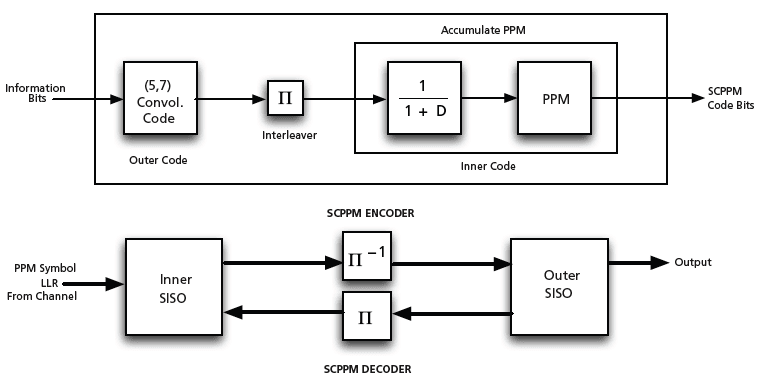
To lower the required memory for storing channel likelihood data and the amounts of data transfer between the decoder and the receiver, one can discard the majority of channel likelihoods, using only the remainder in operation of the decoder. This is accomplished in the receiver by transmitting only a subset consisting of the likelihoods that correspond to time slots containing the largest numbers of observed photons during each PPM symbol period. The assumed number of observed photons in the remaining time slots is set to the mean of a noise slot. In low background noise, the selection of a small subset in this manner results in only negligible loss.
Other features of the decoder design to reduce complexity and increase speed include (1) quantization of metrics in an efficient procedure chosen to incur no more than a small performance loss and (2) the use of the max-star function that allows sum of exponentials to be computed by simple operations that involve only an addition, a subtraction, and a table lookup. Another prominent feature of the design is a provision for access to interleaver and de-interleaver memory in a single clock cycle, eliminating the multiple clock-cycle latency characteristic of prior interleaver and de-interleaver designs.
This work was done by Bruce Moision, Jon Hamkins, Maged Barsoum, Michael Cheng, and Michael Nakashima of Caltech for NASA’s Jet Propulsion Laboratory. For further information, contact











