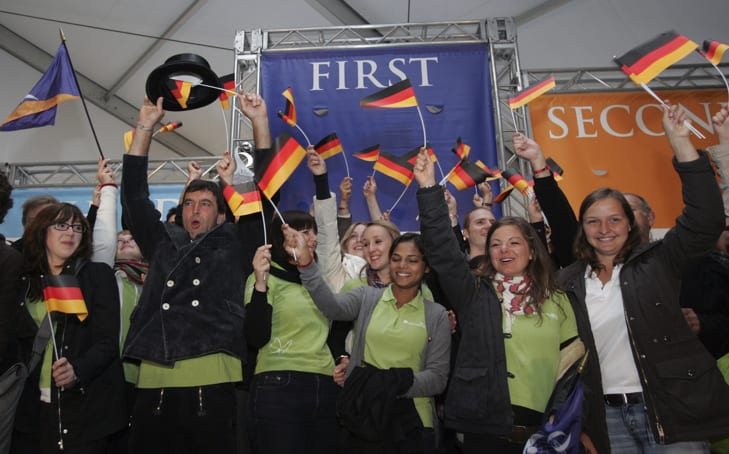
The University of Illinois at Urbana-Champaign won second place, followed by Team California in third. The active competition lasted for a week, with the prototype home designs open to the public through last Sunday. Team Germany's winning "Cube House" design produced a surplus of power - even during three days of rain.
Taking place over the past two weeks, the 2009 Solar Decathlon challenged 20 university-led teams from the United States along with Spain, Germany, and Canada to compete in 10 separate contests. These ranged from judging elements such as architecture, market viability, communications, lighting design, and engineering, to technical measurements of how well the homes provided energy for space heating and cooling, hot water, home entertainment, appliances, and net metering.
The Net Metering Contest - new to this year's competition - was the most heavily weighted contest. Teams were awarded 100 points if the energy supplied to their home's two-way electrical meter registered zero or less after all of the energy demands of the contest week. Each house in the competition was connected to a power grid and equipped with a meter that measured both its consumption and production of energy. When a team's meter showed a negative number, the home had generated surplus energy — worth up to 50 extra points. Team Germany scored a perfect 150 points.
Overall, Team Germany earned 908.29 points out of a possible 1,000, followed by the University of Illinois at Urbana-Champaign with 897.30 points, and Team California with 863.08 points.
Check out the winning team's design:
Transcript
00:00:00 The design was yea pretty easy because having the surface ratio in an optimal way is very important to minimize the surface of the building to prevent the outer surface that can create, that can have heat bridges or something like that. So the best way to for sustainable design in general is to minimize the ratio and this would be the cubist form. This is why we show it off as this shape. The dark materials here are from the facade are photo crystalline photo metallic.
00:00:38 Right. We use that as an overall concept we have them on all the facades, even on the northern side because this type of photo voltaic is also able to produce energy by indirect sunlight. So the main issue if you create a solar house is there's always a northern facade because you don't have that impact on it as you have it on a southern facade. One of the most things that people will recognize as you enter the house is that the whole building creates one big room.
00:01:06 There are no straight separations in between rooms. It is created more like zones. Right. Yea all the functions covered like bathroom, bedroom, living, dining, kitchen and also created a second story. We integrated a heat pump that uses off of the exterior air and changes the heat over to , it can give switch it can give this heat energy over to the warm water tank but it can also give this energy to the. To the fresh air that's going inside of a building.
00:01:43 This element is also able in case it's getting the heat over to the warm water tank it will use cold energy the is provided to the room. So this one heat pump is able to heat active yea in an active way. I am totally happy. I am totally happy and I can't wait to start the competition.