

Miniature scroll pumps have been proposed as roughing pumps (low-vacuum pumps) for miniature scientific instruments (e.g., portable mass spectrometers and gas analyzers) that depend on vacuum. The larger scroll pumps used as roughing pumps in some older vacuum systems are fabricated by conventional machining. Typically, such an older scroll pump includes (1) an electric motor with an eccentric shaft to generate orbital motion of a scroll and (2) conventional bearings to restrict the orbital motion to a circle.
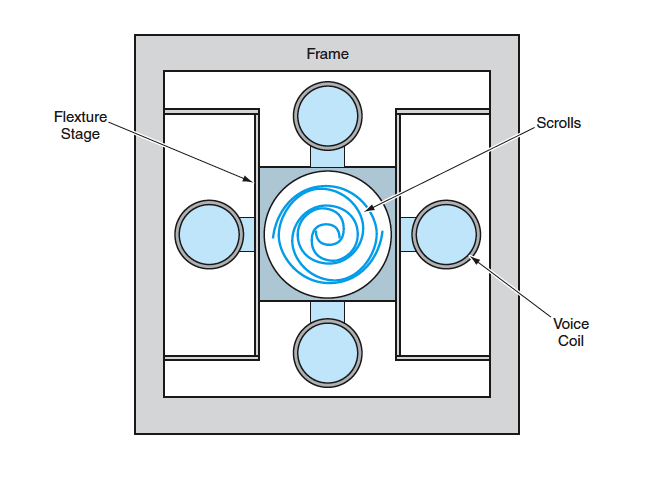
The miniaturization of these pumps would entail both operational and manufacturing tolerances of <1 μm. Such tight tolerances cannot be achieved easily by conventional machining of high-aspect-ratio structures like those of scroll-pump components. In addition, the vibrations of conventional motors and ball bearings exceed these tight tolerances by an order of magnitude. Therefore, the proposed pumps would be fabricated by the micro-fabrication method known by the German acronym LIGA (“lithographie, galvanoformung, abformung,” which means lithography, electroforming, molding) because LIGA has been shown to be capable of providing the required tolerances at large aspect ratios.
This work was done by Dean Wiberg, Kirill Shcheglov, Victor White, and Sam Bae of Caltech for NASA’s Jet Propulsion Laboratory.
In accordance with Public Law 96-517, the contractor has elected to retain title to this invention. Inquiries concerning rights for its commercial use should be addressed to:
Innovative Technology Assets Management
JPL
Mail Stop 202-233
4800 Oak Grove Drive
Pasadena, CA 91109-8099
E-mail:
Refer to NPO-21161, volume and number of this NASA Tech Briefs issue, and the page number.
This Brief includes a Technical Support Package (TSP).
Miniature Scroll Pumps Fabricated by LIGA
(reference NPO-21161) is currently available for download from the TSP library.
Don't have an account?
Overview
The document discusses the development of miniature scroll pumps fabricated using the LIGA (Lithographie, Galvanoformung, Abformung) technique, as detailed in NASA's Technical Support Package NPO-21161. These pumps represent a significant advancement over traditional macroscopic scroll pumps, which are typically made using conventional machining methods.
The primary innovation lies in the use of LIGA, which allows for the precise fabrication of high-aspect ratio structures necessary for the efficient operation of miniaturized pumps. Conventional machining techniques struggle to achieve the tight tolerances required for such small-scale devices, often falling short of the sub-micrometer precision needed. Additionally, traditional electric motors and ball bearings introduce vibrations and play that are unacceptable in miniature designs, where even minor deviations can lead to performance issues.
To address these challenges, the miniature scroll pump employs a flexure-based stage that facilitates smooth movement restricted to the x-y plane, while maintaining high stiffness in the vertical direction. This design minimizes friction and wear, enhancing the longevity and reliability of the pump. The actuation mechanism utilizes electromagnetic actuation (specifically, a voice coil) to drive the scrolls, providing the necessary forces for operation and allowing for precise control over the amplitude of the orbital motion.
An important feature of this design is the incorporation of capacitive gap sensing, which offers active positioning feedback. This feedback mechanism ensures that the scrolls maintain the correct gap and circular motion, further enhancing the precision of the pump's operation. The drive mechanism is optimized to operate on resonance, which reduces power dissipation and contributes to the overall efficiency of the pump.
The document emphasizes the potential applications of these miniature scroll pumps in various fields, particularly in aerospace and other high-tech industries where space and precision are critical. The advancements presented in this technical support package highlight NASA's commitment to developing innovative technologies that can have broader scientific, technological, and commercial applications.
For further inquiries or detailed information, the document provides contact details for the Innovative Technology Assets Management at NASA's Jet Propulsion Laboratory.











