An improved design for a capacitive sensing, rocking-mode vibratory microgyroscope is more amenable to mass production, relative to a prior design. Both the improved design and the prior design call for a central post that is part of a resonator that partly resembles a cloverleaf or a flower. The prior design is such that the post has to be fabricated as a separate piece, then bonded to the rest of the resonator in the correct position and orientation. The improved design provides for fabrication of the post as an integral part of the resonator and, in so doing, makes it possible to produce a waferful of microgyroscopes, without need to fabricate, position, and attach posts.
The improved design offers an additional advantage over the prior design with respect to the fact that the prior design calls for the post to be fabricated in upper and lower halves. The lower half post is fabricated as part of a base-plate in a lower wafer that is subsequently bonded to an upper wafer. Once the wafers are bonded, it is necessary to disconnect the lower half post from the baseplate. For mass production, it would be desirable to effect this disconnection by etching away the post support on the baseplate, but it is difficult to perform such an etch without damaging the microgyroscope, which, except for this etch, is complete at this stage. Therefore, instead of etching, it has proved necessary to perform ablation of individual supports, which entails processing time proportional to the number of microgyroscopes on a wafer. The improved design eliminates the need for ablation of individual supports, thereby correspondingly reducing processing time.
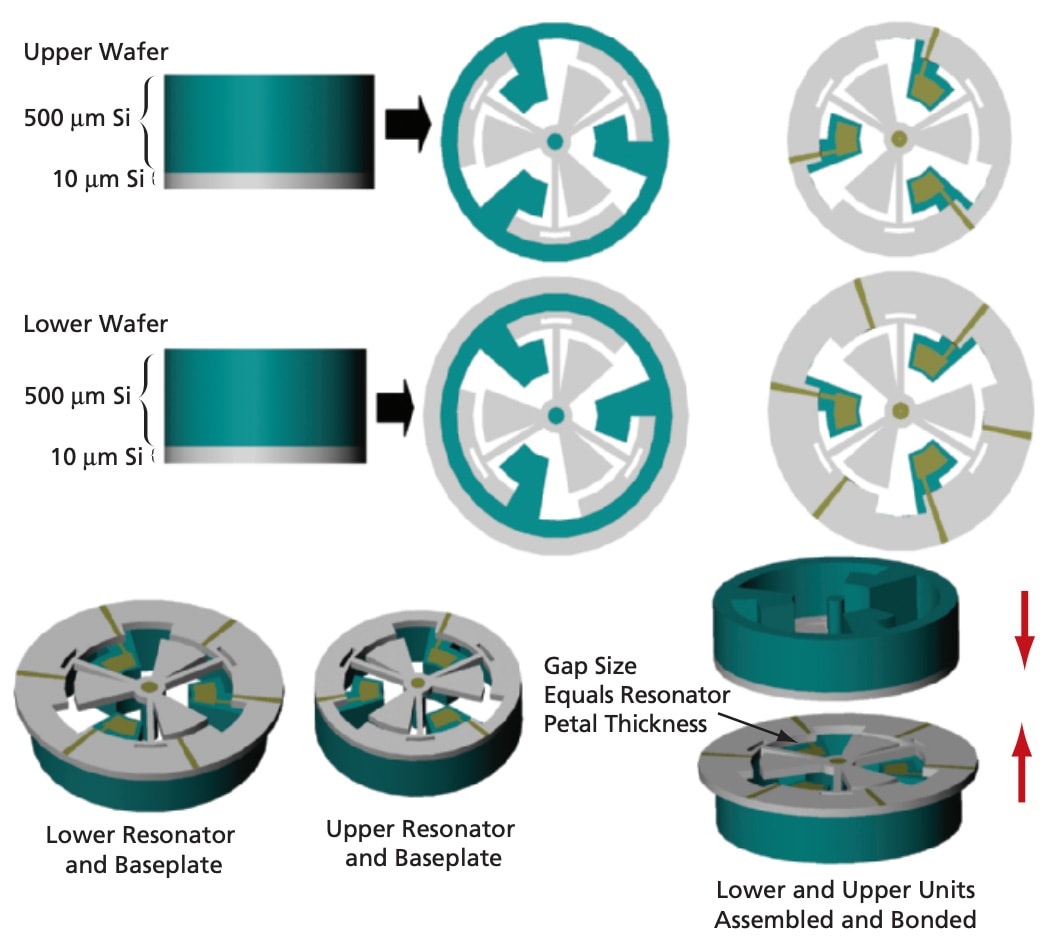
In the improved design (see figure), a resonator is split into an upper and a lower half, which are micromachined out of an upper and a lower wafer, respectively. A baseplate (which supports the resonator and is the relatively stationary object with respect to which the resonator vibrates) is likewise split into upper and lower halves. The upper and lower half resonators are offset from each other such that when the micromachined wafers are assembled and bonded together, the petals of the upper half resonator hang over electrodes on the lower half baseplate, while the petals of the lower half resonator hang over electrodes on the upper half baseplate. The capacitive gaps between the resonator petals and the baseplate are formed by opposing thicknesses of the half resonators.
This work was done by Youngsam Bae, Ken Hayworth, and Kirill Shcheglov of Caltech for NASA's Jet Propulsion Laboratory. For further information, access the Technical Support Package (TSP) free on-line at www.techbriefs.com/tsp under the Mechanics category. In accordance with Public Law 96-517, the contractor has elected to retain title to this invention. Inquiries concerning rights for its commercial use should be addressed to:
Innovative Technology Assets Management
JPL
Mail Stop 202-233
4800 Oak Grove Drive
Pasadena, CA 91109-8099
(818) 354-2240
E-mail: This email address is being protected from spambots. You need JavaScript enabled to view it.
Refer to NPO-30613, volume and number of this NASA Tech Briefs issue, and the page number.
This Brief includes a Technical Support Package (TSP).
Split-Resonator, Integrated-Post Vibratory Microgyroscope
(reference NPO-30613) is currently available for download from the TSP library.
Don't have an account?
Overview
The document is a Technical Support Package for the Split-Resonator, Integrated-Post Vibratory Microgyroscope, identified by NASA Tech Brief NPO-30613. It is produced by NASA’s Jet Propulsion Laboratory (JPL) in Pasadena, California, under the auspices of the National Aeronautics and Space Administration (NASA). The purpose of this package is to disseminate information regarding advancements in aerospace technology that may have broader applications beyond their initial context.
The Split-Resonator, Integrated-Post Vibratory Microgyroscope represents a significant development in the field of microgyroscopes, which are critical components in various navigation and stabilization systems. These devices are essential for applications in aerospace, robotics, and other fields where precise orientation and motion sensing are required. The document outlines the technical specifications, operational principles, and potential applications of this microgyroscope technology.
The Technical Support Package emphasizes the importance of making the results of aerospace-related developments accessible to a wider audience, including commercial and scientific communities. It highlights NASA's commitment to fostering innovation and collaboration through the Commercial Technology Program, which aims to bridge the gap between government research and commercial application.
For those seeking additional information, the document provides contact details for the NASA Scientific and Technical Information (STI) Program Office, which offers a variety of publications and resources related to research and technology in this area. The STI Help Desk is available for inquiries, providing support through various channels, including telephone and email.
Furthermore, the document includes a notice regarding the liability and endorsement of the information contained within. It clarifies that the United States Government and its representatives do not assume liability for the use of the information and that any mention of trade names or manufacturers is for identification purposes only, without implying official endorsement.
In summary, this Technical Support Package serves as a comprehensive resource for understanding the Split-Resonator, Integrated-Post Vibratory Microgyroscope, its technological significance, and its potential applications, while also promoting the dissemination of aerospace innovations for broader use.