

A partly lithographic method of fabrication is being developed to enable the economical mass production of mesoscale electrically conductive coils for miniature electro- magnets, solenoids, electric motors, and the like. This or a similar method is needed to overcome the limitations of prior techniques:
- The practical limit of fabricating miniature coils by conventional winding has been reached at a minimum wire width of ≈25 μm. At this limit, fabrication is a slow, expensive process that requires very skilled technicians.
- Current techniques of microfabrication (e.g., those used to make microelectromechanical devices and integrated circuits) are limited to coils of no more than about 25 turns. This number of turns is insufficient for many anticipated applications in which hundreds of turns would be needed to generate sufficient magnetic flux.
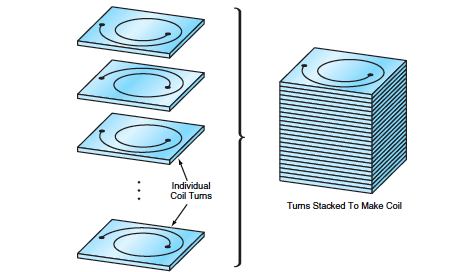
In the present developmental method, thick-film optical lithography is used to generate a series of spiral patterns, and copper is plated into the patterns, thereby forming individual turns of a coil. Then the turns are freed, stacked, and bonded together with the turns electrically connected in series (see figure). It should be possible to make coils of hundreds of turns in very small packages. It should also be possible to scale coils down to sizes smaller than those achievable by conventional winding. This method is compatible with batch fabrication and is expected to cost much less than does fabrication of the smallest conventionally wound coils.
This work was done by Victor White, Juergen Mueller, and Dean Wiberg of Caltech for NASA’s Jet Propulsion Laboratory.
This Brief includes a Technical Support Package (TSP).
Lithographic Fabrication of Mesoscale Electromagnet Coils
(reference NPO-20966) is currently available for download from the TSP library.
Don't have an account?
Overview
The document outlines a technical support package prepared by NASA's Jet Propulsion Laboratory (JPL) regarding the lithographic fabrication of mesoscale electromagnet coils. Authored by inventors Dean Wiberg, Juergen Mueller, and Victor White, the report discusses a novel method aimed at enabling the economical mass production of electrically conductive coils for applications such as miniature electromagnets, solenoids, and electric motors.
Traditional coil fabrication techniques face significant limitations. Conventional winding methods have reached a practical minimum wire width of approximately 25 micrometers, making the process slow, expensive, and reliant on highly skilled technicians. Additionally, current microfabrication techniques, commonly used for microelectromechanical systems (MEMS) and integrated circuits, can only produce coils with about 25 turns. This is insufficient for many applications that require hundreds of turns to generate adequate magnetic flux.
To address these challenges, the document describes a new fabrication method that employs thick-film optical lithography. This technique allows for the generation of spiral patterns, into which copper is plated to form individual coil turns. Once the turns are created, they are freed, stacked, and bonded together, with the turns electrically connected in series. This innovative approach is expected to facilitate the production of coils with hundreds of turns in compact packages, significantly smaller than those achievable through conventional winding methods.
The advantages of this lithographic method include faster fabrication times and reduced costs compared to traditional techniques. The compatibility with batch fabrication further enhances its potential for mass production, making it a promising solution for the growing demand for miniature electromagnetic devices.
The work described in the document was conducted at JPL under a contract with NASA, emphasizing the collaboration between these institutions in advancing technology for space and other applications. The report also includes a disclaimer stating that references to specific commercial products or processes do not imply endorsement by the U.S. Government or JPL.
In summary, this document presents a significant advancement in the fabrication of mesoscale electromagnet coils, highlighting a method that could revolutionize the production of miniature electromagnetic devices by overcoming the limitations of existing techniques.











