Sensor packages that would be dropped from airplanes have been proposed for pre-eruption monitoring of physical conditions on the flanks of awakening volcanoes. The purpose of such monitoring is to gather data that could contribute to understanding and prediction of the evolution of volcanic systems.
Each sensor package, denoted a volcano monitoring system (VMS), would include a housing with a parachute attached at its upper end and a crushable-foam impact absorber at its lower end (see figure). The housing would contain survivable low-power instrumentation that would include a Global Positioning System (GPS) receiver, an inclinometer, a seismometer, a barometer, a thermometer, and CO2 and SO2 analyzers. The housing would also contain battery power, control, data-logging, and telecommunication subsystems. The proposal for the development of the VMS calls for the use of commercially available sensor, power, and telecommunication equipment, so that efforts could be focused on integrating all of the equipment into a system that could survive impact and operate thereafter for 30 days, transmitting data on the pre-eruptive state of a target volcano to a monitoring center.
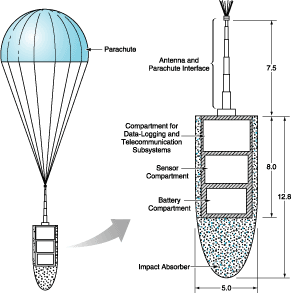
In a typical scenario, VMSs would be dropped at strategically chosen locations on the flanks of a volcano once the volcano had been identified as posing a hazard from any of a variety of observations that could include eyewitness reports, scientific observations from positions on the ground, synthetic-aperture-radar scans from aircraft, and/or remote sensing from aboard spacecraft. Once dropped, the VMSs would be operated as a network of in situ sensors that would transmit data to a local monitoring center. This network would provide observations as part of an integrated volcano-hazard-assessment strategy that would involve both remote sensing and timely observations from the in situ sensors.
A similar strategy that involves the use of portable sensors (but not dropping of sensors from aircraft) is already in use in the Volcano Disaster Assistance Program (VDAP), which was developed by the U. S. Geological Survey and the U. S. Office of Foreign Disaster Assistance to respond to volcanic crises around the world. The VMSs would add a greatly needed capability that would enable VDAP response teams to deploy their volcano-monitoring equipment in a more timely manner with less risk to personnel in the field.
This work was done by Sharon Kedar, Tommaso Rivellini, Frank Webb, Brent Blaes, and Caroline Bracho of Caltech and Andrew Lockhart and Ken McGee of the USGS for NASA's Jet Propulsion Laboratory. For further information, access the Technical Support Package (TSP) free on-line at www.techbriefs.com/tsp under the Computers/Electronics category.
NPO-30827
This Brief includes a Technical Support Package (TSP).
Monitoring Volcanoes By Use of Air-Dropped Sensor Packages
(reference NPO-30827) is currently available for download from the TSP library.
Don't have an account?
Overview
The document outlines NASA's development of an Air-Drop Volcano Monitoring System (VMS) aimed at enhancing the understanding and prediction of volcanic eruptions. This initiative is part of NASA's Earth Science Enterprise (ESE) goals, specifically addressing the need for real-time data collection from volcanoes, particularly those that are awakening and pose a hazard.
The VMS consists of sensor packages that are air-dropped onto the flanks of volcanoes. Each package is designed to survive impact and operate for up to 30 days, transmitting critical data back to a monitoring center. The sensor suite includes a Global Positioning System (GPS) receiver, an inclinometer (tiltmeter), a seismometer, a barometer, a thermometer, and analyzers for carbon dioxide (CO2) and sulfur dioxide (SO2). These sensors are commercially available, and the focus of the project is on integrating them into a robust system capable of withstanding harsh conditions.
The operational deployment of the VMS will occur once a volcanic system is identified as potentially hazardous, based on eyewitness reports, ground observations, or remote sensing imagery. The system will function as a network of in situ sensors, providing data that cannot be obtained through other remote sensing methods. This capability is crucial for timely volcano hazard assessments, especially in inaccessible and dangerous environments.
The VMS is designed in consultation with the U.S. Geological Survey's Volcano Disaster Assistance Program (VDAP), ensuring that it meets the operational needs of agencies involved in volcanic crisis response. By providing detailed scientific data on the physical processes leading to eruptions, the VMS aims to improve hazard assessments and ultimately save lives and property.
The document emphasizes the unique strengths of NASA's Jet Propulsion Laboratory (JPL) in developing small, remote instrument packages that can endure severe impacts. This project represents a significant advancement in volcano monitoring technology, integrating both remote sensing and in situ observations to create a comprehensive monitoring strategy.
In summary, the VMS is a pioneering approach to volcano monitoring that leverages advanced technology to gather essential data, enhancing our ability to predict volcanic activity and respond effectively to potential hazards.