A proposed optoelectronic instrument would identify targets rapidly, without need to radiate an interrogating signal, apply identifying marks to the targets, or equip the targets with transponders. The instrument was conceived as an identification, friend or foe (IFF) system in a battlefield setting, where it would be part of a targeting system for weapons, by providing rapid identification for aimed weapons to help in deciding whether and when to trigger them. The instrument could also be adapted to law-enforcement and industrial applications in which it is necessary to rapidly identify objects in view.
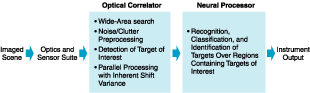
The instrument would comprise mainly an optical correlator and a neural processor (see figure). The inherent parallel-processing speed and capability of the optical correlator would be exploited to obtain rapid identification of a set of probable targets within a scene of interest and to define regions within the scene for the neural processor to analyze. The neural processor would then concentrate on each region selected by the optical correlator in an effort to identify the target. Depending on whether or not a target was recognized by comparison of its image data with data in an internal database on which the neural processor was trained, the processor would generate an identifying signal (typically, "friend" or "foe"). The time taken for this identification process would be less than the time needed by a human or robotic gunner to acquire a view of, and aim at, a target.
An optical correlator that has been under development for several years and that has been demonstrated to be capable of tracking a cruise missile might be considered a prototype of the optical correlator in the proposed IFF instrument. This optical correlator features a 512-by-512-pixel input image frame and operates at an input frame rate of 60 Hz. It includes a spatial light modulator (SLM) for video-to-optical image conversion, a pair of precise lenses to effect Fourier transforms, a filter SLM for digital-to-optical correlation-filter data conversion, and a charge-coupled device (CCD) for detection of correlation peaks. In operation, the input scene grabbed by a video sensor is streamed into the input SLM. Precomputed correlation-filter data files representative of known targets are then downloaded and sequenced into the filter SLM at a rate of 1,000 Hz. When there occurs a match between the input target data and one of the known-target data files, the CCD detects a correlation peak at the location of the target. Distortion-invariant correlation filters from a bank of such filters are then sequenced through the optical correlator for each input frame. The net result is the rapid preliminary recognition of one or a few targets.
The output of the optical correlator would be fed to the neural processor for classification and identification of the preliminarily recognized targets. The neural processor could contain one or more analog and/or digital artificial neural networks, which are well suited for identification of targets by virtue of their fault tolerance and their capabilities for adaptation, classification of patterns, and complex learning. An analog neural processor with a parallel configuration that has been demonstrated to be capable of classifying hyperspectral images and patterns may be suitable as a prototype neural processor for this instrument.
This work was done by Philip Moynihan, Robert Van Steenburg, and Tien-Hsin Chao of Caltech for NASA's Jet Propulsion Laboratory. For further information, access the Technical Support Package (TSP) free on-line at www.techbriefs.com/tsp under the Electronics/Computers category.
NPO-30326
This Brief includes a Technical Support Package (TSP).
Passive IFF: Autonomous Nonintrusive Rapid Identification of Friendly Assets
(reference NPO-30326) is currently available for download from the TSP library.
Don't have an account?
Overview
The document presents a novel optoelectronic instrument developed by NASA's Jet Propulsion Laboratory (JPL) for the rapid and autonomous identification of friendly assets in battlefield scenarios, referred to as a passive Identification, Friend or Foe (IFF) system. This technology addresses a long-standing challenge in military operations: the need for quick and accurate differentiation between friendly and enemy forces to prevent incidents of friendly fire, which have historically caused significant casualties.
The proposed system integrates an optical correlator with a neural processor. The optical correlator is designed to quickly identify potential targets within a scene by processing visual data at a high speed, utilizing a 512-by-512-pixel input image frame and operating at an input frame rate of 60 Hz. It employs a spatial light modulator for video-to-optical image conversion, precise lenses for Fourier transforms, and a charge-coupled device (CCD) for detecting correlation peaks. This setup allows for the rapid preliminary recognition of targets by comparing incoming image data with precomputed correlation-filter data files representing known targets.
Once the optical correlator identifies probable targets, the neural processor analyzes specific regions of interest to confirm the identity of the target. It compares the target's image data against an internal database on which it has been trained. If a match is found, the target is classified as "friend"; if not, it is deemed "foe." This identification process is designed to be faster than the time it takes for a human or robotic gunner to acquire and aim at a target, enhancing operational efficiency and safety.
A significant advantage of this system is its passive nature, meaning it does not require any active signaling or conditioning from the assets being identified. This feature not only improves reliability but also reduces the risk of detection and jamming by adversaries. The technology is positioned to be a game-changer in military engagements, potentially extending its applications to law enforcement and industrial sectors where rapid identification of objects is crucial.
Overall, the document highlights the innovative approach taken by JPL to solve a critical problem in modern warfare, showcasing advancements in optical and neural processing technologies that promise to enhance situational awareness and decision-making on the battlefield.