The miniature autonomous submersible explorer (MASE) has been proposed as a means of scientific exploration—especially, looking for signs of life—in harsh, relatively inaccessible underwater environments. Basically, the MASE would be a small instrumented robotic submarine (see figure) that could launch itself or could be launched from another vehicle. Examples of environments that might be explored by use of the MASE include subglacial lakes, deep-ocean hydrothermal vents, acidic or alkaline lakes, brine lenses in permafrost, and ocean regions under Antarctic ice shelves.
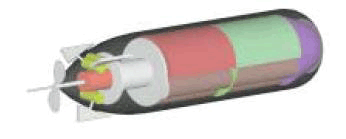
The instrumentation carried aboard the MASE would include one or more high resolution video camera(s), circuitry for capturing image data from the cameras, and microelectromechanical systems-based (MEMS-based) sensors designed to gather scientific data under the extreme conditions (e.g., high pressure, high or low temperature, acidity or alkalinity) of the aqueous environment to be explored. The instrumentation would be contained in easily interchangeable modules. The MASE would be equipped for autonomous control, real-time processing of scientific data, and high-speed, full-duplex communication with a monitoring station via a fiber-optic tether.
The basic MASE concept allows for variations for different applications. In most applications now envisioned, the MASE would be designed as a disposable system to be used once.
This work was done by Alberto Behar, Fredrik Bruhn, and Frank Carsey of Caltech for NASA's Jet Propulsion Laboratory. For further information, access the Technical Support Package (TSP) free on-line at www.techbriefs.com/tsp under the Machinery/Automation category. NPO-40501
This Brief includes a Technical Support Package (TSP).
Miniature Robotic Submarine for Harsh Environments
(reference NPO-40501) is currently available for download from the TSP library.
Don't have an account?
Overview
The document is a Technical Support Package from NASA's Jet Propulsion Laboratory detailing a Miniature Robotic Submarine designed for exploring harsh environments. This innovative vehicle, referred to as MASE (Miniature Autonomous Submersible Explorer), is engineered to operate in extreme conditions, such as deep ocean environments, and is intended for scientific exploration.
The submarine measures approximately 20 cm in length and 5 cm in diameter, with the ability to deploy optical fiber ranging from hundreds of meters to kilometers. It is designed to be self-deploying or to fit within larger vehicles, such as deep ocean mother ships or spacecraft. The vehicle incorporates a small Inertial Navigation System (INS) for localization and navigation, and it features a spool for optical fiber stowage, which is essential for data transmission.
Key subsystems of the MASE include guidance, navigation, and hazard avoidance, which utilize MEMS (Micro-Electro-Mechanical Systems) sensors, particularly MEMS accelerometers. These sensors are crucial for steering control and collision detection. The navigation unit can process data from various scientific instruments, such as Conductivity, Depth, and Temperature (CTD) sensors, and is capable of handling large data sets through onboard processing.
The document also outlines the data handling and signal distribution architecture, which employs an I²C bus for communication between different modules. This distributed architecture allows for efficient data transfer and control among the various subsystems, which include health monitoring and housekeeping modules. The housekeeping module is responsible for system checks, power conditioning, and monitoring, ensuring the reliability of the submarine during missions.
Power for the submarine is provided by primary Li-ion batteries, estimated to have a total storage capacity of 30-40 Ah. The document emphasizes the technological challenges that remain, such as miniaturization of components, ensuring adequate energy density, and addressing the behavior of MEMS under high pressure in fluid environments.
In conclusion, the MASE represents a significant advancement in underwater exploration technology, with potential applications in scientific research and environmental monitoring. The document highlights the ongoing efforts to overcome challenges in miniaturization and system integration, aiming to push the boundaries of exploration in extreme environments.