Electrically tunable microstrip two-pole band-bass filters for a center frequency near 19 GHz and a 4-percent bandwidth have been designed, fabricated, and demonstrated to be functional. These filters are suitable for use in the front ends of K-band communication receivers that operate at low temperatures.
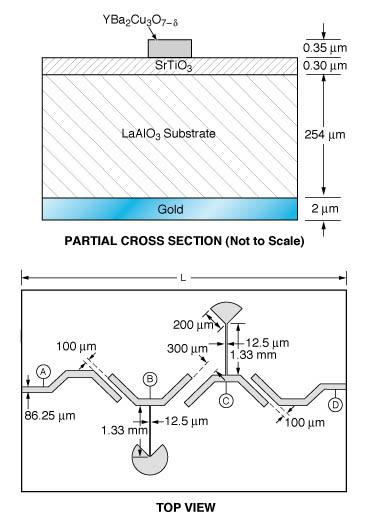
Tunability is achieved through the nonlinearity (specifically, the variation of permittivity with electric field) of the SrTiO3 layer. Using a commercial electromagnetic-analysis computer-aided-engineering software package, the design of the filter was optimized so that normal operation at the center frequency would occur when the relative permittivity εr of the SrTiO3 was 1,650. This resulted in a requirement to maintain a suitable bias in order to maintains ε at 1,650.
Prototypes of these filters were packaged for swept-frequency measurements of their scattering parameters (Sij) in a helium-gas closed-cycle cryogenic system. In experiments on tunability, a dual-polarity biasing technique was used: Referring again to Figure 1, nodes A and C were biased with a positive voltage, while nodes B and D were biased with a negative voltage of equal magnitude. The dc bias connections at A and D were made via input and output bias tees; the bias connections at B and C were achieved via gold-wire bonds on radial biasing stubs. The dc bias was increased from 0 to ±500 V in steps of ±50 V.

This work was done by F. A. Miranda of Glenn Research Center, F. Van Keuls of the National Research Council and G. Subramanyam of the University of Northern Iowa. For further information, access the Technical Support Package (TSP) free on-line at www.nasatech.com/tsp under the Electronics & Computers category.
Inquiries concerning rights for the commercial use of this invention should be addressed to
NASA Glenn Research Center
Commercial Technology Office
Attn: Steve Fedor
Mail Stop 4 —8
21000 Brookpark Road
Cleveland
Ohio 44135.
Refer to LEW-16751.