A three-frequency millimeter-wave feed horn was developed as part of an advanced component technology task that provides components necessary for higher-frequency radiometers to meet the needs of the Surface Water and Ocean Topography (SWOT) mission. The primary objectives of SWOT are to characterize ocean sub-mesoscale processes on 10-km and larger scales in the global oceans, and to measure the global water storage in inland surface water bodies, including rivers, lakes, reservoirs, and wetlands.
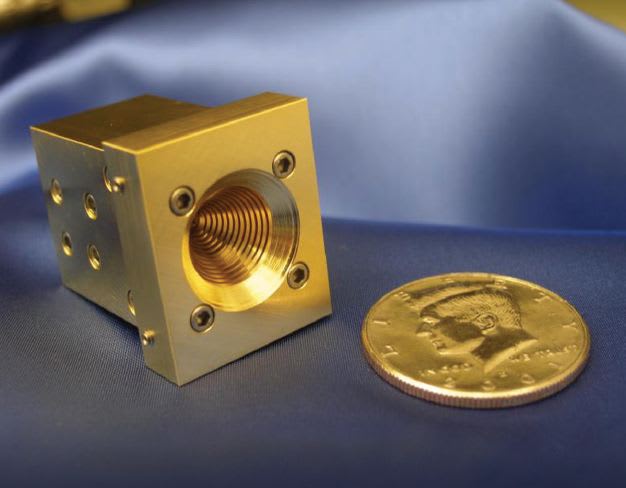
In order to achieve similar E and H plane beam widths over the combined 87-to-183-GHz band ring, loaded slots are employed in the corrugated portion of the feed. The feed operates in a flareangle limited condition, which gives approximately constant beam width across the entire band, and provides a common phase center located near its apex. The half-flare angle for the feed is approximately 30°. Analysis and optimization of the overall feed design employed a combination of finite element and mode-matching tools.
The illumination requirements and relative frequency spacing for this application are similar to those required for the Scanning Multichannel Microwave Radiometer (SMMR) on Seasat, the (TOPEX)/Poseidon, and the Jason missions. However, in this particular application the required fractional bandwidth is larger. Thus, while the three-frequency feed horn described here shares many features in common with the feed previously developed for the above missions, enhancements are necessary in order to achieve broad band performance and manufacturability in the millimeter- wave bands.
This work was done by Daniel J. Hoppe, Behrouz Khayatian, John B. Sosnowski, Alan K. Johnson, and Peter J. Bruneau of Caltech for NASA’s Jet Propulsion Laboratory. For more information, contact