

Pneumatic cushions have been proposed for protecting the afterbodies of two-body instrumented soil-penetrator projectiles. These cushions would be, essentially, doughnut-shaped miniature versions of automotive airbags, designed for rapid inflation upon impact.
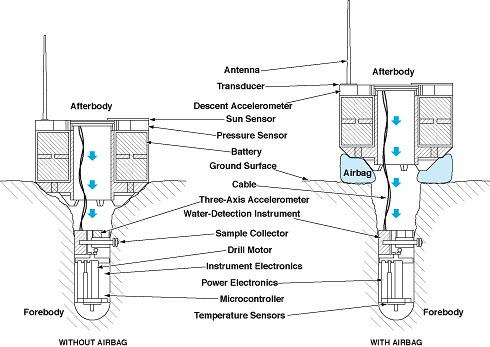
The concept of the two-body instrumented soil-penetrator projectile was described in "Penetrator Projectile Tolerates Some Misalignment" (NPO-20295) NASA Tech Briefs, Vol. 22, No. 10 (October 1998), page 74. To recapitulate: In the original intended application, the projectile would be launched from a spacecraft to impinge on Mars, where it would sample the soil. The design of the projectile might also be adaptable to sampling materials in sand, soil, mud, snow, or ice in hostile or inaccessible environments on Earth. The two bodies of the penetrator would be (1) a forebody that would contain instrumentation and machinery needed to penetrate the ground and (2) an afterbody that would contain batteries, radio-communication circuitry, and those sensors that must not penetrate the ground. Prior to impact, the forebody would be stowed in a longitudinal cylindrical recess in the afterbody. Upon impact, a flange on the bottom of the afterbody would become braked upon contact with the ground. As the afterbody decelerated, the forebody would slide out of the recess, penetrating the ground underneath the afterbody. The forebody and afterbody would remain connected by a flexible cable that would pay out from the forebody during impact.
The forces generated by the expected deceleration (80,000 times normal Earth gravitational acceleration) could damage instrument components in the afterbody. The proposed scheme for pneumatic cushioning is intended to reduce the deceleration to a safe level. The scheme could be implemented with little modification of the basic penetrator design (see figure); one need only add the airbag with its inflation device and electronic inflation-triggering circuit.
The scheme would utilize the following features of the original penetrator design and operation: During descent through the atmosphere, the forebody/afterbody assembly would be protected by an aeroshell, which would be shattered by the impact on the ground. A crash accelerometer would detect the impact of the aeroshell, which would occur only milliseconds before the impact of the forebody.
The output of the crash accelerometer would be fed to the inflation-triggering circuit, so that inflation could be accomplished during the short interval before impact of the forebody on the ground. At full inflation, the outer diameter of the doughnut-shaped bag would exceed the outer diameter of the afterbody. The inflated bag would hug the lower portion of the afterbody, cushioning the afterbody upon impact. The central hole of the bag would be large enough to let the forebody pass through on impact as in the original design.
The bag would be made of a fabric or combination of fabrics so that immediately after inflation, the bag would start to deflate through its pores. Optionally, vents could be added to increase the rate of deflation. Typically, deflation would be completed in less than 1 second. The design of the airbag would be optimized to provide the desired protection for the specific penetrator-probe design and operational environment.
This work was done by Julian Blosiu and Fotios Deligiannis of Caltech for NASA's Jet Propulsion Laboratory. For further information, access the Technical Support Package (TSP) free on-line at www.nasatech.com/tsp under the Mechanics category. NPO-20337
This Brief includes a Technical Support Package (TSP).
Afterbody cushions for instrumented penetrator projects
(reference NPO-20337) is currently available for download from the TSP library.
Don't have an account?
Overview
The document is a technical support package from NASA detailing the development of a doughnut-shaped mini-airbag designed to protect the afterbody of future soil probe penetrators intended for exploration of planets, moons, and asteroids. The work was conducted by Julian Blosiu and Fotios Deligiannis at the Jet Propulsion Laboratory (JPL) under a NASA contract.
The primary focus of the invention is to address the significant impact forces—up to 80,000 Gs—experienced by the probe's components when penetrating the Martian soil to depths of up to 2 meters. Such extreme forces can cause damage to the probe upon impact. To mitigate this, the mini-airbag inflates milliseconds after the probe's aeroshell touches the soil, providing a cushioning effect that dampens the impact and protects the internal components.
The airbag is designed to be made from a fabric or a combination of fabrics that allow for rapid deflation through pores or optional vents, completing the deflation process in less than one second. This quick deflation is crucial for the operational efficiency of the probe, ensuring that it can function correctly after impact.
The document also references the New Millennium Program’s Deep Space 2 (DS2) mission, which is set to launch in January 1999. This mission involves two advanced microprobes that will be released to explore the Martian soil for the presence of water. The probes will be protected during atmospheric entry by an aeroshell that shatters upon impact, allowing the mini-airbags to deploy and protect the afterbody.
Overall, the invention represents a significant advancement in the design of soil penetrators, enhancing their ability to conduct in-situ analyses and collect soil samples on extraterrestrial bodies. The document emphasizes the innovative nature of the airbag design and its potential applications in future NASA missions aimed at robotic exploration of various celestial bodies.
In summary, this technical support package outlines a novel solution to protect soil probe penetrators from the extreme forces of impact, thereby improving the reliability and effectiveness of future space exploration missions.











