

Several improvements have been proposed for the fabrication process known as "rapid prototyping." In this process, a model or prototype of a solid object is built up by controlled ejection of molten polymeric material through programmed orifices to form patterned layers. The second layer is deposited on top of the first layer, the third layer is deposited on top of the second layer, and so forth, until the stack of layers reaches the desired final thickness and shape.
In rapid prototyping according to current practice, the polymeric material is one that has low molecular weight, little or no cross linking, and few (if any) active functional groups in its molecular structure. Such a material is used because (1) it lends itself readily to melting and solidification over a narrow temperature range and (2) when molten, it has a relatively low viscosity that makes it amenable to passage through small orifices. The disadvantage of such a material is that the low molecular weight and absence of cross linking result in a model that has very little strength; this characteristic limits the utility of models fabricated by rapid prototyping.
The first proposed improvement would be the addition of photoactive functional groups to the polymer. The second proposed improvement — a concomitant of the first — would be provision of a radiant source to blanket the model with ultraviolet light to activate the photoactive functional groups. The photoactive functional groups and their locations in the molecular structure of the polymer would be chosen so that upon exposure to ultraviolet light of selected wavelengths, the molecular structure would become lengthened and cross-linked in such ways as to impart greater strength and other structural benefits.
In rapid prototyping incorporating the first and second improvements, each layer of the photoactive-modified polymer would be printed in the same manner as in current practice. However, prior to deposition of the next layer, each layer would be exposed to the ultraviolet illumination to obtain a higher-molecular-weight, cross-linked molecular structure. Subsequent layers would be treated similarly, so that the completed solid model would be stronger and more useful, in comparison with the corresponding model fabricated by conventional rapid prototyping.
The first and second improvements would offer other advantages in addition to increased strength and utility of models. One advantage pertains to molecular weight: In a typical instance of current practice, the molecular weight is a compromise between (a) one that is large enough that the polymer has at least minimum acceptable hardness and strength and (b) one that is small enough that when the polymer is molten, its viscosity is small enough to allow ejection through small orifices. Because the desired high molecular weight could be obtained in the photoactivation step, the proposed first and second improvements would make it possible to start with a base polymer of lower molecular weight and thus lower viscosity; this, in turn, would make it possible to use smaller ejecting orifices, thereby improving the reliability and increasing the level of detail achievable in the deposition of each layer.
Another improvement — also made possible by the first and second improvements — would be the addition of nonreactive plasticizers and/or solvents to the base polymer. Solvents could be used to enhance ejection. Solvents could be removed by heating each layer immediately after deposition and before exposing it to ultraviolet light. Plasticizers could be used, along with suitable amounts of molecular lengthening and cross linking, to tailor the mechanical properties of the finished model.
This work was done by Frank Hartley and Steve Bolin of Caltech for NASA's Jet Propulsion Laboratory. For further information, access the Technical Support Package (TSP) free on-line at www.nasatech.com/tsp under the Manufacturing & Prototyping. NPO-20505
This Brief includes a Technical Support Package (TSP).
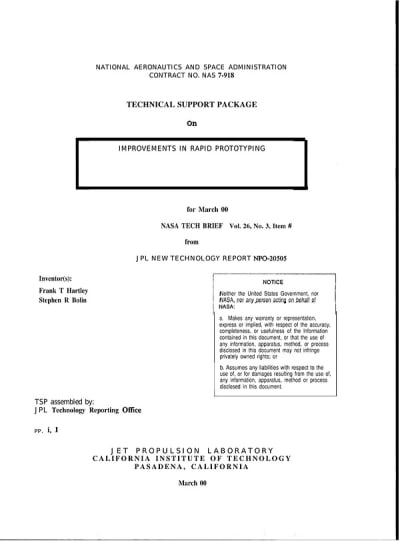
Improvements in rapid prototyping
(reference NPO-20505) is currently available for download from the TSP library.
Don't have an account?
Overview
The document discusses significant improvements in the process of rapid prototyping, a technique used to create solid object models through the controlled ejection of molten polymeric materials. Traditional rapid prototyping methods utilize low molecular weight polymers that lack cross-linking and active functional groups, resulting in models with limited strength and utility. The proposed enhancements aim to address these limitations by introducing three key innovations.
Firstly, the addition of photoactive functional groups to the polymer's molecular structure is suggested. These groups can react to ultraviolet (UV) light, allowing for the formation of new bonds that enhance the polymer's properties. When exposed to specific wavelengths of UV light, the molecular structure of the polymer can be lengthened and cross-linked, resulting in a stronger and more durable model.
Secondly, the document emphasizes the incorporation of a UV illumination source in the rapid prototyping system. This source would blanket the model with UV light after each layer is deposited, activating the photoactive groups and facilitating the cross-linking process. This step is crucial for achieving the desired increase in molecular weight and structural integrity of the final product.
The third improvement involves the use of solvents in the base polymer mix. Solvents can enhance the ejection process by lowering the viscosity of the molten polymer, making it easier to pass through smaller orifices. Additionally, these solvents can be removed by heating each layer before UV exposure, ensuring that the final model maintains its desired properties without compromising strength.
Overall, these enhancements not only improve the strength and utility of the models produced but also allow for greater precision in the printing process. By enabling the use of lower molecular weight polymers, the proposed improvements facilitate the creation of smaller ejecting orifices, which can lead to more detailed and reliable prototypes.
The work presented in this document was conducted by Frank Hartley and Stephen Bolin at NASA's Jet Propulsion Laboratory, highlighting its significance in advancing rapid prototyping technology. The improvements outlined promise to revolutionize the fabrication of solid models, making them more applicable in various industries, including aerospace and engineering.









