

A method of adaptive setting of a threshold level for the detection of pulses in a pulse-position modulation (PPM) free-space optical communication system has been developed. In simplified terms, it is desirable to set a threshold value high enough to greatly reduce the probability (PFA as defined below) of erroneously detecting noise as signal pulses but not so high as to greatly reduce the probability (PD as defined below) of detecting any signal pulses that may be present along with noise. In the present method, the threshold level is varied with time, in response to changing conditions in the optical-communication channel, in an effort to maintain a balance between the aforesaid competing requirements. An integral part of this adaptation scheme is a scheme for estimating key parameters of the optical-communication channel in particular, parameters that describe the fading and total attenuation in the channel, and parameters that characterize spreading of pulses by atmospheric and other effects. The method can be implemented by software processing of digitized optoelectronic-detector output, and has been tested by computational simulation.
In the first stage of processing by this method, the digitized values of the detector output during noise-only time slots of received PPM symbols are averaged to obtain a background level. This background level is subtracted from the detector output in the hope of reducing or eliminating the noise component in the remaining signal. (This background level should not be confused with the detection threshold, which is computed in the last stage of processing.) Next, the remaining signal — in effect, a vector of pulse samples — is normalized by dividing it by its L1 norm (in general, the L1 norm of a vector is defined as the sum of absolute magnitudes of its orthogonal components).
In the next stage of processing, the vector is analyzed to obtain the pulse spreading parameters: The vector is presented to a radial-basis-function neural network that has been trained to recognize the shape of the normalized pulses as either (1) an abrupt rise followed by an exponential decay of characteristic time τ or (2) a Gaussian peak characterized by a spreading time σ. An additional advantage of normalization is that it increases reliability by reducing the likelihood that the network would be confused by differences in pulse amplitudes caused by fading. The output of the network consists of (1) an indication of whether the pulses are deemed to be exponential or Gaussian in shape and (2) the numerical value of τ or σ, whichever is applicable.
The reliability of the averaged PPM symbols presented to the network can be increased by using a (255, 223) Reed-Solomon code to detect and remove defective PPM symbols and shot-noise events that are erroneously detected as PPM symbols. The average is computed anew for each code word. The total of 255 received symbols in each code word are decoded to 223 information symbols, which are, in turn, re-encoded to 255 "corrected" symbols. The "corrected" symbols are compared with the original 255 received symbols. Only those original symbols that agree with the corresponding re-encoded symbols are used in computing the average.
The fade parameter, α, is a linear function of the L1 norm. There exists a family of such linear functions that have different slopes corresponding to different values of the pulse-spread parameters τ and σ. Given the applicable value of τ or σ, the appropriate curve is selected, then its slope computed and used in conjunction with the calculated value of the L1 norm to estimate α. The attenuation parameter, ß, equals the product of α and an analytic function. The choice of analytic function depends on whether the pulses have been determined to be Gaussian or exponential; in either case, the independent variable is the ratio between the duration (Ts) of a pulse time slot and the applicable pulse spread parameter.
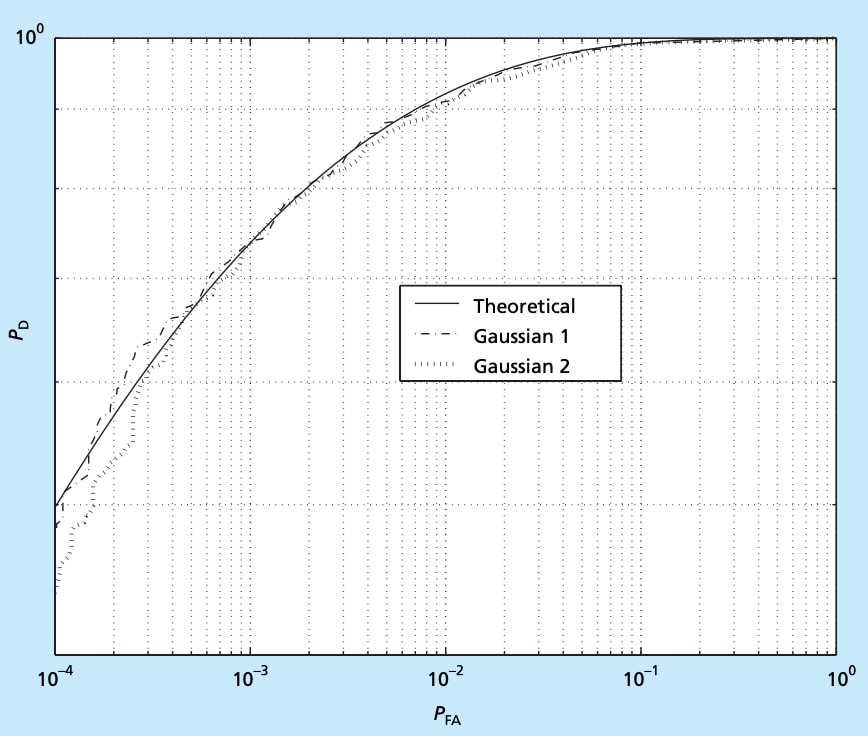
A receiver operating characteristic (ROC) curve is used in the next stage of processing. The ROC curve (see figure) is equivalent to a plot of the probability of detection (PD) versus the false-alarm probability (PFA). More precisely, PD is the probability of successful detection of a PPM pulse when such a pulse is present; PFA is the probability that the detector output noise will exceed the signal detection threshold and thereby cause the detection of a PPM pulse when such a pulse is not present. It turns out that the ROC curve depends primarily on ß, and the location of the receiver operating point on the ROC depends primarily on the detection threshold, λ. The final step is to choose the value of λ that strikes the required balance between PD and PFA.
This work was done by Payman Arabshahi, Ryan Mulai, and Tsun-Yee Yan of Caltech for NASA's Jet Propulsion Laboratory. For further information, access the Technical Support Package (TSP) free on-line at www.techbriefs.com/tsp under the Electronics/Computers category.
NPO-40714
This Brief includes a Technical Support Package (TSP).

Adaptive Thresholding and Parameter Estimation for PPM
(reference NPO-40714) is currently available for download from the TSP library.
Don't have an account?
Overview
The document titled "Adaptive Thresholding and Parameter Estimation for PPM" discusses advancements in optical communications, particularly in the context of deep space missions conducted by NASA's Jet Propulsion Laboratory (JPL). The primary focus is on improving the efficiency and reliability of data transmission from spacecraft by utilizing laser communications, which offer significant advantages over traditional radio frequency methods.
The introduction highlights the ongoing efforts by NASA and JPL to reduce spacecraft size and mass while enhancing information return capabilities. Laser communications are presented as a solution to achieve these goals, allowing for high data rates and minimizing issues related to frequency allocation and interference.
The document details the use of pulse-position modulation (PPM) for data transmission, where each PPM symbol consists of 256 signal slots, each lasting 20 nanoseconds, with a subsequent dead time to allow for laser recharge. The challenges of detecting and acquiring PPM signals under varying atmospheric conditions and potential pointing errors are emphasized, as these factors can lead to signal degradation.
A key component of the proposed system is an adaptive threshold device that aids in the detection and acquisition of PPM signals. This device works in conjunction with an intelligent agent that analyzes channel parameters to optimize signal detection. The system estimates scintillation and fading, which are critical for maintaining synchronization and improving signal detection accuracy.
Future directions outlined in the document include exploring more sophisticated methods for channel analysis and enhancing parameter estimation accuracy. The research aims to leverage the estimated channel conditions to improve overall communication performance.
The acknowledgments section credits contributors who provided essential resources and discussions that aided the research. The document serves as a technical support package under NASA's Commercial Technology Program, aiming to disseminate aerospace-related developments with broader technological applications.
In summary, this document presents a comprehensive overview of innovative techniques in optical communications for space applications, focusing on adaptive thresholding and parameter estimation to enhance the reliability and efficiency of data transmission in challenging environments.







