

Diamond Eye is a computer program that enables a user equipped with only a personal computer, web-browser software, and a network connection to analyze large collections of scientific image data. The system is based on a distributed applet/server architecture that provides platform-independent access to image mining services. A user interacts with the system through a Java applet interface that is dynamically downloaded when a session is established. There is no need for the user to install "client" software or perform upgrades; the latest stable version of the applet is available automatically. Each server program is typically co-located with a large image repository to enable mining the data in place. Servers are also coupled with an object-oriented data base and a computational engine such as a network of high-perfor mance workstations. The data base provides persistent storage and enables querying of the "mined" information. The computational engine provides parallel execution of the most demanding parts of the data-mining task: image processing, object recognition, and querying-by-content operations. Diamond Eye is currently being used to locate and catalog geological objects in large image collections, but the design provides infrastructure for a range of scientific-data-mining applications. The system can be easily extended to incorporate domain-specific algorithms in any executable form (translation to the Java language is unnecessary).
This program was written by Michael Burl, Charless Fowlkes, Saleem Mukhtar, Joseph Roden, and Andre Stechert of Caltech for NASA's Jet Propulsion Laboratory. For further information, access the Technical Support Package (TSP) free on-line at www.nasatech.com/tsp under the Software category.
In accordance with Public Law 96-517, the contractor has elected to retain title to this invention. Inquiries concerning rights for its commercial use should be addressed to
Technology Reporting Office
JPL Mail Stop 249-103
4800 Oak Grove Drive
Pasadena, CA 91109
(818) 354-2240
Refer to NPO-20921, volume and number of this NASA Tech Briefs issue, and the page number.
This Brief includes a Technical Support Package (TSP).
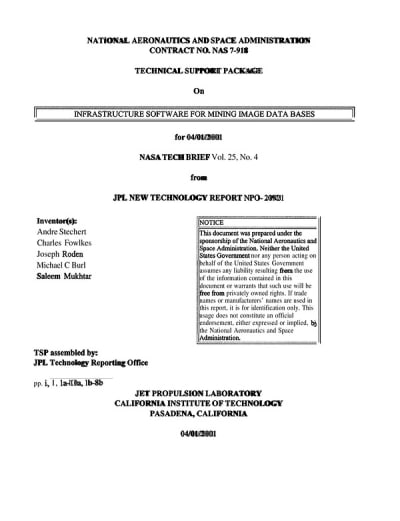
Infrastructure Software for Mining Image Data Bases
(reference NPO-20921) is currently available for download from the TSP library.
Don't have an account?
Overview
The document is a technical support package from NASA's Jet Propulsion Laboratory (JPL) detailing the "Diamond Eye" system, a software architecture designed to facilitate the analysis of large collections of scientific images. The system aims to enhance the capabilities of scientists by providing a user-friendly interface and advanced data mining technologies.
Diamond Eye operates as a distributed system, utilizing a network of high-performance workstations to perform computationally intensive tasks such as image processing, object recognition, and query-by-content operations. The architecture is built on Java applets, allowing for platform independence and ease of access across various hardware systems, including PCs and Macs. This design promotes collaboration among algorithm developers and enables users to evaluate advanced data mining techniques without the need for extensive local resources.
The system supports querying of "mined" information, allowing users to browse, annotate, and select subsets of images based on metadata constraints, such as geographical coordinates and resolution. This capability is crucial for scientists who need to analyze specific datasets efficiently. The document highlights the importance of intelligent compression techniques that prioritize the transmission of relevant data, thereby optimizing the use of bandwidth and storage.
Additionally, the document discusses the integration of various tools and methodologies that facilitate knowledge accumulation and reasoning about the data. It emphasizes the need for a common vocabulary and semantic ontology to enhance the effectiveness of data mining efforts. The Image Understanding Environment (IUE) is also mentioned as a software infrastructure that supports algorithm development and provides a framework for image analysis.
The document outlines the potential applications of Diamond Eye in various scientific fields, particularly in planetary science, where it can assist in the analysis of geological features on celestial bodies. By leveraging advanced data mining techniques, the system aims to improve the efficiency and accuracy of scientific research, ultimately leading to new discoveries and insights.
In summary, the Diamond Eye system represents a significant advancement in the field of image analysis and data mining, providing scientists with the tools necessary to manage and interpret large datasets effectively. Its distributed architecture, user-friendly interface, and advanced capabilities position it as a valuable resource for the scientific community.











