

Hybrid composite-material (fiber/matrix) structures of a proposed type would incorporate recently developed polybenzoxazole (PBO) fibers that feature high strengths and high moduli of elasticity and which can be made in much thinner sections than are possible with graphite fibers. The PBO fibers could be used, for example, in skins, face sheets, or panels, any or all of which could be made as multiple-angle-ply layups.
In comparison with similar structures made from graphite fibers to satisfy a given set of strength and stiffness requirements, those made from PBO fibers to satisfy the same set of requirements could be thinner. In a typical application, PBO-fiber laminated face sheets or skins would be bonded to graphite stiffeners or honeycomb cores to make hybrid composite stiffened sandwich structures thinner and less massive than the corresponding structures made with graphite (only) fibers, due to the thinner sections possible with PBO fibers.
This work was done by Joseph Lewis of Caltech for NASA's Jet Propulsion Laboratory. For further information, access the Technical Support Package (TSP) free on-line at www.nasatech.com/tsp under the Materials category.
NPO-20774
This Brief includes a Technical Support Package (TSP).
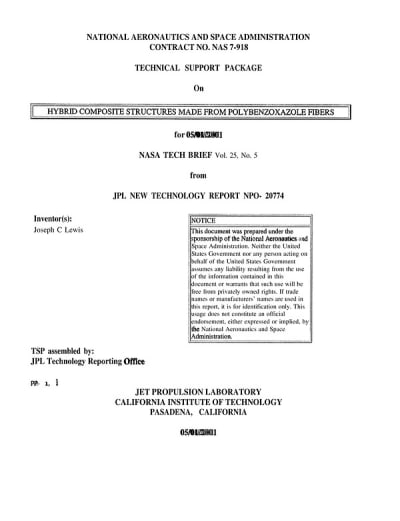
Hybrid Composite Structures Made From Polybenzoxable Fibers
(reference NPO-20774) is currently available for download from the TSP library.
Don't have an account?
Overview
The document presents a technical report on hybrid composite structures utilizing polybenzoxazole (PBO) fibers, developed by Joseph C. Lewis at NASA's Jet Propulsion Laboratory. PBO fibers are highlighted for their high strength and high moduli of elasticity, which enable the creation of thinner composite sections compared to traditional graphite fibers. This innovation is particularly significant in aerospace applications, where weight and structural efficiency are critical.
The report outlines how these PBO fibers can be integrated into various structural components, such as skins, face sheets, or panels, through multiple-angle-ply layups. By employing PBO fibers, the resulting laminated face sheets or skins can be bonded to graphite stiffeners or honeycomb cores, leading to hybrid composite stiffened sandwich structures. These structures are not only thinner but also less massive than those made solely from graphite fibers, while still meeting the same strength and stiffness requirements.
The advantages of using PBO fibers include increased strength-to-thickness ratios, which contribute to the overall performance and efficiency of aerospace structures. The document emphasizes that the use of PBO fibers allows for the design of lighter and more efficient components, which is essential for modern aerospace engineering.
Additionally, the report includes a disclaimer stating that references to specific commercial products or processes do not imply endorsement by the United States Government or the Jet Propulsion Laboratory. It clarifies that the work was conducted under a contract with NASA, ensuring that the findings are rooted in rigorous research and development.
Overall, this technical brief encapsulates a significant advancement in composite material technology, showcasing the potential of PBO fibers to revolutionize the design and manufacturing of lightweight, high-performance aerospace structures. The findings are expected to have a lasting impact on the field, paving the way for future innovations in composite materials and their applications in various industries.











