

A compact, high-current, hollow cathode utilizing a lanthanum hexaboride (LaB6) thermionic electron emitter has been developed for use with high-power Hall thrusters and ion thrusters. LaB6cathodes are being investigated due to their long life, high current capabilities, and less stringent xenon purity and handling requirements compared to conventional barium oxide (BaO) dispenser cathodes. The new cathode features a much smaller diameter than previously developed versions that permit it to be mounted on axis of a Hall thruster (“internally mounted”), as opposed to the conventional side-mount position external to the outer magnetic circuit (“externally mounted”). The cathode has also been reconfigured to be capable of surviving vibrational loads during launch and is designed to solve the significant heater and materials compatibility problems associated with the use of this emitter material. This has been accomplished in a compact design with the capability of high-emission current (10 to 60 A). The compact, high-current design has a keeper diameter that allows the cathode to be mounted on the centerline of a 6-kW Hall thruster, inside the iron core of the inner electromagnetic coil.
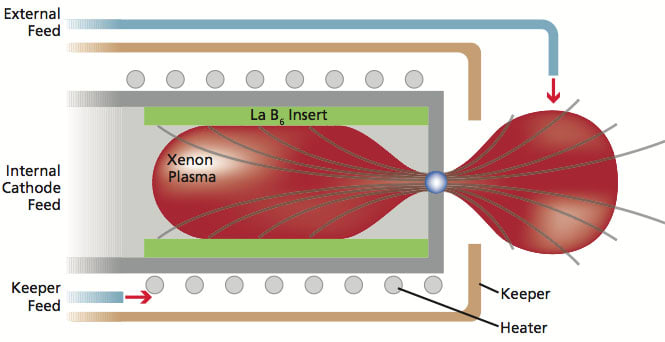
This cathode is specifically designed to integrate on the centerline of a high-power Hall thruster, thus eliminating the asymmetries in the plasma discharge common to cathodes previously mounted externally to the thruster’s magnetic circuit. An alternative configuration for the cathode uses an external propellant feed. This diverts a fraction of the total cathode flow to an external feed, which can improve the cathode coupling efficiency at lower total mass flow rates. This can improve the overall thruster efficiency, thereby decreasing the required propellant loads for different missions. Depending on the particular mission, reductions in propellant loads can lead to mission enabling capabilities by allowing launch vehicle step-down, greater payload capability, or by extending the life of a spacecraft.
This work was done by Ronald Watkins of Columbus Technologies and Dan Goebel and Richard Hofer of Caltech for NASA’s Jet Propulsion Laboratory. For more information, download the Technical Support Package (free white paper) at www.techbriefs.com/tsp under the Mechanics/Machinery category. In accordance with Public Law 96-517, the contractor has elected to retain title to this invention. Inquiries concerning rights for its commercial use should be addressed to:
Innovative Technology Assets Management
JPL
Mail Stop 202-233
4800 Oak Grove Drive
Pasadena, CA 91109-8099
E-mail: This email address is being protected from spambots. You need JavaScript enabled to view it.
Refer to NPO-44923, volume and number of this NASA Tech Briefs issue, and the page number.
This Brief includes a Technical Support Package (TSP).
Compact Rare Earth Emitter Hollow Cathode
(reference NPO-44923) is currently available for download from the TSP library.
Don't have an account?
Overview
The document is a Technical Support Package from NASA's Jet Propulsion Laboratory, detailing the development of a Compact Rare Earth Emitter Hollow Cathode designed to enhance the performance and longevity of Hall thrusters. This innovation addresses the challenges associated with increasing power levels in these thrusters, particularly in the low power range where miniaturization and thermal management are critical.
The engineering drawing (Figure 2) illustrates the compact, high-current LaB6 hollow cathode assembly, which was developed to overcome performance issues linked to traditional cathode designs. The design focuses on materials compatibility, advanced thermal management for the heater, and minimizing thermal losses through careful engineering. The cathode features a keeper diameter of 0.786 inches and an orifice diameter of 0.24 inches, with an insert inner diameter of 0.151 inches and a length of 1 inch. This compact design allows for emission currents ranging from 20 to 60 A, significantly outperforming the SOA discharge cathode used in the NSTAR ion thruster, which can only handle about 15 A.
The document highlights the innovative approach of using a cathode orifice equal to the insert inner diameter, which maximizes performance by improving plasma contact and reducing internal pressures—contrasting with traditional barium oxide cathodes that typically have smaller orifice diameters. Experimental results demonstrate that thermal losses from the cathode do not hinder thruster operation, as evidenced by the successful performance of the 6 kW H6 Hall thruster (Figure 4).
Additionally, the document includes photographs of the fabricated assembly (Figure 3), showcasing the cathode with and without the keeper electrode, and emphasizes the use of tantalum radiation shielding to further reduce thermal losses. An alternate configuration utilizing an external propellant feed is also mentioned (Figure 5).
Overall, this Technical Support Package provides valuable insights into the advancements in cathode technology for Hall thrusters, showcasing NASA's commitment to improving aerospace propulsion systems through innovative engineering solutions. The findings have implications for both scientific research and commercial applications in the field of space exploration and satellite technology.











