

Systems of caged trim masses manipulated by magnetic fields have been proposed for effecting fine control of the positions and/or orientations of spacecraft. The systems were conceived for use during observations by spaceborne interferometers, the component instruments of which (1) are located on multiple spacecraft flying in formation and (2) are required to be kept aligned with each other within narrow position and orientation tolerances. The proposed systems would make it possible to avoid the spurious effects generated by the spacecraft propulsion systems that would otherwise have to be used for fine position control; the spurious effects would include vibrations, exhaust, and flashes of light, which would be detrimental to the interferometric observations. Terrestrial versions of the proposed systems might be useful for fine horizontal positioning of delicate scientific instruments.
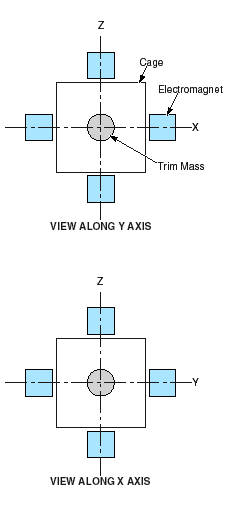
Three caged trim masses would be needed for complete position and orientation control of a spacecraft in three dimensions. Each trim mass would be manipulated by three pairs of opposing electromagnets — one pair for each of three mutually orthogonal axes (see figure). During times when observations were not being performed (e.g., during use of the spacecraft thrusters), the electromagnets would be activated to reset the trim masses to, and hold them at, the central positions within their cages.
This work was done by James Kelley of Caltech for NASA’s Jet Propulsion Laboratory. For further information, access the Technical Support Package (TSP) free on-line at www.nasatech.com/tsp under the Mechanics category. NPO-20570
This Brief includes a Technical Support Package (TSP).
Magnetically Moved Trim Masses for FIne Position Control
(reference NPO-20570) is currently available for download from the TSP library.
Don't have an account?
Overview
The document presents a technical support package from NASA detailing a novel system for fine position and orientation control of spacecraft using magnetically moved trim masses. Developed by James H. Kelley at the Jet Propulsion Laboratory (JPL), this innovative approach addresses the challenges faced by spaceborne interferometers, which require precise alignment of multiple spacecraft flying in formation.
Traditional propulsion systems used for fine control can introduce unwanted disturbances, such as vibrations, exhaust, and flashes of light, which can adversely affect sensitive observations. The proposed system utilizes caged trim masses manipulated by electromagnetic fields to achieve ultra-fine control without these spurious effects. Each spacecraft would employ three caged trim masses, with each mass controlled by six opposing electromagnets—two for each of the three orthogonal axes (X, Y, and Z). This configuration allows for comprehensive control over the spacecraft's position and orientation in three dimensions.
During observation periods, the trim masses would be held in place by the electromagnets, ensuring stability and precision. When not observing, the system can reset and maintain the trim masses at their central positions, effectively managing the spacecraft's orientation without relying on thrusters. This method not only enhances the quality of scientific data collected by interferometers but also has potential applications on Earth, particularly for the fine horizontal positioning of delicate scientific instruments.
The document emphasizes the novelty of this approach, highlighting its advantages over traditional methods, including the elimination of exhaust and vibration, which are critical for maintaining the integrity of sensitive measurements. The work is part of NASA's ongoing efforts to improve spacecraft technology and enhance the capabilities of space exploration missions.
Overall, the magnetically moved trim masses system represents a significant advancement in spacecraft control technology, promising to improve the performance of spaceborne observatories and potentially benefiting various terrestrial applications. The research was conducted under NASA's sponsorship, and the findings are intended to contribute to the broader field of aerospace engineering and scientific instrumentation.











