

A proposed scheme for generating electric power from rivers and from ocean currents, tides, and waves is intended to offer economic and environmental advantages over prior such schemes, some of which are at various stages of implementation, others of which have not yet advanced beyond the concept stage. This scheme would be less environmentally objectionable than are prior schemes that involve the use of dams to block rivers and tidal flows. This scheme would also not entail the high maintenance costs of other proposed schemes that call for submerged electric generators and cables, which would be subject to degradation by marine growth and corrosion.
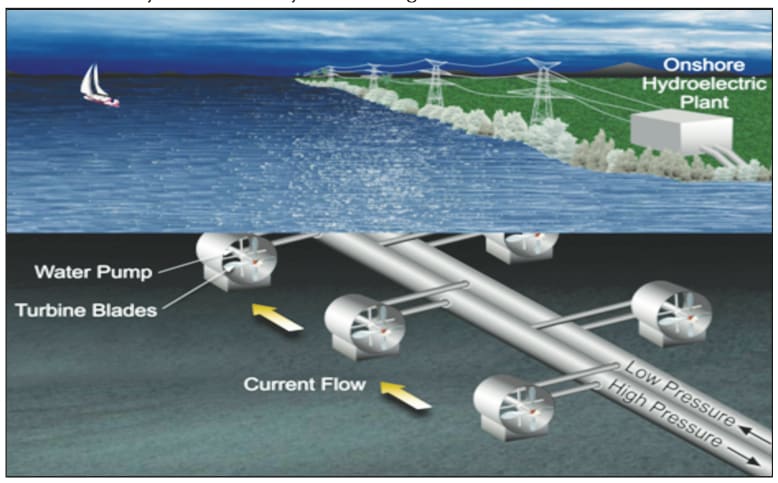
A basic power-generation system according to the scheme now proposed would not include any submerged electrical equipment. The submerged portion of the system would include an all-mechanical turbine/pump unit that would superficially resemble a large land-based wind turbine (see figure). The turbine axis would turn slowly as it captured energy from the local river flow, ocean current, tidal flow, or flow from an ocean-wave device. The turbine axis would drive a pump through a gearbox to generate an enclosed flow of water, hydraulic fluid, or other suitable fluid at a relatively high pressure [typically ≈500 psi (≈3.4 MPa)].
The pressurized fluid could be piped to an onshore or offshore facility, above the ocean surface, where it would be used to drive a turbine that, in turn, would drive an electric generator. The fluid could be recirculated between the submerged unit and the power-generation facility in a closed flow system; alternatively, if the fluid were seawater, it could be taken in from the ocean at the submerged turbine/pump unit and discharged back into the ocean from the power-generation facility. Another alternative would be to use the pressurized flow to charge an elevated reservoir or other pumped-storage facility, from whence fluid could later be released to drive a turbine/generator unit at a time of high power demand.
Multiple submerged turbine/pump units could be positioned across a channel to extract more power than could be extracted by a single unit. In that case, the pressurized flows in their output pipes would be combined, via check valves, into a wider pipe that would deliver the combined flow to a power-generating or pumped-storage facility.
This work was done by Jack Jones and Yi Chao of Caltech for NASA’s Jet Propulsion Laboratory.
In accordance with Public Law 96-517, the contractor has elected to retain title to this invention. Inquiries concerning rights for its commercial use should be addressed to:
Innovative Technology Assets Management
JPL
Mail Stop 202-233
4800 Oak Grove Drive
Pasadena, CA 91109-8099 E-mail: This email address is being protected from spambots. You need JavaScript enabled to view it.
Refer to NPO-45174.
This Brief includes a Technical Support Package (TSP).

Mechanical Extraction of Power From Ocean Currents and Tides
(reference NPO-45174) is currently available for download from the TSP library.
Don't have an account?
Overview
The document titled "Mechanical Extraction of Power From Ocean Currents and Tides" (NPO-45174) from NASA's Jet Propulsion Laboratory outlines the potential for harnessing energy from ocean currents, tides, and waves. It emphasizes that a small percentage of the energy from the Gulf Stream alone could supply a significant portion of the electricity needs in the United States, highlighting the vast untapped power-generating potential of the oceans.
The document discusses the current state of ocean energy systems, which predominantly rely on barrage dams and above-water turbines. These systems, while functional, have significant drawbacks, including environmental damage and high maintenance costs due to marine growth and corrosion of submerged electrical equipment. The high cost of long, submerged cables further complicates the feasibility of these systems.
To address these challenges, the document proposes a novel approach using submersible turbines that convert ocean mechanical energy directly into high-pressure water mechanical energy, rather than converting it to electricity underwater. This method keeps all electrical components out of the water, reducing maintenance issues and allowing for the pressurized fluid to be transported through relatively small pipes to onshore or offshore platforms for electricity generation. The pressurized fluid can also be stored in elevated reservoirs to manage time-varying flows, such as those from tides and waves.
The document details the mechanics of the proposed system, explaining how water flow from ocean waves, currents, or tides can turn turbine blades, which then drive a mechanical fluid pump to generate high-pressure fluid flow. It notes that a water turbine can capture approximately 30% of the energy from ocean currents, and with proper design, high-pressure systems can deliver substantial power over long distances with minimal pressure loss.
Overall, the document presents a promising alternative to traditional ocean energy systems, emphasizing the potential for efficient energy extraction while minimizing environmental impact and operational challenges. It serves as a call to explore innovative technologies that can harness the power of the oceans sustainably and effectively.











