The newest wind farms, which can be located on land or offshore, typically use turbines with rotor diameters of about 300 feet. Currently, turbines on these large wind farms are typically spaced about seven rotor diameters apart. The new spacing model developed by Charles Meneveau, a Johns Hopkins fluid mechanics and turbulence expert, and Johan Meyers, an assistant professor at Katholieke Universiteit Leuven in Belgium, suggests that placing the wind turbines 15 rotor diameters apart - more than twice as far apart as in the current layouts - results in more cost-efficient power generation.
Meneveau and Meyers argue that the energy generated in a large wind farm has less to do with horizontal winds and is more dependent on the strong winds that the turbulence created by the tall turbines pulls down from higher up in the atmosphere. Using insights gleaned from high-performance computer simulations as well as from wind tunnel experiments, they determined that in the correct spacing, the turbines alter the landscape in a way that creates turbulence, which stirs the air and helps draw more powerful kinetic energy from higher altitudes.
In the video below, the researchers conduct previous experiments in the campus wind tunnel.
Transcript
00:00:17 as somebody once said we didn't move out of the Stone Age because we ran out of stones you have to essentially develop new technologies that are better not necessarily because you run out of something but because there are other problems and and and better Alternatives in seeing the recent Trends over the past 3 4 years it's very clear to me that wind energy in fact is is on a
00:00:40 really steep growth path globally so last year in collaboration with a colleague and a poster Raul C we thought up a very nice research project to study the interactions between large amounts of wind turbines and turbulent wind that flows over the Earth's surface when you when you want to see what are the effects of these um huge massive structures on the atmosphere you want to
00:01:08 be able to quantify them you want to recognize what is it that these structures do what happens when you put these turbin too close or too far apart not only horizontally but vertically if you align them staggered or in parallel so all of these are different effects that we want to be able to comprehend and quantify rather than just going out there and building these massive
00:01:34 structures implementing them and not knowing what's really going to happen the modern wind turbine is in fact the largest rotating turbo Machinery ever built the way they they work is the wind blows on them and they're essentially a inverted propeller the kinetic energy in the wind it generates a torque on the blade which makes it turn and then that is connected to a an electric generator
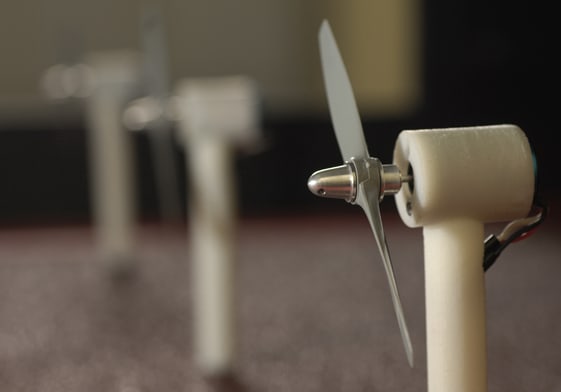
00:01:59 one of the the convenient wonderful things of fluid dynamics is something called similarity which means you can under some conditions you can do tests at smaller scales compared to the real thing so what we try to do here in the wind tunnel is we scale everything down everything becomes very minute very small the models that we have here are
00:02:23 18 cm in real life they can go up to 100 m 150 M High the the experiment that uh we are uh about to conduct essentially generates uh a wind in the Wind Tunnel then we feed that air flow through an active grid an active grid what that creates is higher levels of uh freest stream turbulence so this also helps us mimic what happens in real life using something that is called uh particle
00:02:55 image Velo symmetry which is a relatively new measurement technique in fluid mechanics we will take very detailed velocity measurements what we're trying to do is um obtain the velocities and the flow field for that particular case in front and in the back of uh of one wind turbine after it has gone through two rows of uh turbines and that is done to see the cumulative
00:03:21 effect so the the way this technique works is very simple in fact you seed the air with very tiny particles there's so so tiny that they're actually really following the air flow in great detail then you with a laser you generate a light sheet which is very thin and that light sheet is illuminated twice so it's pulsed twice and you take uh pictures of the of what you see when we do the image
00:03:48 analysis we see that every dot is actually duplicated there's two dots for every particle and since we know the time difference between the two l laser shots we can find the velocity so we get a snapshot an instantaneous snapshot of the air velocity at that particular Point having these vectors having these Vector Maps allows us to actually calculate and evaluate how much flow of
00:04:14 kinetic energy is going from one place to another place when you go out into into the real life into real flows it's much more complex so you cannot account for everything that is happening all at once so here at least we we start to understand um control parameters that that we can tweak as it is always with research we don't quite know what exactly we will find we don't know how
00:04:41 exactly we will analyze the data after finding the preliminary things that we we tend to uh go Fairly open-minded into subjects like this and and let the phenomenon guide us and and and and see what happens