

An improved method has been devised for the computational prediction of a collision between (1) a robotic manipulator and (2) another part of the robot or an external object in the vicinity of the robot. The method is intended to be used to test commanded manipulator trajectories in advance so that execution of the commands can be stopped before damage is done. The method involves utilization of both (1) mathematical models of the robot and its environment constructed manually prior to operation and (2) similar models constructed automatically from sensory data acquired during operation. The representation of objects in this method is simpler and more efficient(with respect to both computation time and computer memory), relative to the representations used in most prior methods.
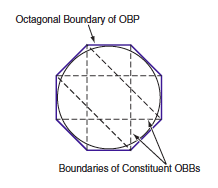

OBBs are also used to represent the terrain and any objects on the terrain sensed by the stereoscopic vision system. A conceptual multi-resolution map pyramid of the manipulator work space is computed from the stereoscopic sensory data and is then used in a coarse-to-fine sequence to detect collisions between the manipulator and terrain. As described next, tests for collisions are performed in a hierarchical sequence to minimize the amount of computation needed to detect collisions.
Starting with the second-highest level of the pyramid, each level is characterized by twice the horizontal spatial resolution of the level above it (see Figure 2). For example, at the highest level of the pyramid (coarsest resolution) there is a single terrain OBB that encloses all of the sensed data points. The model for each manipulator link is one low-resolution OBP. If no collisions between any of the OBPs and the coarsest-resolution terrain OBB are detected, then there is no need for further computation to detect collisions with terrain. On the other hand, if collisions are detected at the coarsest resolution, then tests for collisions are performed on each of the terrain OBBs at the second coarsest resolution. This process continues to successively finer levels of resolution until the finest resolution is reached or no more collisions are detected. Similar tests for collisions are performed with a similarly hierarchical model of the non-manipulator parts of the robot (body, cameras, sensors, suspension, and wheels).
This work was done by Chris Leger of Caltech for NASA’s Jet Propulsion Laboratory.
This Brief includes a Technical Support Package (TSP).
Improved Collision-Detection Method for Robotic Manipulator
(reference NPO-30356) is currently available for download from the TSP library.
Don't have an account?
Overview
The document presents a technical support package from NASA detailing a novel safeguarding method for planetary robot manipulators, specifically designed to enhance the safety and efficiency of robotic operations on planetary surfaces. The work, developed at the Jet Propulsion Laboratory (JPL), addresses the unique challenges faced by planetary rovers, such as the absence of human supervision and the unpredictability of the environment, which can lead to hazardous manipulator motions.
The primary focus of the invention is a method for checking manipulator trajectories to prevent collisions with the robot itself or with external objects in its environment. This method combines model-based and sensor-based approaches, allowing for a more flexible and accurate representation of both the robot and its surroundings. Unlike previous purely model-based methods, this approach utilizes real-time data from on-board sensors to build an environmental model, significantly improving the robustness and numerical accuracy of collision detection.
Key innovations include the elimination of complex mathematical functions (like divisions and transcendental functions) in collision checks, which enhances computational efficiency and reduces the risk of numerical errors. The method also employs a simpler representation for objects, requiring less memory and computational power, making it suitable for the limited resources available on planetary rovers, such as the Mars Exploration Rovers.
The document emphasizes the importance of on-board safeguarding, which is crucial for autonomous operations where pre-programmed safety checks are not feasible. This capability allows for fully autonomous deployments of the robot arm, increasing the potential for scientific discoveries through opportunistic actions.
The safeguarding method has been tested on the JPL FIDO rover, demonstrating its effectiveness in both manually commanded and fully autonomous scenarios. The approach has been adopted by the MER flight software team for use in mission planning and on-board operations, showcasing its practical application in real-world missions.
Overall, this document outlines a significant advancement in robotic safety protocols for planetary exploration, highlighting the integration of advanced computational techniques and real-time environmental modeling to ensure safe and efficient robotic operations in unpredictable extraterrestrial environments.











