An improved mathematical model enables the somewhat more accurate prediction of the spectral response of a mixer circuit (see figure) that comprises a twin-slot antenna coupled via coplanar waveguides to a hot-electron bolometer (HEB). The development of the improved model is part of a continuing effort to understand and overcome the limitations of circuit models in order to enhance capabilities for designing and analyzing heterodyne mixers to operate at frequencies in the terahertz range.
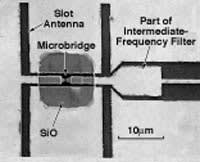
The improved model is an extension of the prior model, incorporating two major additions: The first addition is that of a submodel of the junctions between the coplanar waveguides and the slot antennas. The fringing fields at these junctions add parasitic reactance to the circuit. The second addition is that of a submodel of the reactance (predominantly inductive) of the very narrow HEB microbridge and of the tapered transition pieces, if any, with which it is connected to the center conductors of the coplanar waveguides. These additions exert a small effect on the real part of the embedding impedance, but a large effect on the imaginary part. The predictions obtained by use of the improved model show that in a typical case, the inductance of the narrow HEB microbridge dominates the estimated shift in the resonance frequency below that of the prior model. However, because the results of the experiments showed that the improved model does not account for all of the observed frequency shift, it is apparent that further refinements of the model are still necessary.
This work was done by Andrea Neto and Rolf Wyss of Caltech for NASA's Jet Propulsion Laboratory. For further information, access the Technical Support Package (TSP) free on-line at www.nasatech.com/tsp under the Electronics & Computers category.
NPO-21075
This Brief includes a Technical Support Package (TSP).

Improved Model of Spectral Respomse of an HEB Mixer
(reference NPO-21075) is currently available for download from the TSP library.
Don't have an account?
Overview
The document titled "Improved Model of Spectral Response of an HEB Mixer" presents advancements in the modeling of hot-electron bolometer (HEB) mixers, which are crucial for applications in the terahertz frequency range. Developed by Andrea Neto and Rolf Wyss at the Jet Propulsion Laboratory (JPL) for NASA, the improved model addresses limitations found in prior models by incorporating additional factors that affect the spectral response of the mixer circuit.
The improved model includes two significant enhancements: a submodel for the junctions between coplanar waveguides and slot antennas, and a submodel for the inductive reactance of the narrow HEB microbridge and its connections to the waveguides. These additions account for parasitic reactance and fringing fields that were previously overlooked, leading to more accurate predictions of the mixer’s performance.
Experimental validation of the model involved measuring the direct-detection and impedance spectra of HEB mixers designed for resonance at frequencies ranging from 0.6 to 2.5 THz. The results indicated that the improved model could predict the imaginary part of the embedding impedance more accurately, although it still did not fully account for all observed frequency shifts. Specifically, the inductance of the HEB microbridge was found to dominate the estimated shift in resonance frequency compared to the prior model, which had predicted frequencies that were approximately 20 percent higher than those measured in experiments.
The document emphasizes the ongoing need for refinement in the modeling of HEB mixers to enhance their design and operational capabilities. The work is part of a broader effort to improve the understanding of circuit models and their limitations, ultimately aiming to advance the technology used in heterodyne mixers for high-frequency applications.
Overall, this research represents a significant step forward in the field of terahertz technology, providing a more robust framework for predicting the behavior of HEB mixers and facilitating their development for future scientific and engineering applications. The findings underscore the importance of continuous improvement in modeling techniques to keep pace with the evolving demands of high-frequency electronic systems.