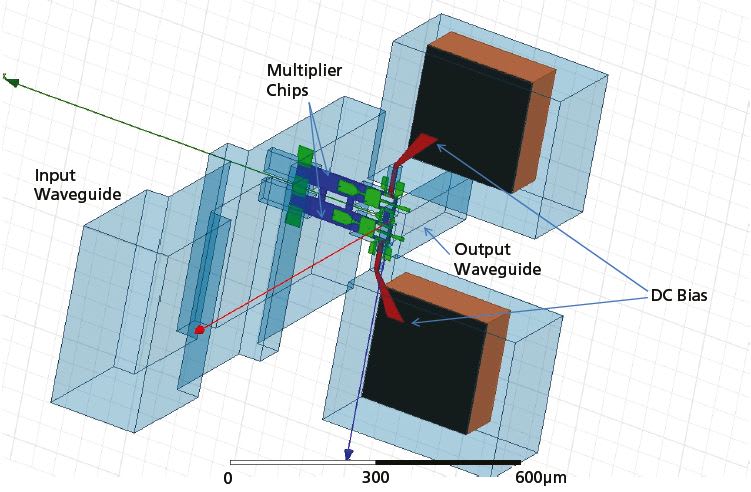
A 1.6-THz power-combined Schottky frequency tripler was designed to handle approximately 30 mW input power. The design of Schottky-based triplers at this frequency range is mainly constrained by the shrinkage of the waveguide dimensions with frequency and the minimum diode mesa sizes, which limits the maximum number of diodes that can be placed on the chip to no more than two. Hence, multiple-chip power-combined schemes become necessary to increase the power-handling capabilities of high-frequency multipliers. However, the traditional powercombining topologies that are used below 1 THz present some inconvenience beyond 1 THz. The use of Y-junctions or hybrid couplers to divide/combine the input/output power at these frequency bands increases unnecessarily the electrical path of the signal in the range of frequencies where waveguide losses are considerable. Also, guaranteeing a perfect alignment of the very small chips during assembly, in order to preserve the balanced nature of the multiplier, is practically impossible with the subsequent impact on the multiplier performance.
This work was done by Goutam Chattopadhyay, Imran Mehdi, Erich T. Schlecht, and Choonsup Lee of NASA’s Jet Propulsion Laboratory and Caltech; Jose V. Siles – Fulbright Fellow at NASA’s Jet Propulsion Laboratory; Alain E. Maestrini of the University of Paris; Bertrand Thomas of Radiometer Physics; and Cecile D. Jung of ORU for NASA’s Jet Propulsion Laboratory.
In accordance with Public Law 96-517, the contractor has elected to retain title to this invention. Inquiries concerning rights for its commercial use should be addressed to:
Innovative Technology Assets Management
JPL
Mail Stop 202-233
4800 Oak Grove Drive
Pasadena, CA 91109-8099
E-mail: This email address is being protected from spambots. You need JavaScript enabled to view it.
NPO-48155
This Brief includes a Technical Support Package (TSP).
On-Chip Power-Combining for High-Power Schottky Diode- Based Frequency Multipliers
(reference NPO-48155) is currently available for download from the TSP library.
Don't have an account?
Overview
The document is a Technical Support Package from NASA's Jet Propulsion Laboratory (JPL) detailing advancements in on-chip power-combining technology for high-power Schottky diode-based frequency multipliers, particularly in the submillimeter-wave region (300 GHz – 3 THz). This frequency range is crucial for studying various astrophysical phenomena, including the evolution of galaxies, star formation, and atmospheric composition on planets and moons.
The introduction emphasizes the importance of detecting emission and absorption lines of key species such as methane (CH₄), carbon monoxide (CO), water (H₂O), and others, which are vital for understanding molecular chemistry and atmospheric conditions. High-resolution THz heterodyne spectrometers, driven by Schottky diode multiplier chains, are identified as the best tools for these studies. However, current THz local oscillator (LO) sources face significant limitations, including high volume and mass, low efficiency, and inadequate output power beyond 1 THz, which complicates multi-pixel operations.
To address these challenges, the document discusses the need for novel circuit topologies and the development of next-generation THz instruments that can provide multi-pixel operation. It highlights the advancements in Gallium Nitride (GaN) amplifiers, which now produce 5W of power—over 20 times higher than those used in previous missions like Herschel.
The document outlines specific configurations for power-combining techniques, including designs for both 1.6 THz and 1.9 THz systems using multiple chips. These configurations aim to enhance output power while minimizing size and complexity, which is essential for space missions where weight and volume are critical factors.
Acknowledgments are made to various contributors and supporting organizations, including the U.S. Department of State and the Fulbright Postdoctoral Scholar Program. The document serves as a resource for those interested in aerospace-related technological developments with potential applications beyond space exploration.
In summary, this Technical Support Package presents a comprehensive overview of the current state and future directions of THz technology, emphasizing the importance of innovative solutions to overcome existing limitations and enhance scientific research capabilities in astrophysics and related fields.