

The figure shows the basic optical configuration of an improved all-reflecting imaging spectrometer. This spectrometer would differ from older spectrometers in several respects, one being its convex spherical diffraction grating: heretofore, spectrometers have contained, variously, concave or plane diffraction gratings. The specific design, featuring the convex grating and two concave spherical mirrors, would afford a wide field of view and a compact layout that would make the size of this spectrometer about 1/3 that of a spectrometer of typical older design and similar capabilities. The sphericity of the optical surfaces would make fabrication relatively easy and inexpensive.
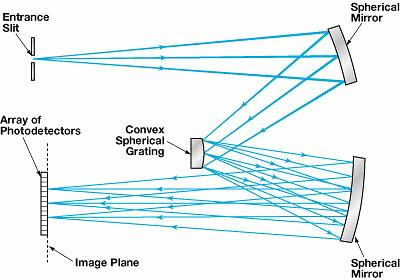
The radii of curvature of the grating and mirrors and the off-axis positions and angles at which these optical components would be mounted have been selected to give the excellent spatial and spectral performance over the image plane. The spectrometer would produce a well-corrected, spectrally dispersed image of the entrance slit over a wide spectral range. The outstanding quality of the image would be attributable to good correction of astigmatism and field curvature over the image area. Heretofore, it has been extremely difficult to achieve correction of both field curvature and astigmatism over the image areas of imaging spectrometers.
The all-reflecting design would be suited for spectral regions from vacuum ultraviolet through visible to far infrared. Unlike in older imaging spectrometers, there would be no need for a field-flattening lens: this would constitute a major advantage for operation over extended spectral regions. The relative flatness of the focal plane would make this spectrometer suitable for use with a planar array of photodetectors.
The design would use the variation of astigmatism of the second mirror with wavelength to compensate for the variation of astigmatism of the grating with wavelength. The design would use the variation of astigmatism of both mirrors with field angle to compensate for the variation of astigmatism of the grating with field angle. The design would also use both spherical mirrors to compensate for the spectral and spatial field curvature intrinsic to the grating. Though the design does not look complicated, the process of optimizing the design was complicated because it involved careful selection of design parameters to balance astigmatism, field curvature, and coma over the spatial and spectral fields.
Design calculations show that in both the spectral and spatial aspects, the optical performance of this spectrometer would exceed that of any imaging spectrometer now in existence. Excellent spatial resolution perpendicular to the spectral dispersion axis would make this instrument attractive for a variety of industrial and medical applications that have already given rise to a multimillion-dollar market in imaging spectrometers.
This work was done by Michael P. Chrisp of Caltech for NASA's Jet Propulsion Laboratory. For further information, access the Technical Support Package (TSP) free on-line at www.techbriefs.com under the Physical Sciences category, or circle no. 125on the TSP Order Card in this issue to receive a copy by mail ($5 charge).
This invention is owned by NASA, and a patent application has been filed. Inquiries concerning nonexclusive or exclusive license for its commercial development should be addressed to
the Patent Counsel
NASA Resident Office-JPL; (818) 354-5179.
Refer to NPO-19293.
This Brief includes a Technical Support Package (TSP).
Convex-grating spectrometer with two spherical mirrors
(reference NPO19293) is currently available for download from the TSP library.
Don't have an account?
Overview
The document presents a new convex grating spectrometer design developed by Michael P. Chrisp, aimed at addressing significant challenges in imaging spectrometer systems. The primary issues identified in conventional spectrometers include eliminating astigmatism across the spectrum, correcting field curvature to focus the spectrum onto a flat detector array, and achieving good spatial resolution of the entrance slit. The most challenging of these is the elimination of astigmatism from various points on the entrance slit, which typically requires increasing the spectrometer size.
The proposed solution involves a unique design that utilizes a convex spherical grating in conjunction with two concave spherical mirrors. This configuration allows for the correction of astigmatism and field curvature, resulting in superior spectral and spatial resolution compared to existing designs, such as the Czerny-Turner spectrometers. The design is particularly advantageous for solid-state detector arrays, as it enables smaller spectrometers to achieve better performance within a given volume.
The document highlights the novelty of the design, emphasizing that it is the first to employ a convex spherical grating, which offers improved performance over traditional concave or plane gratings. The careful optimization of the angles of incidence on the mirrors and grating is crucial for balancing aberrations like astigmatism and coma across both spatial and spectral fields.
In terms of applications, the spectrometer is particularly suited for aerospace uses, especially in imaging spectrometer remote sensing systems. It allows for a size reduction of imaging spectrometers by a factor of three, making it feasible to deploy on smaller launch vehicles. The design is also noted for its capability to operate across a wide spectral range, from the vacuum ultraviolet (VUV) to the far infrared, without the need for refractive field flattening lenses, which is a significant advantage over conventional designs.
Overall, this new convex grating spectrometer design promises to enhance imaging spectrometry by providing high-quality spectral data while reducing the size and complexity of the instruments, making it a valuable advancement for both scientific and commercial applications.











