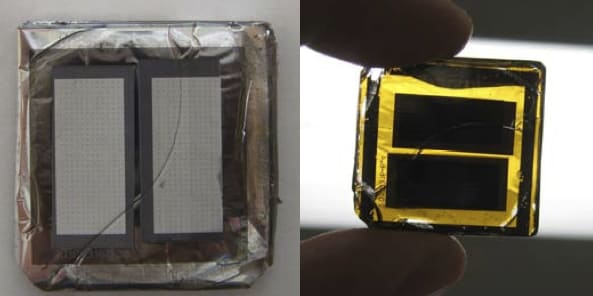
An enhanced thin-film silicon photovoltaic device with improved efficiency has been developed. Thin-film silicon solar cells suffer from low material absorption characteristics, resulting in poor cell efficiencies. SiOnyx’s approach leverages black silicon, an advanced material fabricated using ultra-fast lasers.
The laser-treated films show dramatic enhancement in optical absorption with measured values in excess of 90% in the visible spectrum and well over 50% in the near infrared spectrum.
Thin-film black silicon solar cells demonstrate 25% higher current generation with almost no impact on open circuit voltage as compared with representative control samples. The initial prototypes demonstrated an improvement of nearly 2 percentage points in the suns Voc efficiency measurement. In addition, the researchers validated the capability to scale this processing technology to the through-puts (< 5 min/m2) required for volume production using state of the art commercially available high power industrial lasers. With these results, the feasibility for the enhancement of thin-film solar cells with this laser processing technique was clearly demonstrated.
This work was done by SiOnyx and provided the necessary feasibility to secure a development program to support thin film flexible photovoltaics for soldier applications funded by DARPA.
This Brief includes a Technical Support Package (TSP).
Black Silicon Enhanced Thin-Film Silicon Photovoltaic Devices
(reference GDM0011) is currently available for download from the TSP library.
Don't have an account?
Overview
The document is a final program report detailing the development of Black Silicon enhanced thin film silicon photovoltaic devices by SiOnyx, Inc., covering the period from June 29, 2009, to June 30, 2010. The project aimed to improve the efficiency of thin film silicon solar cells, which traditionally suffer from low material absorption and, consequently, poor efficiency.
SiOnyx's approach involved leveraging Black Silicon, a material created using ultrafast laser processing, which significantly enhances optical absorption. The report highlights that the laser-treated films exhibit optical absorption values exceeding 90% in the visible spectrum and over 50% in the near-infrared spectrum. This enhancement leads to a notable increase in current generation, with the Black Silicon solar cells demonstrating a 25% increase in current (from 20 mA/cm² to 25 mA/cm²) while maintaining nearly the same open circuit voltage (Voc) performance.
The project achieved a 2 percentage point improvement in the Suns Voc efficiency, resulting in an efficiency of 8.9% for the Black Silicon enhanced cells compared to 7.0% for control samples. The report emphasizes that this improvement is significant for thin film photovoltaics, which typically lag behind other technologies like CdTe in efficiency.
Additionally, the document discusses the feasibility of scaling the Black Silicon processing technology for commercial production, indicating that the manufacturing process can be completed in under five minutes per square meter using industrial lasers. This scalability is crucial for meeting the demands of the solar market.
The report concludes that the program successfully demonstrated the potential of Black Silicon as a process enhancement for thin film silicon photovoltaics, with implications for cost savings and improved performance in solar energy applications. The partnership between SiOnyx and the University of Delaware’s Institute for Energy Conversion, along with a Joint Development Agreement with Coherent Laser, aims to further develop ultrafast laser processing tools for the solar manufacturing industry.
Overall, the document presents a comprehensive overview of the advancements made in enhancing thin film solar cell efficiency through innovative material processing techniques, highlighting the potential for future applications in renewable energy.