Smaller (volume, mass, power) electronics for a Ka-band (36 GHz) radar interferometer were required. To reduce size and achieve better control over RF-phase versus temperature, fully hybrid electronics were developed for the RF portion of the radar’s two-channel receiver and single-channel transmitter. In this context, fully hybrid means that every active RF device was an open die, and all passives were directly attached to the subcarrier. Attachments were made using wire and ribbon bonding. In this way, every component, even small passives, was selected for the fabrication of the two radar receivers, and the devices were mounted relative to each other in order to make complementary components isothermal and to isolate other components from potential temperature gradients. This is critical for developing receivers that can track each other’s phase over temperature, which is a key mission driver for obtaining ocean surface height.
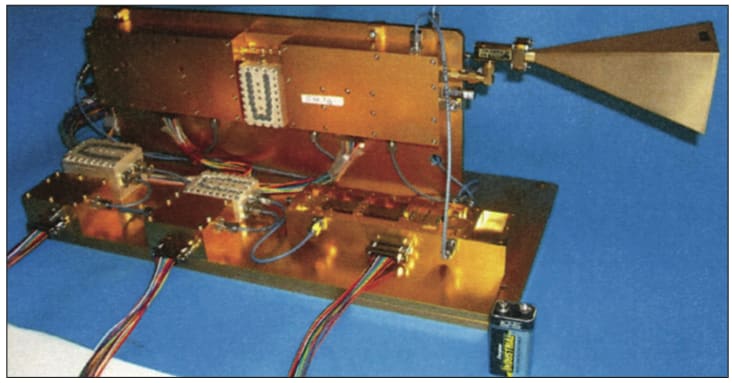
The last item is key to fabricating a dual-channel receiver, where one wants components from the two channels to be isothermal, and therefore mounted back-to-back, while also having the routing as similar as possible. This drives the design to be mirrored, where the two channels are fabricated back-to-back, achieving direct mechanical interface to improve the isothermal performance, which drives RF phase balance. This back-to-back design forces components to have a “left” and “right” handed version, which is not typically possible for packaged components, but with full design control of hybrid design, this is achievable. The radar was designed to have a series of separate subcarriers, which could be hermetically sealed individually, which is much easier than sealing the entire unit. Also, in the event of late component failure, rather than losing or reworking the entire unit, the subcarrier can easily be replaced by another qualified subcarrier.
This new instrument is a smaller, higher-bandwidth dual-channel interferometer with 500-MHz bandwidth at Ka-band (35.5 to 36 GHz), as compared to the prior instrument WSOA (Wide Swath Ocean Altimeter), which was Ku-band (13.275 GHz) with 80-MHz bandwidth. The new instrument has six-fold improvement in resolution capability, and better control of factors that contribute to RF phase stability.
This work was done by James P. Hoffman, Alina Moussessian, Masud Jenabi, and Brian Custodero of Caltech for NASA’s Jet Propulsion Laboratory. NPO-47346
This Brief includes a Technical Support Package (TSP).
Miniaturized Ka-Band Dual-Channel Radar
(reference NPO-47346) is currently available for download from the TSP library.
Don't have an account?
Overview
The document is a Technical Support Package from NASA detailing the development of a Miniaturized Ka-Band Dual-Channel Radar, specifically designed for Earth science missions recommended by the National Research Council (NRC) for the next decade (2010-2020). The primary objective of this initiative is to focus on the miniaturization and risk reduction of radar components, which is crucial for enhancing the performance and cost-effectiveness of radar systems used in high-accuracy measurements related to solid earth, atmospheric composition, and water cycle studies.
The document outlines the challenges and advancements made in radar technology, particularly in the context of the SWOT (Surface Water Ocean Topography) mission. It discusses the importance of commonality and compatibility in radar electronics, which helps to reduce costs and risks associated with developing new systems. The miniaturization efforts aim to decrease the mass, volume, power consumption, and overall cost of radar systems, making them more competitive for future missions.
Key achievements highlighted include the successful fabrication, integration, and testing of a Ka-band radar system. The document describes the use of a prototyping method that allowed for direct measurement of key components, leading to optimized designs that can be directly integrated into flight hardware. This approach not only saves costs but also reduces the uncertainty typically associated with rebuilding circuits for larger instruments.
The document also presents significant results from testing the radar's receiver and transmitter. It notes that the receiver achieved a bandwidth of 500 MHz and a spurious-free dynamic range (SFRD) that meets the instrument's requirements. The transmitter's output power, while limited to 20 dBm due to oscillations, still exceeds the minimum requirement of 5 dBm.
Overall, the work demonstrates that the Jet Propulsion Laboratory (JPL) can effectively build hybridized radar systems that are smaller, more efficient, and cost-effective. This advancement is expected to enhance JPL's competitiveness in the radar technology market and improve opportunities for future Earth and planetary missions. The document emphasizes the significance of these developments in supporting NASA's goals for Earth science applications and advancing radar technology for various scientific endeavors.