

A proposed instrumented robotic vehicle called an "aerover" would fly, roll along the ground, and/or float on bodies of liquid, as needed. The aerover would combine features of an aerobot (a robotic lighter-than-air balloon) and a wheeled robot of the "rover" class. An aerover would also look very much like a variant of the "beach-ball" rovers described in "Lightweight 'Beach- Ball' Robotic Vehicles" (NPO-20283), NASA Tech Briefs, Vol. 22, No. 7 (July 1998), page 74. Although the aerover was conceived for use in scientific exploration of Titan (the largest moon of the planet Saturn), the aerover concept could readily be adapted to similar uses on Earth.
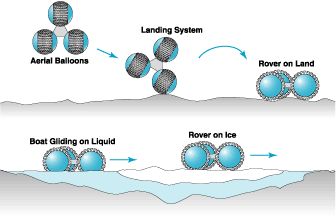
Following initial inflation, the aerover would be set free to drift at a controlled altitude, gathering images of terrain. Altitude control could be effected by (1) heating and/or inflation from a supply tank for ascent and (2) venting helium and/or turning off the heater for descent. From time to time, helium would be vented to make the aerover descend to collect ground samples by use of tethered coring modules or a landing snake. Thereafter, the aerover would make several ascents and descents to acquire additional images and samples.
Eventually, the helium supply would approach depletion; helium would then be vented gradually to effect a final descent. The residual helium in the balloons would provide cushion for a soft landing. Thereafter, the aerover would remain permanently on the surface.
Once the aerover was on the surface, the residual helium in the balloons would be replaced with ambient air. The aerover would then roll along the ground and/or traverse liquid to travel to designated sites, where it would collect highly localized images and samples.
The three-balloon design concept is a fail-safe one. The aerover would be designed so that two functional balloons would provide sufficient lift for ascent. Three balloons would afford redundancy to protect against a failure of one of the balloons. If all three balloons were intact and functioning as intended, then the aerover would have a capability for initial overinflation.
This work was done by Aaron Bachelder of Caltech for NASA's Jet Propulsion Laboratory. For further information, access the Technical Support Package (TSP) free on-line at www.techbriefs.com/tsp under the Machinery/Automation category. NPO-20609.
This Brief includes a Technical Support Package (TSP).
Hybrid Aerial/Rover Vehicle
(reference NPO-20609) is currently available for download from the TSP library.
Don't have an account?
Overview
The document is a Technical Support Package prepared by the Jet Propulsion Laboratory (JPL) under the sponsorship of the National Aeronautics and Space Administration (NASA). It focuses on a novel hybrid vehicle concept known as the Titan Aerover, which combines aerial and rover technologies for exploration on Titan, Saturn's largest moon.
The Titan Aerover is designed to address the diverse scientific requirements for a post-Cassini mission to Titan. It aims to facilitate both global aerial exploration and localized ground sampling, which are critical for understanding Titan's surface, subsurface, and atmospheric conditions. The vehicle operates in two primary phases: as a balloon (Aerobot) for aerial mapping, imaging, and sampling, and as a rover for detailed ground inspections and site-specific investigations.
The document outlines the novelty of the Aerover concept, emphasizing its ability to provide a comprehensive exploration strategy that leverages Titan's unique environment. Aerial platforms are advantageous for terrain characterization and can cover large areas quickly, while rovers offer the capability for in-depth analysis of specific sites. This hybrid approach is particularly appealing for missions that require both broad overviews and detailed examinations of Titan's diverse landscapes.
The report also highlights the motivation behind the development of the Aerover, which stems from the need for a simple yet effective exploration method that can meet the complex scientific goals of future missions. The combination of aerial and ground-based capabilities allows for real-time site selection and the potential to sample multiple locations, enhancing the overall efficiency and effectiveness of the exploration efforts.
In summary, the document presents a forward-looking vision for Titan exploration through the Titan Aerover, showcasing its potential to revolutionize how we study extraterrestrial environments. By integrating aerial and rover technologies, the Aerover aims to provide a more comprehensive understanding of Titan, paving the way for future discoveries in planetary science. The work is part of ongoing efforts at JPL and NASA to advance space exploration technologies and methodologies.











