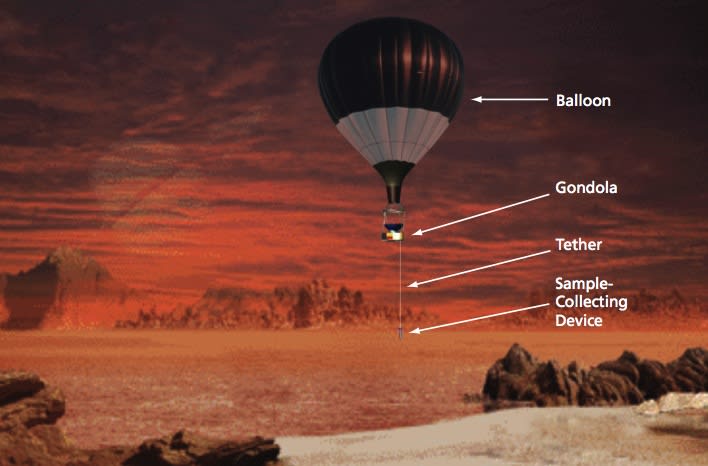
A proposed system in a gondola containing scientific instruments suspended by a balloon over the surface of the Saturn moon Titan would quickly acquire samples of rock or ice from the ground below. Prototypes of a sample-collecting device that would be a major part of the system have been tested under cryogenic and non-cryogenic conditions on Earth. Systems like this one could also be used in non-cryogenic environments on Earth to collect samples of rock, soil, ice, mud, or other ground material from such inaccessible or hazardous locations as sites of suspected chemical spills or biological contamination.
This work was done by Jack Jones, Wayne Zimmerman, and Jiunn Jenq Wu of Caltech for NASA’s Jet Propulsion Laboratory. NPO-44444
This Brief includes a Technical Support Package (TSP).
Collecting Ground Samples for Balloon- Borne Instruments
(reference NPO-44444) is currently available for download from the TSP library.
Don't have an account?
Overview
The document outlines a project led by Jack A. Jones at NASA's Jet Propulsion Laboratory, focusing on the development of a self-contained harpoon and sample handling device for remote platforms, particularly for planetary exploration missions to Titan, Mars, Venus, and other celestial bodies. The primary objective is to design a system capable of collecting surface samples, specifically targeting materials like cryogenic ice and regolith.
Key project goals include measuring penetration energies for sampling various materials, designing and testing a gravity-dropped harpoon system, and creating a pyro-activated harpoon for rapid sample acquisition. The harpoon system is intended to simulate the collection of at least 1 gram of surface material from a balloon platform hovering above Titan's surface.
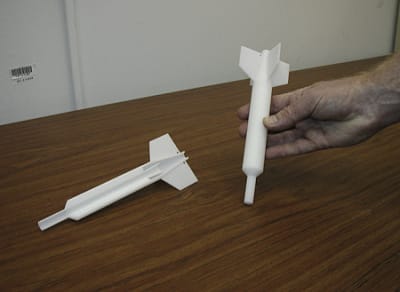
The document details the results from the fiscal year 2006, highlighting successful measurements of penetration energies for sampling ice at different temperatures and the design and testing of both gravity-drop and pyro-activated harpoon systems. The gravity-drop harpoon was tested from a height of 100 meters above Titan's surface, while the pyro-activated system demonstrated the ability to collect over 1 gram of cryogenic ice. Additionally, a tethered harpoon system was developed to allow for rapid collection and retrieval of samples.
The document also discusses the broader implications of the technology for various planetary missions. For Mars, balloon platforms are proposed to sample water ice at the north pole. For Venus, balloons are considered the most viable means to descend to the surface and return with samples. The pyro sampling devices are also applicable for in-situ analyses and sample return from comets and asteroids.
The harpoon design features a sharp point, a hollow core for sample retention, and aerodynamic fins for stability during descent. The system is engineered to operate efficiently in the challenging environments of other planets, addressing the limitations of previous sampling methods such as robotic arms and mechanical drills.
Overall, this document presents a significant advancement in planetary exploration technology, showcasing innovative solutions for sample acquisition that could enhance our understanding of extraterrestrial environments.