A family of proposed miniature sources of power would exploit the direct conversion of the kinetic energy of a particles into electricity. In addition to having long operational lives, these sources are expected to operate with energy-conversion efficiencies from 70 to 90 percent.
A power source as proposed (see figure) would be an electrolytic cell in which liquid gallium would serve as both an electrolyte and an energy-conversion medium. The cell would contain an iridium cathode and a zirconium anode. The a particles, each with a kinetic energy ~5.8 MeV, would be emitted by radioactive decay of 244Cm, which has a half-life of 18 years. The 244Cm source would be positioned so that the a particles would enter the liquid gallium, where their kinetic energy would be dissipated mostly through ionization of Ga atoms, creating Ga+ ions and free electrons. The electrons would be collected by iridium cathode, and the Ga+ ions would be neutralized at the zirconium cathode by electrons returning after flowing through an external circuit.
Gallium is a candidate for use as the electrolyte and the energy-conversion medium because in the liquid state it is a semimetal: its electrical conductivity is greater than that of a typical semiconductor but small in comparison with the conductivities of metals. Consequently, in liquid gallium, electrons and Ga+ can exist without immediate recombination and can be moved by electric fields. It is expected that electric fields, resulting at least partly from the difference between the work functions of the electrode metals, would move the electrons and ions to their respective electrodes. The open-circuit potential of the cell is expected to be 1.62 V — equal to the difference between the work functions of iridium and zirconium.
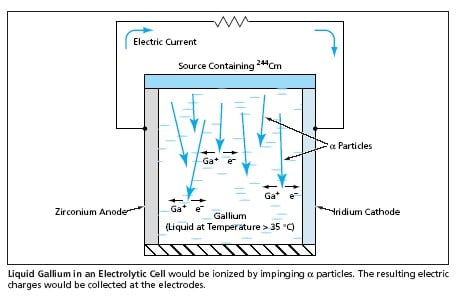 Unlike in a solid-state energy conversion medium, the impingement of energetic a particles would not give rise to displacement damage in the liquid gallium. Hence, the cell should have a long life, limited only by the half-life of 244Cm. A cell having a volume less than 25 mm3, containing 1 curie of 244Cm (the curie is a unit of radioactivity equal to 3.7 × 10¹⁰ disintegrations per second) is expected to deliver a current between 7 and 12 mA, which, at the expected open-circuit potential, would provide a power in the approximate range of 11 to 20 mW.
This work was done by Jagdish U. Patel, Jean-Pierre Fleurial, and G. Jeffrey Snyder of Caltech for NASA’s Jet Propulsion Laboratory. For further information, access the Technical Support Package (TSP) free online at www.techbriefs.com/tsp under the Physical Sciences category.
This invention is owned by NASA, and a patent application has been filed. Inquiries concerning nonexclusive or exclusive license for its commercial development should be addressed to
the Patent Counsel
NASA Management Office–JPL at (818) 354-7770.
Refer to NPO-30322.
This Brief includes a Technical Support Package (TSP).
Alpha-Voltaic Sources Using Liquid Ga as Conversion Medium
(reference NPO-30322) is currently available for download from the TSP library.
Don't have an account?
Overview
The document presents a technical overview of a miniaturized alpha-voltaic power source utilizing liquid gallium as the energy conversion medium, developed by researchers at NASA's Jet Propulsion Laboratory. This innovative device is designed to convert the kinetic energy of alpha particles emitted from the radioisotope Curium-244 into electricity, offering a highly efficient and long-lasting power solution for various applications, particularly in space exploration.
The alpha-voltaic cell operates as an electrolytic cell, where liquid gallium serves as the electrolyte. The device features iridium as the cathode and zirconium as the anode. When alpha particles, approximately 5.8 MeV in energy, collide with gallium atoms, they ionize these atoms, producing Ga⁺ ions and free electrons. The electrons are collected at the iridium cathode, while the Ga⁺ ions are neutralized at the zirconium anode, completing the electrical circuit. The open circuit voltage of the device is approximately 1.62 volts, determined by the work function difference between the two electrode materials.
One of the key advantages of this technology is its high efficiency, with the potential to convert over 90% of the alpha particle energy into electricity. The device is expected to deliver a power output of around 12.5 milliwatts, with a current of 7 mA from a typical activity of 1 Ci (3 x 10¹⁰ alpha particles per second). The long operational life of the device, limited only by the half-life of the radioisotope (18 years for Curium-244), makes it particularly suitable for high-priority NASA missions, such as those to Mars, Europa, and beyond.
The document emphasizes the unique features of this alpha-voltaic technology, including its miniaturized size, high specific power, and the absence of displacement damage due to the liquid medium, which allows for efficient energy conversion without degradation over time. These characteristics position the device as an enabling technology for self-powered electronics, distributed sensors, and other applications in long-duration space missions.
In summary, the proposed alpha-voltaic power source represents a significant advancement in energy technology, offering a reliable, efficient, and long-lasting power solution for future aerospace endeavors and potentially other commercial applications.