

The purpose of this development was to validate the use of the external Rover Ultra High Frequency (RUHF) antenna for space under extreme thermal environments to be encountered during the surface operations of the Mars Science Laboratory (MSL) mission. The antenna must survive all ground operations plus the nominal 670 Martian sol mission that includes summer and winter seasons of the Mars thermal environment. The qualification effort was to verify that theRUHF antenna design and its bonding and packaging processes are adequate to survive the harsh environmental conditions.
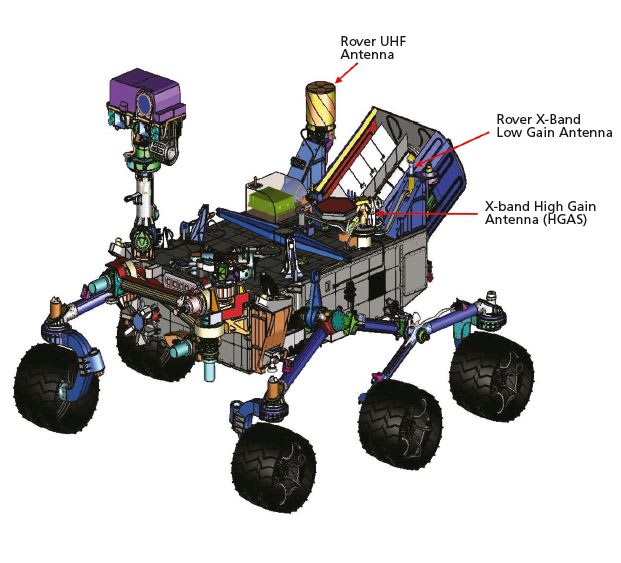
In the case of MSL rover externally mounted hardware, not only are the expected thermal cycle depths severe, but there are temperature offsets between the Mars summer and winter seasons. The total number of temperature cycles needed to be split into two regimes of summer cycles and winter cycles.
The qualification test was designed to demonstrate a survival life of three times more than all expected ground testing, plus a nominal 670 Martian sol missions. Baseline RF tests and a visual inspection were performed prior to the start of the qualification test. Functional RF tests were performed intermittently during chamber breaks over the course of the qualification test. For the RF return loss measurements, the antenna was tested in a controlled environment outside the thermal chamber with a vector network analyzer that was calibrated over the antenna’s operational frequency range.
A total of 2,010 thermal cycles were performed. Visual inspection showed a dulling of the solder material. This change will not affect the performance of the antenna. No other changes were observed. RF tests were performed on the RUHF helix antenna, hybrid, and load after the 2,010 qualification cycles test. The RF performance of the RUHF antenna, hybrid, and load were almost identical before and after the complete test. Therefore, the developed design of RUHF is qualified for a long-duration MSL mission.
The RUHF antenna has not been used for long-duration missions such as MSL in the past. The state-of-the-art technology of the RUHF antenna is used to develop the antennas for MSL mission survivability. This developmental test data provides the confidence in using this RUHF antenna for future NASA missions to Mars.
This work was done by Rajeshuni Ramesham, Luis R. Amaro, Paula R. Brown, and Robert Usiskin of Caltech for NASA’s Jet Propulsion Laboratory. NPO-48475
This Brief includes a Technical Support Package (TSP).
Qualification of UHF Antenna for Extreme Martian Thermal Environments
(reference NPO-48475) is currently available for download from the TSP library.
Don't have an account?
Overview
The document outlines the qualification of the Rover Ultra High Frequency (RUHF) antenna developed by NASA's Jet Propulsion Laboratory (JPL) for use in extreme thermal environments on Mars, specifically for the Mars Science Laboratory (MSL) mission. The RUHF antenna is designed for direct communication between the MSL rover and Earth, as well as with orbiters like Mars Reconnaissance Orbiter (MRO) and Odyssey.
The primary goal of the qualification effort was to ensure that the RUHF antenna could withstand the harsh conditions of deep space, particularly the severe temperature fluctuations experienced on Mars. The MSL mission has a planned operational lifetime of 670 Martian sols, and to meet JPL's design principles, the antenna needed to survive three times that duration, equating to 2010 thermal cycles.
To achieve this, the antenna underwent rigorous testing, including 600 thermal cycles from -130°C to +15°C to simulate Martian winter conditions and 1410 cycles from -105°C to +40°C for summer conditions. This testing regime was designed to validate the antenna's design, bonding, packaging processes, and the reliability of solder joints, ensuring no degradation in performance over the expected mission life.
Visual inspections revealed minor changes, such as dulling of the solder material and a broken rubber seal around one connector, but these did not affect the antenna's performance. Return loss tests and RF performance evaluations conducted before and after the qualification test showed almost identical results, confirming the antenna's reliability.
The successful completion of the PQV (Performance Qualification Verification) test, which included 2010 thermal cycles, demonstrated that the RUHF antenna is qualified for long-duration missions, providing confidence for its use in future NASA missions to Mars. The document emphasizes the importance of this technology for deep space exploration and its potential applications in other aerospace endeavors.
In summary, the RUHF antenna represents a significant advancement in communication technology for Mars missions, ensuring robust and reliable communication capabilities under extreme conditions, thereby enhancing the overall success of NASA's exploration efforts on the Red Planet.










