
-1
1170
30
INSIDER: Electronics & Computers
As scientists continue to hunt for a material that will make it possible to pack more transistors on a chip, new research from McGill University and Université de Montréal adds to evidence that...

INSIDER: Photonics/Optics
'Electron Camera' Reveals Nature's Fastest Processes
Using a method known as ultrafast electron diffraction (UED), a scientific instrument from the Department of Energy’s SLAC National Accelerator Laboratory reveals nature's fastest processes, including the rapid motions of atoms and molecules.
INSIDER: Electronics & Computers
Simulations Reveal Material with Record-Setting Melting Point
Using advanced computers and a computational technique to simulate physical processes at the atomic level, researchers at Brown University have predicted that a material made from hafnium, nitrogen, and carbon would have the highest known melting point: 4,400 kelvins (7,460 degrees...
INSIDER: Photonics/Optics
It’s often said that necessity is the mother of invention. Such was the case for Ames Laboratory physicist Adam Kaminski who took a challenge he was facing and turned it...

INSIDER: Photonics/Optics
A research team has realized one of the long-standing theoretical predictions in nonlinear optical metamaterials: creation of a nonlinear material that has opposite refractive...
INSIDER: Imaging
MIT has been investigating techniques for amplifying movements captured by video, but indiscernible to the human eye. The algorithms can make the human pulse visible and even recover...

INSIDER: Motion Control
When robots and humans have to work together, it often leads to problems. Researchers on the CogIMon project want to teach robots to understand the forces during the movement of an...

INSIDER: Test & Measurement
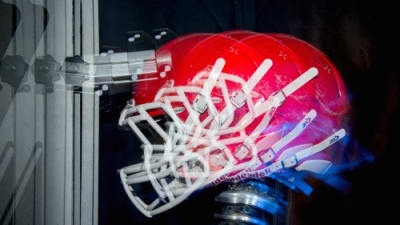
When modern football helmets were introduced, they all but eliminated traumatic skull fractures caused by blunt force impacts. Mounting evidence, however, suggests that...
INSIDER: Materials
Simulations Reveal Near-Frictionless Material
Scientists from Argonne National Laboratory used simulations to identify and improve a new mechanism for reducing friction. The resulting hybrid material exhibited superlubricity at the macroscale.
INSIDER: Energy
New Nanowires Absorb Light
Harvard University scientists have created nanowires with new useful properties. The wire not only absorbs light at specific wavelengths, but also light from other parts of the spectrum. The technology could have applications in areas ranging from consumer electronics to solar panels.
INSIDER: Lighting
Nanogenerator Harvests Power from Rolling Tires
A group of University of Wisconsin-Madison engineers and a collaborator from China have developed a nanogenerator that harvests energy from a car's rolling tire friction. The technology ultimately could provide automobile manufacturers with a new way to reuse energy and provide greater vehicle...
INSIDER: Test & Measurement
Researchers at Rice University have discovered a new way to make ultrasensitive conductivity measurements at optical frequencies on high-speed nanoscale electronic components. The...

INSIDER: Medical
An advanced driving simulator will be used to test a patient’s driving ability after cataract surgery. The trial will help determine if a newly developed artificial lens will be...

INSIDER: Test & Measurement
The first of five instruments for a spacecraft that will collect a sample from an asteroid and bring it back to Earth has arrived at Lockheed Martin for installation onto NASA’s Origins Spectral...

INSIDER: Photonics/Optics
New System Stores Solar Energy at Night
Common solar energy systems today are unable to use the generated energy at night or in cloudy conditions. A University of Texas at Arlington materials science and engineering team has developed a new energy cell that stores large-scale solar energy even when it is dark.
INSIDER: Materials
The high cost to manufacture nanofibers has relegated them to just a few niche industries. MIT researchers developed a new technique for producing nanofibers that increases the rate...
INSIDER: Materials
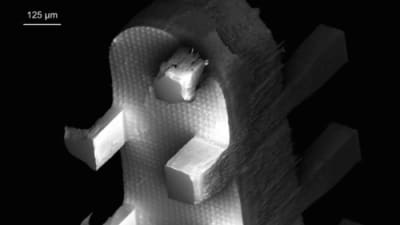
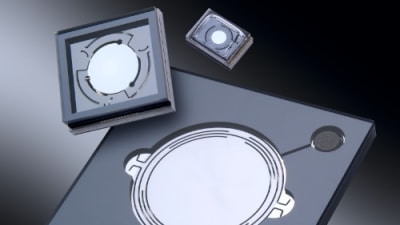
Silicon micromirrors can guide laser beams at extremely high speeds, allowing operators to dose heat input to workpieces with absolute precision. But to date, they have not been robust enough to be...
INSIDER: Energy
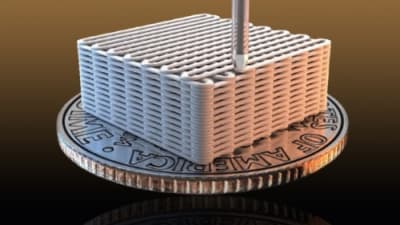
A new type of graphene aerogel will make for better energy storage, sensors, nanoelectronics, catalysis, and separations. Lawrence Livermore National Laboratory made graphene aerogel microlattices with...
INSIDER: Semiconductors & ICs
Tiny Origami Robot Folds Itself Up
MIT researchers have developed a printable origami-inspired robot that, when heated, folds itself up from a flat sheet of plastic. The robot weighs a third of a gram and measures about a centimeter from front to back.
INSIDER: Motion Control
More American homes could be powered by the Earth's natural underground heat with a new, nontoxic, and potentially recyclable liquid that is expected to use half as much water as other fluids used to tap...

INSIDER: Motion Control
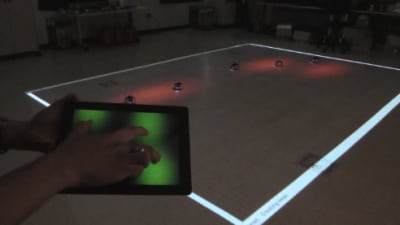
Using a tablet and a red beam of light, researchers at Georgia Tech have created a system that controls a fleet of robots with the swipe of a finger. A person taps the tablet to control where the beam...
INSIDER: Motion Control
What if handheld tools knew what needs to be done and were even able to guide and help inexperienced users to complete jobs that require skill? Researchers at the University of Bristol (UK)...

INSIDER: Electronics & Computers
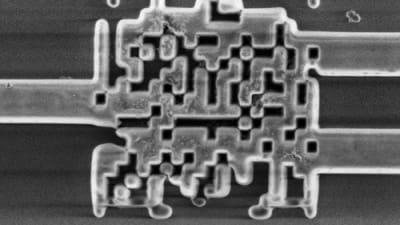
University of Utah engineers have taken a step forward in creating the next generation of computers and mobile devices capable of speeds millions of times faster than current machines. The Utah engineers have...
INSIDER: Electronics & Computers
Portable electronics — typically made of non-renewable, non-biodegradable and potentially toxic materials — are discarded at an alarming rate in consumers' pursuit of the next best...

INSIDER: Electronics & Computers
A revolution is coming in flexible electronic technologies as cheaper, more flexible, organic transistors come on the scene to replace expensive, rigid, silicone-based...

INSIDER: Energy
Engineer Creates Origami Battery
A Binghamton engineer, Seokheun "Sean" Choi, developed an inexpensive, bacteria-powered battery made from paper. Using a drop of bacteria-containing liquid, the battery generates power from microbial respiration and delivers enough energy to run a paper-based biosensor.
INSIDER: Electronics & Computers
New Computer Operates on Water Droplets
A synchronous computer from Stanford University operates using the unique physics of moving water droplets. The work combines the manipulation of droplet fluid dynamics with a fundamental element of computer science – an operating clock.
INSIDER: Medical
A new study shows that the recently developed Compact Light Source (CLS) – a commercial X-ray source with roots in research and development efforts at the Department of Energy’s SLAC National...

INSIDER: Lighting
Flexible optoelectronic devices that can be produced roll-to-roll – much like newspapers are printed – are a highly promising path to cheaper devices such as solar cells...

Top Stories
 Blog: Manufacturing & Prototyping

2025 Holiday Gift Guide for Engineers: Tech, Tools, and Gadgets
 INSIDER: Research Lab
Scientists Create Superconducting Semiconductor Material
 Blog: Software

 Quiz: Materials

 Blog: Aerospace

Tech Briefs Wrapped 2025: Top 10 Technology Stories
 Blog: Manufacturing & Prototyping

Webcasts
 Upcoming Webinars: AR/AI

The Real Impact of AR and AI in the Industrial Equipment Industry
 Upcoming Webinars: Motion Control

Next-Generation Linear and Rotary Stages: When Ultra Precision...
 Upcoming Webinars: Energy

Hydrogen Engines Are Heating Up for Heavy Duty
 Podcasts: Medical

How Wearables Are Enhancing Smart Drug Delivery
 Podcasts: Power

SAE Automotive Podcast: Solid-State Batteries
 Podcasts: Power