-1
4050
30
News: Green Design & Manufacturing
Noble metals such as platinum and palladium are becoming increasingly important because of growth in environmentally friendly applications such as fuel cells and pollution control...

Blog
Cleared for Takeoff
You just know somebody’s going to make a movie about this.
On October 22, New Mexico’s governor, Bill Richardson, presided over the dedication of what could become the world’s first commercial spaceport. And what is a spaceport, you ask? Think of it as an airport for space travelers, and apparently they’re building one...
Blog: Energy
New Energy-Efficient Design Brings the Heat
To provide an alternative to energy-inefficient, fume-heavy fire cooking, Paul Montgomery, a graduate student at Pennsylvania State University, is helping to design a better, cleaner stove for people in developing countries. Central to the design is a heat-powered fan.
Here's how the process is more...
News: Energy
The heat radiating off roadways has long been a factor in explaining why city temperatures are often considerably warmer than nearby suburban or rural areas....
Question of the Week
Should toys be kept out of a Happy Meal?
This week's Question of the Week concerns a new law in San Francisco, taking effect on Dec. 1 that bans restaurant toy giveaways unless the meals meet certain healthy standards for calories, sodium, and fat. Supporters say the move will offer better nutrition standards for children, while opponents say the...
News: Energy
With a National Science Foundation (NSF) grant, researchers from North Carolina State University are developing a cost-effective electronic monitoring system that will advance understanding of critical...
Blog
Finally! My invisible cardigan is ready!
Designing a material to cloak objects from visible light has always been a challenge -- Trust me, I've tried it many times during my childhood.
Published today, the New Journal of Physics (co-owned by the Institute of Physics and German Physical Society) details how Meta-flex, a new material designed by...
Blog
R2's Excellent Adventure
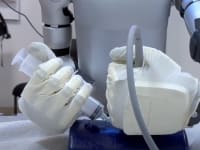
When the Space Shuttle Discovery launches tomorrow, it will carry six human -- and one non-human -- crewmembers to the International Space Station. The non-human is Robonaut 2 (R2), which is set to become the first humanoid robot in space. R2 will be unpacked several months after it arrives, and tested on the station. He...
Question of the Week
Should Congress pass the Right to Repair Act?
This week's Question of the Week, a suggestion from INSIDER reader Glenn Barkley, concerns the Right to Repair Act, a bill that would require auto manufacturers to sell to non-dealer repair shops the complete repair information and diagnostic tools, currently only provided to dealer service centers....
News: Energy
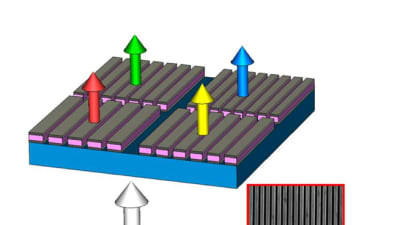
University of Michigan scientists have created pixels that will enable LED-projected and -wearable displays to be more energy efficient with more light manipulation possible -...
News: Green Design & Manufacturing
An equation developed in part by researchers at the University of Michigan could do for organic semiconductors what the Shockley ideal diode equation did for inorganic semiconductors:...

Blog
Analysts Add to Creo Conversation
Yesterday, after unveiling Creo, PTC's soon-to-arrive design application suite, the company arranged for a panel of analysts to address attendee questions about the product. The roundtable included Marc Halpern, Research VP at Gartner, Sanjeev Pal, Research Manager at IDC, and John MacKrell, a senior consultant at...
News: Lighting
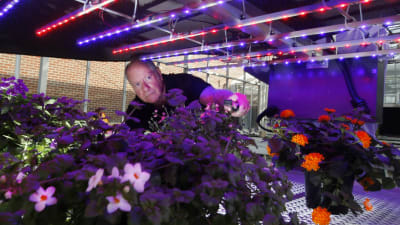
Purdue researchers will collaborate with Rutgers University, the University of Arizona, Michigan State University, and Orbital Technologies Corp. (Madison, WI) on a four-year project...
Blog: Software
Lightning Strikes With PTC's Creo
There was a bit of a crowd lining up near Boston's Park Plaza this morning, and if it wasn't for all the business-casual attire, you may have thought another Apple Store was opening up down the street. The event was actually PTC's unveiling of its new product suite: Creo.
Here's the quick rundown:
Creo is a suite...
Question of the Week: Robotics, Automation & Control
Will you drive this type of robotic car in your lifetime?
This week's Question of the Week addresses another technical development from Google. In early October, the search giant announced that it has been testing robotic cars on U.S. city streets. The vehicles, equipped with a complex array of sensors and cameras that allowed them to steer around...
Question of the Week
Should there be a large-scale freeze on foreclosures?
This week's Question of the Week addresses home foreclosures. Several major home lenders, including JP Morgan Chase and Bank of America, have suspended foreclosures in parts or all of the country because of sloppy paperwork and improper oversight of the many loans that went bad. Some say, absent...
News: Transportation
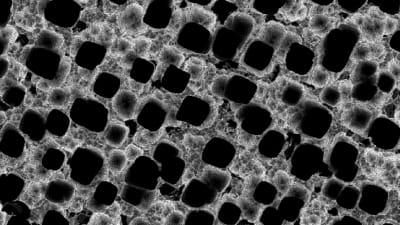
Scientists from Rice University and Lockheed Martin have discovered a way to use simple silicon to radically increase the capacity of lithium-ion batteries. The researchers are...
Question of the Week
Do you plan to buy the Google TV device?
This week's Question of the Week addresses Google TV. Engineers are putting the finishing touches on Google TV, a software platform that aims to bring the complete Internet experience to television sets. Expected in stores later this month, the Google TV device has a remote-control keyboard/pointing device...
News: Energy
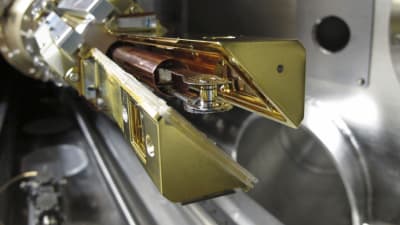
The National Ignition Facility (NIF) of Livermore, CA is home to the world's largest and highest-energy laser. On September 29th, the NIF completed its first integrated ignition...
Question of the Week
Do you have faith in the news media to provide fair, reliable information?
This week's Question of the Week concerns a recent Gallup poll that revealed that a majority of Americans (57%) say they have little or no trust in the mass media to report the news fully, accurately, and fairly. Sixty-three percent of respondents perceived bias. What do...
INSIDER: Energy
Graphite foam technology developed by James Klett of Oak Ridge National Laboratory's Materials Science and Technology Division extends the life of light-emitting diode...

INSIDER: Energy
The Office of Naval Research Global (ONR Global) continues to pursue aggressive energy goals established by Secretary of the Navy Ray Mabus, with the design of a system...

Question of the Week
Should Internet communication services be redesigned so that law enforcement can carry out legally authorized intercepts?
This week's Question of the Week focuses on the redesign of some Internet communication services. Law enforcement officials want Congress to require all services that enable communications — including encrypted e-mail...
INSIDER: Energy
Electronic products pollute the environment with a number of heavy metals before, during, and after they're used. In the U.S. alone, an estimated 70% of heavy metals in...

INSIDER: Energy
Sensors developed by researchers at the University of Washington and the Georgia Institute of Technology use residential wiring to transmit information to and from...

News: Green Design & Manufacturing
November 2011 Lighting Technology Advances in LEDs & Solid-State Lighting
August 2011 Lighting Technology Advances in LEDs & Solid-State Lighting
September 2011 May 2011 Solar & Wind PowerAlternative...
INSIDER: Power
As industries and consumers seek improved battery power sources, a new microscopy technique developed by Oak Ridge National Laboratory (ORNL) researchers is providing a novel...

Question of the Week
Should smartphones be used as learning tools in the classroom?
This week's Question of the Week focuses on smartphones in the classroom. Ontario Premier Dalton McGuinty recently suggested students should be allowed to use smartphones in the classroom, saying that the devices have a variety of helpful educational tools -- calendars, planners, and...
News: Energy
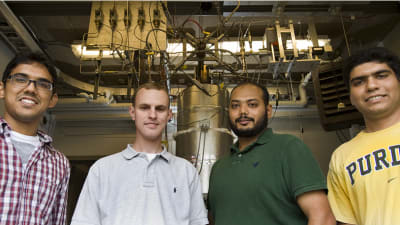
Purdue University researchers have developed a facility aimed at learning precisely how coal and biomass are broken down in reactors called gasifiers as part of a project to strengthen the scientific...
Top Stories
 Blog: Lighting

A Stretchable OLED that Can Maintain Most of Its Luminescence
 Blog: Energy

Batteries that Can Withstand the Cold
 INSIDER: Energy

Advancing All-Solid-State Batteries
 Blog: Power

My Opinion: We Need More Power Soon — Is Nuclear the Answer?
 Quiz: Power

 Blog: Data Acquisition

Webcasts
 Upcoming Webinars: Test & Measurement

From Spreadsheets to Insights: Fast Data Analysis Without Complex...
 Upcoming Webinars: Aerospace

Cooling a New Generation of Aerospace and Defense Embedded...
 Upcoming Webinars: Sensors/Data Acquisition

Beyond AI-Copy-Paste Engineering: Advanced AI-Integration Success...
 Upcoming Webinars: Energy

Battery Abuse Testing: Pushing to Failure
 Upcoming Webinars: Power

A FREE Two-Day Event Dedicated to Connected Mobility
 Upcoming Webinars: RF & Microwave Electronics

Choosing the Right N-Port Strategy: Multiport VNAs vs. Switch...