42
-1
1020
30
Briefs: Software
The Autonomous Exploration for Gathering Increased Science System (AEGIS) provides automated targeting for remote sensing instruments on the Mars Exploration Rover (MER) mission, which at...

Briefs: Software
Space Images for NASA/JPL is an Apple iPhone application that allows the general public to access featured images from the Jet Propulsion Laboratory (JPL). A back-end infrastructure stores, tracks, and retrieves space...

Briefs: Software
Real-Time Feature Tracking Using Homography
This software finds feature point correspondences in sequences of images. It is designed for feature matching in aerial imagery. Feature matching is a fundamental step in a number of important image processing operations: calibrating the cameras in a camera array, stabilizing images in aerial movies,...
Briefs: Software
Stereo Imaging Tactical Helper
The Stereo Imaging Tactical Helper (SITH) program displays left and right images in stereo using the display technology made available by the JADIS framework, which was described in “JAVA Stereo Display Toolkit,” NASA Tech Briefs, Vol. 32, No. 4 (April 2008), page 63. An overlay of the surface described by the...
Briefs: Software
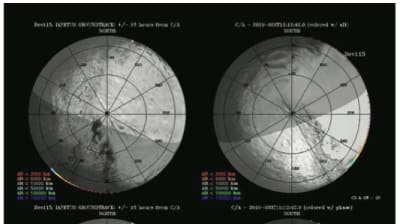
XMbodyinfo was designed to evaluate potential reference trajectories, providing a proficient way to assess the quality of all satellite body flybys for a Cassini type mission tour. It is autonomous and will generate a variety of ORS...
Briefs: Software
Software was developed that automatically detects minerals that are present in each pixel of a hyperspectral image. An algorithm based on sparse spectral unmixing with Bayesian...

Briefs: Software
Over 150 years ago, Faraday provided the first comprehensive scientific study on the physics of burning candles. Complex combustion driven by the rate at which gases diffuse through each other produces...

Briefs: Software
Plasmas consist of electrons, ions, and neutral species interacting with each other and with externally imposed electromagnetic fields. Plasma etching and deposition of thin films are critical...

Briefs: Software
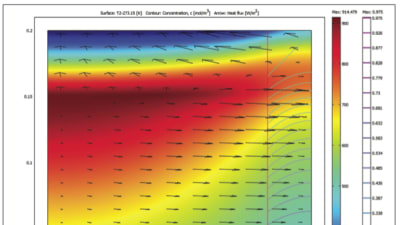
SYNGAS specializes in thermal and micro-thermal technology, and designs and analyzes pre-production heating, cooling, and thermal insulation systems for a...
Briefs: Software
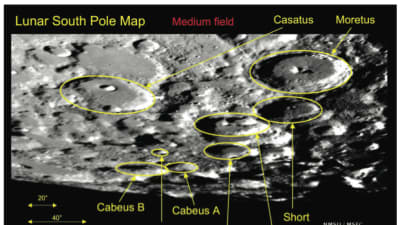
In 1999, NASA’s Lunar Prospector revealed concentrated hydrogen signatures detected in permanently shadowed craters at the lunar poles. While scientists have long speculated about the source of vast quantities...
Briefs: Software
TEAMS Model Analyzer
The TEAMS model analyzer is a supporting tool developed to work with models created with TEAMS (Testability, Engineering, and Maintenance System), which was developed by QSI.
Briefs: Software
MIRO Computational Model
A computational model calculates the excitation of water rotational levels and emission-line spectra in a cometary coma with applications for the Microwave Instrument for Rosetta Orbiter (MIRO). MIRO is a millimeter-submillimeter spectrometer that will be used to study the nature of cometary nuclei, the physical processes...
Briefs: Software
Team Collaboration Software
The Ground Resource Allocation and Planning Environment (GRAPE 1.0) is a Web-based, collaborative team environment based on the Microsoft SharePoint platform, which provides Deep Space Network (DSN) resource planners’ tools and services for sharing information and performing analysis. The foundation platform for GRAPE...
Briefs: Software
Comet Gas and Dust Dynamics Modeling
This software models the gas and dust dynamics of comet coma (the head region of a comet) in order to support the Microwave Instrument for Rosetta Orbiter (MIRO) project. MIRO will study the evolution of the comet
67P/Churyumov-Gerasimenko’s coma system. The instrument will measure surface temperature,...
Briefs: Software
Online Planning Algorithm
AVA v2 software selects goals for execution from a set of goals that oversubscribe shared resources. The term “goal” refers to a science or engineering request to execute a possibly complex command sequence, such as image targets or ground-station downlinks.
Briefs: Software
AutoGNC Testbed
A simulation testbed architecture was developed and implemented for the integration, test, and development of a TRL-6 flight software set called AutoGNC. The AutoGNC software will combine the TRL-9 Deep Impact AutoNAV flight software suite, the TRL-9 Virtual Machine Language (VML) executive, and the TRL-3 G-REX guidance, estimation,...
Briefs: Software
Optical Imaging and Radiometric Modeling and Simulation
OPTOOL software is a general-purpose optical systems analysis tool that was developed to offer a solution to problems associated with computational programs written for the James Webb Space Telescope optical system. It integrates existing routines into coherent processes, and provides a...
Briefs: Software
Automated Computer Access Request System
The Automated Computer Access Request (AutoCAR) system is a Web-based account provisioning application that replaces the time-consuming paper-based computer-access request process at Johnson Space Center (JSC). AutoCAR combines rules-based and role-based functionality in one application to provide a...
Briefs: Software
Range Safety for an Autonomous Flight Safety System
The Range Safety Algorithm software encapsulates the various constructs and algorithms required to accomplish Time Space Position Information (TSPI) data management from multiple tracking sources, autonomous mission mode detection and management, and flight-termination mission rule evaluation. The...
Briefs: Software
Fast and Easy Searching of Files in Unisys 2200 Computers
A program has been written to enable (1) fast and easy searching of symbolic files for one or more strings of characters, dates, or numerical values in specific fields or columns and (2) summarizing results of searching other fields or columns. Intended for use in Unisys 2200-series...
Briefs: Software
Parachute Drag Model
DTV-SIM is a computer program that implements a mathematical model of the flight dynamics of a missile-shaped drop test vehicle (DTV) equipped with a multistage parachute system that includes two simultaneously deployed drogue parachutes and three main parachutes deployed subsequently and simultaneously by use of pilot...
Briefs: Software
Evolutionary Scheduler for the Deep Space Network
A computer program assists human schedulers in satisfying, to the maximum extent possible, competing demands from multiple spacecraft missions for utilization of the transmitting/receiving Earth stations of NASA’s Deep Space Network. The program embodies a concept of optimal scheduling to attain...
Briefs: Software
Integrating Radar Image Data With Google Maps
A public Web site has been developed as a method for displaying the multitude of radar imagery collected by NASA’s Airborne Synthetic Aperture Radar (AIR-SAR) instrument during its 16-year mission. Utilizing NASA’s internal AIRSAR site, the new Web site features more sophisticated visualization...
Briefs: Software
Mercury Toolset for Spatiotemporal Metadata
Mercury http://mercury.ornl.gov is a set of tools for federated harvesting, searching, and retrieving metadata, particularly spatiotemporal metadata. Version 3.0 of the Mercury toolset provides orders of magnitude improvements in search speed, support for additional metadata formats, integration with...
Briefs: Software
Social Tagging of Mission Data
Mars missions will generate a large amount of data in various forms, such as daily plans, images, and scientific information. Often, there is a semantic linkage between images that cannot be captured automatically. Software is needed that will provide a method for creating arbitrary tags for this mission data so that...
Briefs: Software
Public Risk Assessment Program
The Public Entry Risk Assessment (PERA) program addresses risk to the public from shuttle or other spacecraft re-entry trajectories. Managing public risk to acceptable levels is a major component of safe spacecraft operation. PERA is given scenario inputs of vehicle trajectory, probability of failure along that...
Briefs: Software
Particle Swarm Optimization Toolbox
The Particle Swarm Optimization Toolbox is a library of evolutionary optimization tools developed in the MAT-LAB environment. The algorithms contained in the library include a genetic algorithm (GA), a single-objective particle swarm optimizer (SOPSO), and a multi-objective particle swarm optimizer (MOPSO)....
Briefs: Software
Telescience Support Center Data System Software
The Telescience Support Center (TSC) team has developed a database-driven, increment-specific Data Requirement Document (DRD) generation tool that automates much of the work required for generating and formatting the DRD. It creates a database to load the required changes to configure the TSC data...
Briefs: Software
Update on PISCES
An updated version of the Platform Independent Software Components for the Exploration of Space (PISCES) software library is available. A previous version was reported in “Library for Developing Spacecraft-Mission-Planning Software” (MSC-22983), NASA Tech Briefs, Vol. 25, No. 7 (July 2001), page 52. To recapitulate: This...
Top Stories
 Blog: Power

My Opinion: We Need More Power Soon — Is Nuclear the Answer?
 Blog: AR/AI

Aerial Microrobots That Can Match a Bumblebee's Speed
 News: Energy

 Blog: Electronics & Computers

Turning Edible Fungi into Organic Memristors
 Blog: Robotics, Automation & Control

Microscopic Swimming Machines that Can Sense, Respond to Surroundings
 INSIDER: Sensors/Data Acquisition
Webcasts
 Upcoming Webinars: Automotive

Hydrogen Engines Are Heating Up for Heavy Duty
 Upcoming Webinars: Transportation

Advantages of Smart Power Distribution Unit Design for Automotive...
 Upcoming Webinars: Transportation

Quiet, Please: NVH Improvement Opportunities in the Early Design...
 Upcoming Webinars: Sensors/Data Acquisition

From Spreadsheets to Insights: Fast Data Analysis Without Complex...
 Upcoming Webinars: Test & Measurement

Battery Abuse Testing: Pushing to Failure
 Upcoming Webinars: Transportation