

New designs, and materials appropriate for such designs, are under investigation in an effort to develop coronagraph occulting masks having broad-band spectral characteristics superior to those currently employed. These designs and materials are applicable to all coronagraphs, both ground-based and spaceborne. This effort also offers potential benefits for the development of other optical masks and filters that are required (1) for precisely tailored spatial transmission profiles, (2) to be characterized by optical-density neutrality and phase neutrality (that is, to be characterized by constant optical density and constant phase over broad wavelength ranges), and/or (3) not to exhibit optical-density-dependent phase shifts.
The need for this effort arises for the following reasons:
- Coronagraph occulting masks are required to impose, on beams of light transmitted through them, extremely precise control of amplitude and phase according to carefully designed transmission profiles.
- In the original application that gave rise to this effort, the concern has been to develop broad-band occulting masks for NASA’s Terrestrial Planet Finder coronagraph. Until now, experimental samples of these masks have been made from high-energy-beam-sensitive (HEBS) glass, which becomes locally dark where irradiated with a high-energy electron beam, the amount of darkening depending on the electron-beam energy and dose. Precise mask profiles have been written on HEBS glass blanks by use of electron beams, and the masks have performed satisfactorily in monochromatic light. However, the optical-density and phase profiles of the HEBS masks vary significantly with wavelength; consequently, the HEBS masks perform unsatisfactorily in broad-band light.
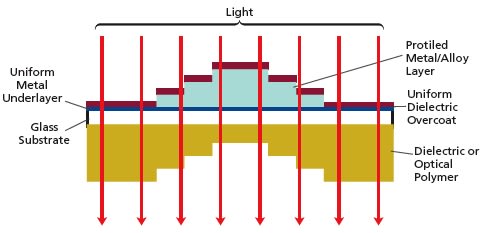
A mask as now envisioned would include thin metal and dielectric films having stepped or smoothly varying thicknesses (see figure). The thicknesses would be chosen, taking account of the indices of refraction and extinction coefficients, to obtain an acceptably close approximation of the desired spatial transmittance profile with a flat phase profile.
This work was done by Kunjithapatham Balasubramanian of Caltech for NASA’s Jet Propulsion Laboratory. For more information, contact







