Stories
39
121
0
1590
30
Briefs: Mechanical & Fluid Systems
Phase-oriented gear systems are differential planetary transmissions in which each planet gear has two sets of unequal numbers of teeth indexed at prescribed relative angles (phases). The figure illustrates an...

Briefs: Mechanical & Fluid Systems
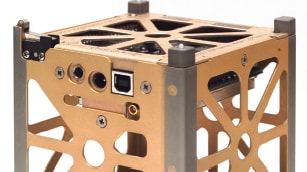
The CubeSat standard (10 × 10 × 10 cm and weighing 1kg) has evolved into one of the most widely accepted families of picosatellite designs. A CubeSat can...
Who's Who: Software
The Inductive Monitoring System (IMS) is a new computer program that monitors gyroscopes that keep the International Space Station properly oriented in space. IMS...
Briefs: Mechanical & Fluid Systems
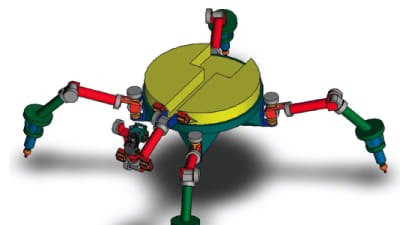
The figure depicts the steep terrain access robot (STAR) — a walking robot that has been proposed for exploring steep terrain on remote planets. Robots based on the STAR concept could also be used on steep...
Briefs: Mechanical & Fluid Systems
Measuring Dynamic Transfer Functions of Cavitating Pumps
A water-flow test facility has been built to enable measurement of dynamic transfer functions (DTFs) of cavitating pumps and of inducers in such pumps. Originally, the facility was intended for use in an investigation of the effects of cavitation in a rocket-engine low-pressure oxygen...
Briefs: Mechanical & Fluid Systems
Capacitors Would Help Protect Against Hypervelocity Impacts
A proposal investigates alternatives to the present "bumper" method of protecting spacecraft against impacts of meteoroids and orbital debris. The proposed method is based on a British highvoltage- capacitance technique for protecting armored vehicles against shapedcharge warheads.
Briefs: Mechanical & Fluid Systems
Improved Quick-Release Pin Mechanism
An improved quick-release pin mechanism supplants a prior such mechanism in which the pin bears a shear load to hold two objects together. The prior mechanism, of a ball-locking design, can fail when vibrations cause balls to fall out. The load-bearing pin is an outer tube with a handle at one end (hereafter...
Briefs: Mechanical & Fluid Systems
Launching Payloads Into Orbit at Relatively Low Cost
A report proposes the development of a system for launching payloads into orbit at about one-fifth the cost per unit payload weight of current systems. The system would be based on the formerly secret PILOT micro-satellite-launching system developed in response to the Soviet launch of Sputnik-1....
Briefs: Mechanical & Fluid Systems
Injection of working fluid into a centrifugal compressor in the reverse tangent direction has been invented as a way of preventing flow instabilities (stall and surge) or restoring stability...

Briefs: Mechanical & Fluid Systems
A diaphragm pump driven by a piezoelectric actuator is undergoing development. This pump is intended to be a prototype of lightweight, highly reliable pumps for circulating cooling liquids in...

Briefs: Mechanical & Fluid Systems
Rover Wheel-Actuated Tool
A report describes an interface for utilizing some of the mobility features of a mobile robot for general-purpose manipulation of tools and other objects. The robot in question, now undergoing conceptual development for use on the Moon, is the All-Terrain Hex-Limbed Extra-Terrestrial Explorer (ATHLETE) rover, which is...
Briefs: Mechanical & Fluid Systems
Cobra Probes Containing Replaceable Thermocouples
A modification of the basic design of cobra probes provides for relatively easy replacement of broken thermocouples. [Cobra probes are standard tube-type pressure probes that may also contain thermocouples and that are routinely used in wind tunnels and aeronautical hardware. They are so named...
Briefs: Mechanical & Fluid Systems
Railguns, which propel a projectile using electromagnetic forces instead of chemical explosions, promise to revolutionize projectile launchers. Such guns have been...

Briefs: Mechanical & Fluid Systems
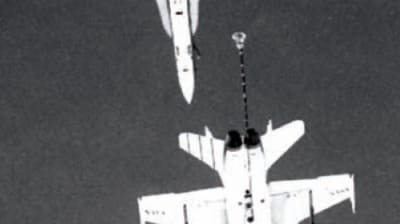
The recent introduction of uninhabited aerial vehicles [UAVs (basically, remotely piloted or autonomous aircraft)] has spawned new developments in autonomous operation and posed new challenges....
Blog: Mechanical & Fluid Systems
Techs of the Week
An electromagnetic actuator is a highly sensitive motion control device that employs more reliable and cleaner electromagnetic technologies to replace slower, less precise, larger, noisier, and environmentally unfriendly hydraulic omponents. This patented technology uses an armature in the form of a piston that moves on its own...
Briefs: Mechanical & Fluid Systems
Efficient Optimization of Low-Thrust Spacecraft Trajectories
A paper describes a computationally efficient method of optimizing trajectories of spacecraft driven by propulsion systems that generate low thrusts and, hence, must be operated for long times. A common goal in trajectory-optimization problems is to find minimum-time, minimum-fuel, or...
Briefs: Mechanical & Fluid Systems
Algorithm Optimally Allocates Actuation of a Spacecraft
A report presents an algorithm that solves the following problem: Allocate the force and/or torque to be exerted by each thruster and reaction-wheel assembly on a spacecraft for best performance, defined as minimizing the error between (1) the total force and torque commanded by the spacecraft...
Briefs: Mechanical & Fluid Systems
During a vehicle's braking action, a wheel's kinetic energy is transformed into heat, which doesn't dissipate fast enough into the air stream from the brake to...

Briefs: Mechanical & Fluid Systems
Pseudo-Waypoint Guidance for Proximity Spacecraft Maneuvers
A paper describes algorithms for guidance and control (G&C) of a spacecraft maneuvering near a planet, moon, asteroid, comet, or other small astronomical body. The algorithms were developed following a model- predictive-control approach along with a convexification of the governing...
Briefs: Mechanical & Fluid Systems
Update on Controlling Herds of Cooperative Robots
A document presents further information on the subject matter of “Controlling Herds of Cooperative Robots” (NPO-40723), NASA Tech Briefs, Vol. 30, No. 4 (April 2006), page 81. To recapitulate: A methodology for controlling a herd of cooperative and autonomous mobile robots exploring the surface...
Briefs: Mechanical & Fluid Systems
Simulation and Testing of Maneuvering of a Planetary Rover
A report discusses the development of a computational model of a Mars Explorer Rover maneuvering across terrain under varying conditions. The model is used to increase understanding of the rover dynamics. Increased understanding is helpful in planning further tests and in extending the...
Briefs: Mechanical & Fluid Systems
An apparatus has been designed and built for testing the effects, on moderatesized objects, of cushioned decelerations having magnitudes ranging up to several hundred g [where g = normal Earth gravitational...

Briefs: Mechanical & Fluid Systems
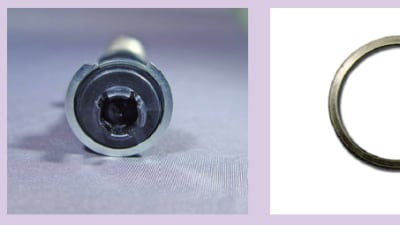
A discussion of retaining rings inevitably must begin with a debunking of myths; namely, that one style of retaining ring will function better than all other types in all instances. No one...
Briefs: Mechanical & Fluid Systems
Development of Vapor-Phase Catalytic Ammonia Removal System
A report describes recent accomplishments of a continuing effort to develop the vapor-phase catalytic ammonia removal (VPCAR) process for recycling wastewater for consumption by humans aboard a spacecraft in transit to Mars. The VPCAR process is implemented by a system of highly integrated...
Briefs: Mechanical & Fluid Systems
Several Developments in Space Tethers
Five reports address different aspects of development of tethers to be deployed from spacecraft in orbit around the Earth. The first report discusses proposed optoelectronic tracking of retroreflective objects located at intervals or of retroreflective coats along the entire length of a tether to measure...
Briefs: Mechanical & Fluid Systems
Design Concept for a Nuclear Reactor-Powered Mars Rover
A report presents a design concept for an instrumented robotic vehicle (rover) to be used on a future mission of exploration of the planet Mars. The design incorporates a nuclear fission power system to provide long range, long life, and high power capabilities unachievable through the use of...
Briefs: Mechanical & Fluid Systems
Formation-Initialization Algorithm for N Spacecraft
A paper presents an algorithm to initialize a formation of N distributed spacecraft in deep space. Such formations will enable variable-baseline interferometers in future NASA missions designed to study the structure and origin of the universe. The algorithm described in the paper reflects some...
Briefs: Mechanical & Fluid Systems
A proposed electromechanical display system would be capable of presenting as many as six distinct messages. This system would be a more capable and more complex successor to the proposed system...

Briefs: Mechanical & Fluid Systems
A streamliner motorcycle designed and built by Sierra Design Engineering and BUB Enterprises achieved a new world-record speed of 350.884 miles per hour last year at the Bonneville Salt...
Top Stories
 Blog: Lighting

A Stretchable OLED that Can Maintain Most of Its Luminescence
 Blog: Energy

Batteries that Can Withstand the Cold
 INSIDER: Energy

Advancing All-Solid-State Batteries
 Blog: Power

My Opinion: We Need More Power Soon — Is Nuclear the Answer?
 Quiz: Power

 Blog: Data Acquisition

Webcasts
 Upcoming Webinars: Test & Measurement

From Spreadsheets to Insights: Fast Data Analysis Without Complex...
 Upcoming Webinars: Defense

Cooling a New Generation of Aerospace and Defense Embedded...
 Upcoming Webinars: AR/AI

Beyond AI-Copy-Paste Engineering: Advanced AI-Integration Success...
 Upcoming Webinars: Automotive

Battery Abuse Testing: Pushing to Failure
 Upcoming Webinars: Connectivity

A FREE Two-Day Event Dedicated to Connected Mobility
 Upcoming Webinars: RF & Microwave Electronics

Choosing the Right N-Port Strategy: Multiport VNAs vs. Switch...