
Stories
48
-1
1710
30
INSIDER: Energy
New Materials Enable Flapping Robotic Wings
Dielectric elastomers, popular materials in robotic hands, soft robots, tunable lenses, and pneumatic valves, may now be used to create flapping robotic wings.
Briefs: Sensors/Data Acquisition
MMOD Risk Mitigation Technology for Spacecraft Thermal Protection Systems
The proposed concept uses sensors to detect high-temperature plasma ingestion during entry through a breach in the thermal protection system (TPS) caused by a micrometeoroid orbital debris (MMOD) impact. It uses consumables usually available on human-rated spacecraft such as...
Briefs: Sensors/Data Acquisition
Acompact shock-sensing device, which employs an innovative light sheet generator, has been created. The device may be used either as a solo aerodynamic shock detector or in combination with a scanning mode shock sensor....

Briefs: Materials
High-Performance Photocatalytic Oxidation Reactor System
As crewed space missions extend beyond low Earth orbit, the need to reliably recover potable water is critical. Aboard the International Space Station (ISS), the water is recycled from cabin humidity condensate, urine distillate, and hygiene wash wastes. In spacecraft cabin air environments,...
Briefs: Mechanical & Fluid Systems
ACS Anchor Guide Stud and Caddy
An alignment guide and a mounting interface for two of the repair tools on orbit during the Hubble Space Telescope Servicing Mission 4 (see SM4) were developed. This design can be installed in a timely manner, and was specifically developed for a worksite with minimal access and minimal visual line-of-sight to the...
Briefs: Mechanical & Fluid Systems
Next-Generation, Lightweight Hard Upper Torso/Hatch Assembly
The current MK-III carbon-graphite/epoxy Hard Upper Torso (HUT)/hatch assembly represented an 8.3 psi (≈57 kPa) technology demonstrator model of a zero pre-breathe suit. In this configuration, the MK-III suit weighed about 120 lb (≈54 kg). Since future lunar/planetary suits will need...
Briefs: Mechanical & Fluid Systems
Elastic Deployable Composite Tubular Roll-Out Boom
The objective of this work was to develop an innovative deployable boom/structure technology that is ultra-lightweight (<30-grams/meter potential), and has extremely compact stowage volume (>100:1 compaction ratio), broad scalability (no size limits envisioned), high deployed frequency, high...
Briefs: Aerospace
Performing Launch Depressurization Test on Large Test Articles Using Two Vacuum Chambers in Tandem
Two vacuum chambers were used in tandem to perform a launch depressurization test. The test article was mounted in a 10-ft (≈3 m) Vertical Vacuum Chamber (Chamber 248-10). The 25-ft (≈7.6-m) Space Simulator (Chamber 150-25) was rough-pumped and...
Briefs: Mechanical & Fluid Systems
Pyramid Micro-Electrofluidic-Spray Propulsion Thruster with Integrated Attitude and Thrust Vector Control
A micro-electrofluidic-spray propulsion (MEP) system was built on a micro scale, in which arrays of hundreds of nano-thrusters are etched on silicon wafers like ICs, only a centimeter on a side. Many dozens of these thruster chips can be...
Briefs: Aerospace
Sample return missions have the ability to vastly increase scientific understanding of the origin, history, current status, and resource potential of solar system objects including asteroids,...
Application Briefs: Photonics/Optics
Reverse engineering and inspection software Verisurf Software Anaheim, CA 714-970-1683 www.verisurf.com
In spaceflight, the first eight minutes are critical. This is when...
Briefs: Aerospace
The work described here is part of the U.S. Air Force-sponsored Operational Based Vision Assessment (OBVA) program that has been tasked with developing a high-fidelity flight...

Briefs: Aerospace
Ad Hoc Adaptive Pitch Axis Pilot Model
Flight research has shown that adaptive flight control systems can be susceptible to adverse pilot-controller interactions, including pilot-in-the-loop oscillations (PIO). Conventional PIO analysis is performed using a static pilot model and a linear, time-invariant model of the aircraft and its control...
Briefs: Aerospace
Development of a Turnkey Clear Air Turbulence Detection System
Currently, the only available means of reporting clear air turbulence (CAT) is the pilot report (PIREP), whereby a pilot experiencing turbulence reports their location and associated data. In this report, a system is proposed that would allow the detection of CAT through infrasonic...
Briefs: Manufacturing & Prototyping
Lunar Cold Trap Contamination by Landing Vehicles
The emerging interest in lunar mining poses a threat of contamination to pristine craters at the lunar poles, which act as cold traps for water, and may harbor other valuable minerals. Lunar Prospector type missions will be looking for volatile (molecular) compounds that may be masked by the exhaust...
Briefs: Aerospace
Delay Tolerant Networking Contact Graph Routing MACHETE Model
This simulation environment of Contact Graph Routing that uses the QualNet network simulator leverages the previously developed space communication models. This software models the Contact Graph Routing (CGR) system proposed for future NASA missions and used in DINETl and DINET2...
Briefs: Test & Measurement
Miniature Laser Magnetometer
Space missions using magnetometers have been very successful. However, science missions now require higher levels of accuracy and stability in order to refine existing understanding and improve modeling. In most space missions that require high-accuracy vector measurement of magnetic fields, a separate scalar...
Briefs: Physical Sciences
Hydrogen Peroxide for Microbial Growth Control in Space Potable Water Systems
NASA uses a biocide to prevent contamination of astronaut drinking water with harmful microorganisms. Concerns have arisen over existing biocides — that they’re inadequately effective, and may have toxic side effects when consumed. New microbial control methods are a...
News: Imaging
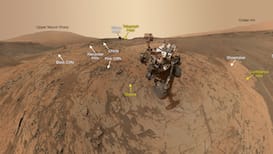
A sweeping view of the "Pahrump Hills" outcrop on Mars, where NASA's Curiosity rover has been working for five months, surrounds the rover in Curiosity's latest self-portrait. The selfie is assembled from...
News: Imaging
During 10 years of discovery, NASA's Cassini spacecraft has pulled back the smoggy veil that obscures the surface of Titan, Saturn's largest moon. Thanks to a recently developed...

Articles: Sensors/Data Acquisition
The technologies NASA develops don’t just blast off into space. They also improve our lives here on Earth. Life-saving search-and-rescue tools, implantable medical devices, advances in commercial aircraft safety,...

Application Briefs: Aerospace
SSL 1300 commercial satellite bus Space Systems/Loral Palo Alto, CA 650-852-4000 www.sslmda.com
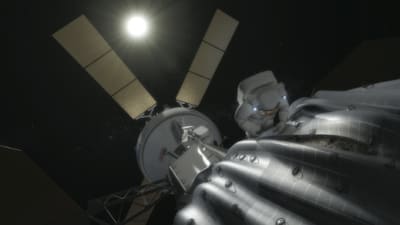
NASA continues to advance the journey to Mars through progress on the Asteroid...
Application Briefs: Sensors/Data Acquisition
Data recorders and software Diversified Technical Systems (DTS) Seal Beach, CA 562-493-0158 www.dtsweb.com
It’s no simple task to travel 3,600 miles into space, blaze back through Earth’s...

Articles: Imaging
Visual Flight Rules (VFR) define a minimum of clear weather conditions under which a pilot can operate an aircraft using visual cues, such as the horizon and buildings. Under VFR, a...

Articles: Aerospace
On April 24, 1990, something happened that forever altered mankind’s view of the universe. It was on that day that the Hubble Space Telescope (HST) was launched into space aboard the Space Shuttle Discovery.

Podcasts: Aerospace
Interview with Jim Odom, Hubble Project Manager 1983-1986
Jim Odom served as project manager on the Hubble Space Telescope from 1983 to 1986. As the world celebrates Hubble’s 25th anniversary, Mr. Odom shared some of his experiences on the project.
Application Briefs: Imaging
The United States government spends a lot of money on its defense programs, investing in the training and technology necessary to arm and prepare the most advanced fighting force on the planet. The price tag for...

News: Aerospace
NASA and Microsoft have teamed up to develop software called OnSight, a new technology that will enable scientists to work virtually on Mars using wearable technology called...

Briefs: Information Technology
Modeling for Partitioned and Multicore Flight Software Systems
The current flight software approach is monolithic in nature. Every module has tentacles that reach deep within dozens of other software modules. Because of these interdependencies between modules, functionality is difficult to extract and reuse for other missions.
Top Stories
 Blog: Manufacturing & Prototyping

2025 Holiday Gift Guide for Engineers: Tech, Tools, and Gadgets
 INSIDER: Research Lab

Scientists Create Superconducting Semiconductor Material
 Blog: Software

 Quiz: Materials

 Blog: Aerospace

Tech Briefs Wrapped 2025: Top 10 Technology Stories
 Blog: Manufacturing & Prototyping

Webcasts
 Upcoming Webinars: AR/AI

The Real Impact of AR and AI in the Industrial Equipment Industry
 Upcoming Webinars: Motion Control

Next-Generation Linear and Rotary Stages: When Ultra Precision...
 Upcoming Webinars: Energy

Hydrogen Engines Are Heating Up for Heavy Duty
 Podcasts: Medical

How Wearables Are Enhancing Smart Drug Delivery
 Podcasts: Power

SAE Automotive Podcast: Solid-State Batteries
 Podcasts: Power