Stories
48
-1
2010
30
Application Briefs: Aerospace
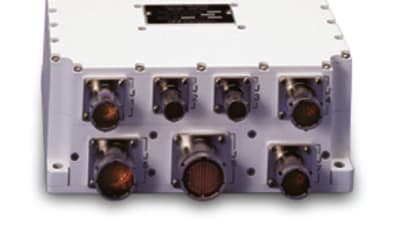
Ares I First Stage Avionics Subsystem Line-Replaceable Units L-3 Communications, Cincinnati Electronics Mason, OH 513-573-6505 www.L-3Com.com/ce
L-3...
News: Aerospace
This year, NASA celebrates its 50th anniversary, which will be observed on October 1. All year, NASA Tech Briefs will join in the celebration, highlighting technology innovations and epic moments in NASA...

Who's Who: Sensors/Data Acquisition
Using NASA's Cosmic Background Explorer (COBE) satellite to measure microwaves and infrared light that originated with the formation of the universe, Dr. John C. Mather helped...
Briefs: Energy
CHEM-Based Self-Deploying Planetary Storage Tanks
A document proposes self-deploying storage tanks, based on the cold elastic hibernated memory (CHEM) concept, to be used on remote planets. The CHEM concept, described in previous NASA Tech Briefs articles, involves the use of open-cell shape-memory-polymer (SMP) foam sandwich structures to make...
Blog: Materials
Small Strength
Researchers at Rensselaer Polytechnic Institute have developed a new technique for identifying and repairing small, potentially dangerous cracks in aircraft wings and other structures made from polymer composites. By infusing a polymer with electrically conductive carbon nanotubes, and then monitoring the structure's electrical...
Who's Who: Software
The Inductive Monitoring System (IMS) is a new computer program that monitors gyroscopes that keep the International Space Station properly oriented in space. IMS...
Blog: Transportation
Smooth Flying
A new turbulence detection system alerts pilots to patches of rough air as they fly through clouds. The system, designed by the National Center for Atmospheric Research (NCAR) and tested by United Airlines on commercial flights, is designed to better protect passengers from injuries caused by turbulence while reducing flight delays...
Blog: Aerospace
To The Moon
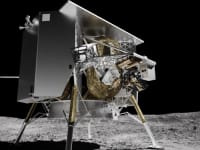
The X PRIZE Foundation and Google announced the Google Lunar X PRIZE, a robotic race to the Moon to win a $30 million prize. Private companies from around the world will compete to land a privately funded robotic rover on the Moon that is capable of completing several mission objectives, including roaming the lunar surface for at least...
Briefs: Software
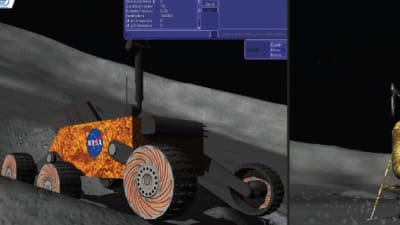
DSS-Prototyper is an open-source, real-time 3D virtual environment software that supports design simulation for the new Vision for Space Exploration (VSE). This is a simulation of NASA's proposed Robotic...
Who's Who: Regulations/Standards
NASA's IPP provides leveraged technology for NASA's mission directorates, programs, and projects through investments and technology partnerships with industry,...

Who's Who: Nanotechnology
NASA recently tested the Nano ChemSensor, the first nanotechnology- based electronic device to fly in space. The test showed that the sensor could monitor trace gases inside a...
Who's Who: Aerospace
NASA plans to return to the Moon by 2020. For a sustained lunar presence, however, astronauts need habitats that can support them and their experments. To this end, researchers...

Blog: Software
NASA Innovative Partnership
As part of NASA's Partnership Seed Fund program, Goddard Space Flight Center is integrating the ILIADS software, a geospatial information system (GIS) it developed for lunar applications, with Questus(TM), a management and planning software tool developed by United Space Alliance (USA) for space shuttle operations. The...
Who's Who: Aerospace
Supersonic speed would allow travelers to cut significantly their travel time. However, because of the resulting sonic booms, the Federal Aviation Administration...

Blog: Aerospace
MIT Creates Software to Track Supplies to the Moon
By 2020, NASA plans to establish a long-term human presence on the Moon, which means that necessities such as fuel, food and oxygen, and spare parts would have to get from the Earth to the Moon as predictably as an Earth-based delivery system - especially when the delivery point is 240,000 miles...
Blog: Test & Measurement
Current Attractions
In a crash, keeping the occupants alive and uninjured is paramount. As a part of the Structural Dynamics Branch in the Research and Technology Directorate at NASA Langley, the Landing and Impact Research Facility (LandIR) tests the safety of aircraft by crashing them. Dr. Karen Jackson is part of the research team.
Who's Who: Aerospace
In a crash, keeping the occupants alive and uninjured is paramount. In order to study the dynamics of an impact, military and general aviation aircraft,...

Articles: Aerospace
Meet the Judges, “Create the Future” 2006 Design Contest
William Brosey, Section Manager,BWXT Y-12, Oak Ridge, TN
Joe Buford, Mfg. Engineer,Boeing Satellite Development Center, El Segundo, CA
Blog: Software
Supply Chain Software
By 2020, NASA plans to establish a long-term human presence on the Moon. To make this possible, a reliable stream of consumables such as fuel, food and oxygen, spare parts, and exploration equipment would have to make its way from the Earth to the Moon as predictably as any Earth-based delivery system. To figure out how to do...
Blog: Aerospace
Technology Business Briefs
Lightweight, High-Performance Propeller/Rotor/Wind Turbine Blade
The turbine blade features a much lighter, more efficient, less expensive, and entirely new structural design. Other advantages offered bythis technology include increased performance, lower noise, decreased maintenance time and expense, and optimized...
Blog: Aerospace
NASA News
The Subregional Bone Assessment, a NASA study of the long-term effects of microgravity on the bones of International Space Station crewmembers, showed that the astronauts lost roughly 11% of their total hipbone mass over the course of their mission, more than an elderly woman in a year. While bone mass was regained after a year on Earth,...
Blog: Aerospace
Engine For Satellites
Georgia Tech researchers have developed a new protoype engine that uses up to 40% less fuel by running on solar power while in space and by fine-tuning exhaust velocity.
The key to the engine improvements is the ability to optimize the use of available power. A traditional chemical rocket engine (attached to a satellite ready...
Application Briefs: Communications
NASA’s John Glenn Research Center in Cleveland, OH, has chosen the Green Hills Platform for Software Defined Radio (SDR) — with Spectrum Signal’s flexComm™...

Who's Who: Aerospace
Before becoming NASA Ames Research Center Director, Dr. Worden was a Research Professor of Astronomy, Optical Sciences, and Planetary Sciences at the University...

Articles: Aerospace
In celebration of the 30th Anniversary of NASA Tech Briefs, our features in 2006 highlight a different technology category each month, tracing the past 30 years of the technology, and continuing with a glimpse...
Briefs: Aerospace
Flight Operations Analysis Tool (FLOAT) is a computer program that partly automates the process of assessing the benefits of planning spacecraft missions to incorporate various combinations of launch vehicles...
Application Briefs: Aerospace
Fluke 54 Series II digital thermometer and Fluke 80PK-27 surface probe Fluke Corp. Everett, WA 425-347-6100 www.fluke.com

Briefs: Aerospace
Stellar Gyroscope for Determining Attitude of a Spacecraft
A paper introduces the concept of a stellar gyroscope, currently at an early stage of development, for determining the attitude or spin axis, and spin rate of a spacecraft. Like star trackers, which are commercially available, a stellar gyroscope would capture and process images of stars to...
Briefs: Physical Sciences
Preparing and Analyzing Iced Airfoils
SmaggIce version 1.2 is a computer program for preparing and analyzing iced airfoils.It includes interactive tools for
measuring ice-shape characteristics,
controlled smoothing of ice shapes,
curve discretization,
generation of artificial ice shapes,and
detection and correction of input errors.
Top Stories
 Blog: Materials

A Stretchable OLED that Can Maintain Most of Its Luminescence
 INSIDER: Energy

Advancing All-Solid-State Batteries
 Blog: Energy

My Opinion: We Need More Power Soon — Is Nuclear the Answer?
 Quiz: Energy

 Blog: Robotics, Automation & Control

Microscopic Swimming Machines that Can Sense, Respond to Surroundings
 Blog: Physical Sciences

Webcasts
 Upcoming Webinars: Transportation

Advantages of Smart Power Distribution Unit Design for Automotive...
 Upcoming Webinars: Transportation

Quiet, Please: NVH Improvement Opportunities in the Early Design...
 Upcoming Webinars: AR/AI

From Spreadsheets to Insights: Fast Data Analysis Without Complex...
 Upcoming Webinars: Aerospace

Cooling a New Generation of Aerospace and Defense Embedded...
 Upcoming Webinars: Sensors/Data Acquisition

Beyond AI-Copy-Paste Engineering: Advanced AI-Integration Success...
 Upcoming Webinars: Power