Stories
0
4260
30
INSIDER: Materials
Scientists at the U.S. Department of Energy’s Pacific Northwest National Laboratory (Richland, WA) have shown that low-cost organic compounds hold promise for...

INSIDER: Electronics & Computers
A collaboration led by Cornell University (Ithaca, NY) used X-ray nanoimaging to gain an unprecedented view into solid-state electrolytes, revealing previously undetected crystal...

Question of the Week: Electronics & Computers
Will Recyclable Electronics Catch On?
Our June issue of Tech Briefs features a completely recyclable transistor from Duke University. The fully functional semiconductor is made out of three carbon-based inks that can be easily printed onto paper or other flexible, environmentally friendly surfaces.
Blog: Robotics, Automation & Control
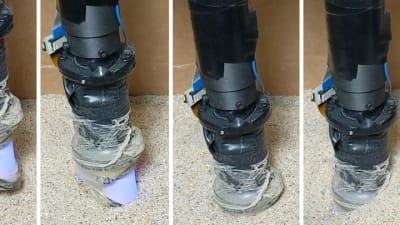
The technology uses tactile sensing to identify objects underground.
Blog: Sensors/Data Acquisition
A "self-aware," self-powering material can be used in heart stents, bridges, and even space.

Special Reports: Data Acquisition

Smart Factory/IIoT - June 2021
Factories are getting "smarter" and more automated by the day, thanks to advances in AI, connectivity, controls, and sensors. In this compendium of recent articles from the editors of Tech Briefs and Sensor...Application Briefs: Sensors/Data Acquisition
A valve actuator has deep-sea applications.

Articles: Materials
Learn the distinct forms that linear bearings take, and where the bearings are being used today.

Briefs: Motion Control
The system could one day replace LiDAR and cameras in automated manufacturing, biomedical imaging, and autonomous driving.

Articles: Motion Control
Designers who must sense motor position, speed, or acceleration have a lot of choices, including resolvers, optical encoders, and Hall-effect devices.

Briefs: Robotics, Automation & Control
Biobots based on muscle cells can swim at unprecedented velocities.

Briefs: Robotics, Automation & Control
Exoskeleton legs are capable of thinking and making control decisions on their own using artificial intelligence technology.

Articles: Sensors/Data Acquisition
Faster inline CT inspections makes it possible to inspect far greater numbers of circuit boards.


Briefs: Mechanical & Fluid Systems
A catalytic reaction causes a two-dimensional, chemically coated sheet to spontaneously morph into a three-dimensional gear.

Briefs: Mechanical & Fluid Systems
The machines fold themselves within 100 milliseconds and can flatten and refold thousands of times.

Briefs: Mechanical & Fluid Systems
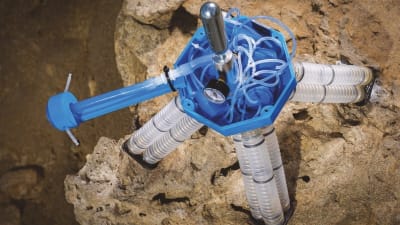
The walking quadruped is controlled and powered by pressurized air.
Briefs: Robotics, Automation & Control
The design could contribute to various applications in the robotics field such as smart prosthetics and human-robot interaction.

Application Briefs: Sensors/Data Acquisition
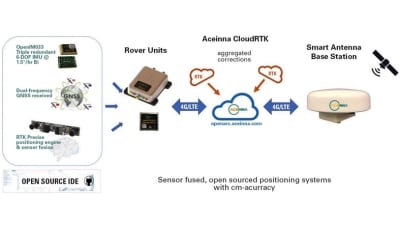
Editor Ed Brown explores what’s ahead for MEMS automobile navigation systems.
Briefs: Sensors/Data Acquisition
One of the final hurdles to hydrogen power is securing a safe method for detecting hydrogen leaks.

Briefs: Sensors/Data Acquisition
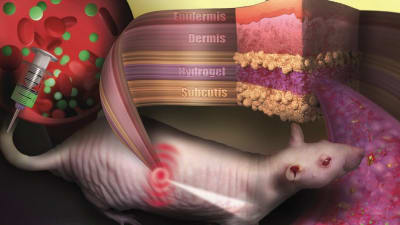
Color changes of gold nanoparticles under the skin reveal concentration changes of substances in the body.
Products: Sensors/Data Acquisition
High-precision medical sensors, battery-cell mappers, signal conditioners, and more.

Technology Leaders: Communications
AI will only reach its full potential when it can be fed with a constant stream of data from a plentitude of diverse sources.

Briefs: Test & Measurement
Researchers at KU Leuven have succeeded for the first time in measuring brain waves directly via a cochlear implant.

Technology Leaders: Test & Measurement
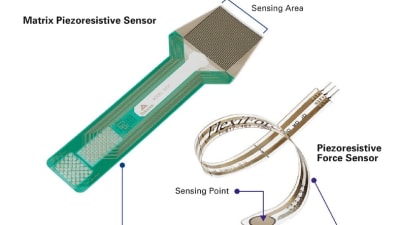
Ultra-thin piezoresistive sensors can be used in both R&D and as embedded components to develop safer, longer-lasting lithium-ion battery technologies.
Application Briefs: Wearables
Over the last 75 years, sensors have played an increasingly significant part in the advancement of medicine.

Application Briefs: Sensors/Data Acquisition
The MPS Flammable Gas Sensor can detect and identify the concentrations of 12 of the most common combustible gases,

Articles: Wearables
MEMS sensors have been around for a long time, but requests from the market for new applications are driving upgrades in the technology.

Briefs: Photonics/Optics
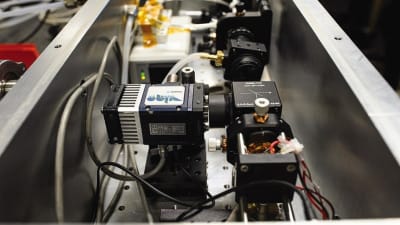
Recent advances could make it feasible to deploy networks of methane sensors to detect this greenhouse gas at large facilities.
Top Stories
 Blog: Sensors/Data Acquisition

Going for Gold in Winter Olympic Curling
 Blog: Energy

Batteries that Can Withstand the Cold
 Blog: Lighting

A Stretchable OLED that Can Maintain Most of Its Luminescence
 INSIDER: Design

Advancing All-Solid-State Batteries
 Blog: Data Acquisition

 Blog: Materials

Webcasts
 On-Demand Webinars: Defense

Cooling a New Generation of Aerospace and Defense Embedded Computing...
 Upcoming Webinars: Software

Beyond AI-Copy-Paste Engineering: Advanced AI-Integration Success...
 Upcoming Webinars: Automotive

Battery Abuse Testing: Pushing to Failure
 Upcoming Webinars: Power

A FREE Two-Day Event Dedicated to Connected Mobility
 Upcoming Webinars: RF & Microwave Electronics

Choosing the Right N-Port Strategy: Multiport VNAs vs. Switch...
 Upcoming Webinars: AR/AI