Stories
0
6060
30
INSIDER: Photonics/Optics
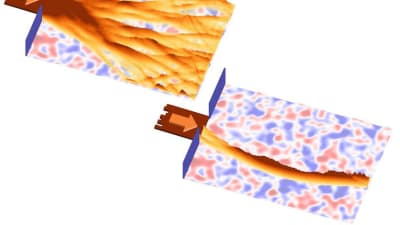
In free space, the light wave of a laser beam spreads on an exactly straight line. Under certain circumstances, however, a much more complicated behavior occurs. If the movement of the wave is...
INSIDER: Photonics/Optics
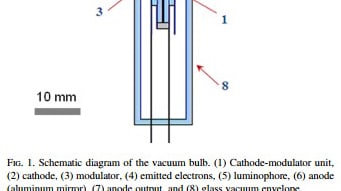
Researchers from the Moscow Institute of Physics and Technology and Lebedev Physical Institute of the Russian Academy of Sciences have designed and tested a prototype...
Question of the Week: Robotics, Automation & Control
Will ‘4D Knitting’ Lead to Better Robots and Wearables?
Carnegie Mellon University researchers have demonstrated "4D knitting. The computationally-controlled machines are being used to make a variety of soft textile objects.
Blog: Aerospace
A reader asks our industry expert: Will air taxis be influenced by military UAV standards?

Blog: Aerospace
Many of the technologies we use today – space blankets, hearing aids, food packaging – began on the Apollo 11 mission.

Articles: Sensors/Data Acquisition
The population is aging and more people need healthcare support, which is having a big impact on the overall cost of medical care. As a result, authorities and health insurance companies are putting...

Briefs: Test & Measurement
Accurately measuring semiconductor properties of materials in small volumes helps engineers determine the range of applications for which these materials may be suitable in the...
Briefs: Electronics & Computers
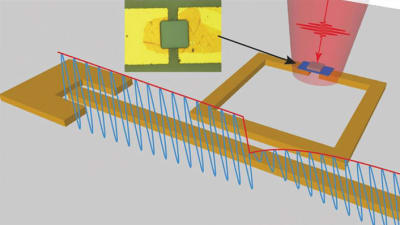
Whereas hydrogen fuel cells (e.g., proton exchange membrane (PEM) and other fuel cells) generate electricity from the chemical reaction between pure hydrogen and oxygen, direct carbon fuel cells (DCFCs)...
Briefs: Electronics & Computers
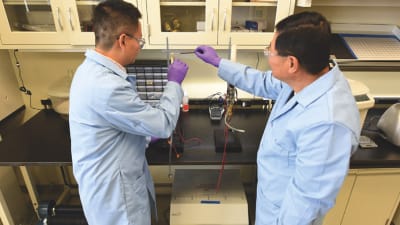
A process for fabricating atom-thin processors can be used to produce at the nanoscale for smaller and faster semiconductors.
Q&A: Electronics & Computers
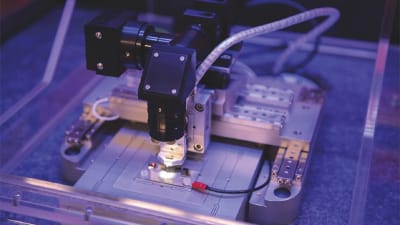
Aydin Aysu, Ph.D., is Assistant Professor in the Electrical & Computer Engineering Department at North Carolina State University in Raleigh, where he helped develop a technique for...

Briefs: Sensors/Data Acquisition
Smartphone Test Spots Poisoned Water Risk
Researchers have developed a biosensor that attaches to a smartphone and uses bacteria to detect unsafe arsenic levels. The device generates easy-to-interpret patterns similar to volume-bars that display the level of contamination.
Briefs: Nanotechnology
A system was developed that can remove radioactive cesium contamination from porous structures such as brick and concrete that are hard to clean, as well as contamination from metal...

Briefs: Electronics & Computers
Researchers have developed a hybrid transformer that has the benefit of a full planar transformer design but uses a wire-wound secondary winding to keep the parasitic winding capacitances lower. Alone, planar transformers...
5 Ws: Automotive
Who
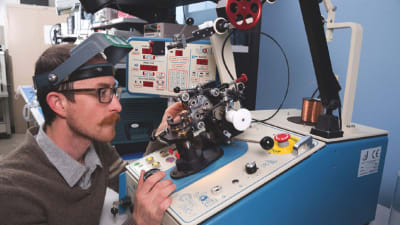
Anyone who uses products made of plastic. The new recyclable plastic could be a good alternative to many nonrecyclable plastics in use today.
Briefs: Internet of Things
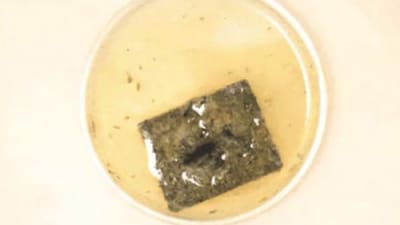
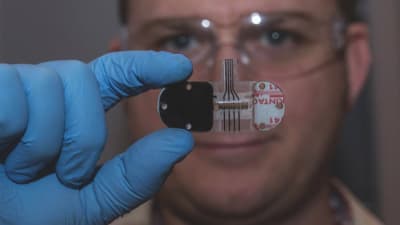
A continuous-testing device was developed that samples sweat as effectively as blood but in a noninvasive way and over many hours. After examining the use of saliva, tears, and interstitial...
Application Briefs: Materials
InsacoQuakertown, PAwww.insaco.com
Since 1947, Insaco has been machining, grinding, and polishing ceramics, sapphire, and glass to meet and often exceed client specifications. A large...

Briefs: Electronics & Computers
Researchers have created highly stretchable supercapacitors for powering wearable electronics that consist of crumpled carbon nanotube (CNT) forests. The supercapacitors demonstrated solid performance and...

Briefs: Energy
Innovators at NASA’s Glenn Research Center have developed a new means of avoiding and mitigating icing events for aircraft flying above 14,000 feet, dramatically improving aviation safety...

Briefs: Test & Measurement
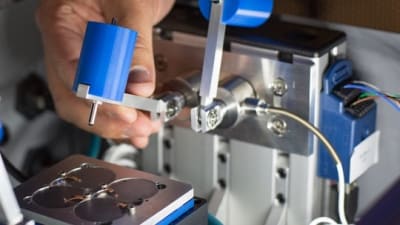
There is a need for high-volume material testing/qualification but industry and researchers are currently limited by commercially available testing devices. Most wear testers can only handle one sample...
Articles: Manufacturing & Prototyping
Just 54 years ago, the first photograph of Mars from a passing spacecraft appeared to show a hazy atmosphere. Now, decades of exploration on the planet itself has shown it to be a world...

NASA Spinoff: Imaging
Spinoff is NASA’s annual publication featuring successfully commercialized NASA technology. This commercialization has contributed to the development of products and...

Briefs: Data Acquisition
Aircraft currently fly based on coarse estimations of environment and aircraft state. Real-time measurements are traditionally restricted to laboratory environments (e.g. wind tunnel) due to the size and weight...

Facility Focus: Manufacturing & Prototyping
On September 1, 1961, NASA requested appropriations for initial land purchases on Merritt Island on Florida’s east coast to support the Apollo Lunar Landing Program. Designers quickly began developing...

Application Briefs: Sensors/Data Acquisition
Humidity Measurement Devices for Mars Are Ready for Final Testing
Vaisala Corp. Helsinki, Finlandwww.vaisala.com
The Finnish Meteorological Institute (FMI) is delivering pressure and humidity measuring devices based on Vaisala technology for use on NASA’s next robotic mission to Mars — the Mars 2020 rover. The pressure measurement devices were...
Articles: Propulsion
For the first time in a generation, NASA is building a human spacecraft for deep-space missions that will usher in a new era of space exploration. A...

Briefs: Lighting
3D Printing of Flexible Circuits
A process was developed for 3D printing that can be used to produce transparent and mechanically flexible electronic circuits. The electronics consist of a mesh of silver nanowires that can be printed in suspension and embedded in various flexible and transparent plastics (polymers). This technology can enable new...
Articles: Test & Measurement
Before becoming an astronaut candidate in 1996, Mike Massimino was busy earning degrees — an undergraduate degree from Columbia University and four additional degrees from the...

Briefs: Manufacturing & Prototyping
Multistep Self-Assembly for Reconfigurable Materials
Self-assembling synthetic materials come together when tiny, uniform building blocks interact and form a structure; however, nature lets materials like proteins of varying size and shape assemble, allowing for complex architectures that can handle multiple tasks.
Articles: Test & Measurement
On May 25, 1961, President John F. Kennedy announced before a special joint session of Congress the dramatic and ambitious goal of sending an American safely to the Moon before...

Top Stories
 Blog: Sensors/Data Acquisition

Going for Gold in Winter Olympic Curling
 Blog: Energy

Batteries that Can Withstand the Cold
 Blog: Lighting

A Stretchable OLED that Can Maintain Most of Its Luminescence
 INSIDER: Design

Advancing All-Solid-State Batteries
 Blog: Data Acquisition

 Blog: Materials

Webcasts
 On-Demand Webinars: Defense

Cooling a New Generation of Aerospace and Defense Embedded Computing...
 Upcoming Webinars: Software

Beyond AI-Copy-Paste Engineering: Advanced AI-Integration Success...
 Upcoming Webinars: Automotive

Battery Abuse Testing: Pushing to Failure
 Upcoming Webinars: Power

A FREE Two-Day Event Dedicated to Connected Mobility
 Upcoming Webinars: RF & Microwave Electronics

Choosing the Right N-Port Strategy: Multiport VNAs vs. Switch...
 Upcoming Webinars: AR/AI