Stories
0
11040
30
INSIDER: Motion Control
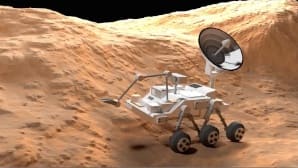
Looking for life on other planets is not straightforward. It usually relies on chemical detection, which might be limited or even completely irrelevant to alien biology. On the other hand, motion...
INSIDER: Medical
Implantable Neurostimulator Alleviates Dry Eye
Stanford Biodesign fellows are testing two tiny devices that stimulate natural tear production. The technologies deliver micro-electrical pulses to the lacrimal gland.
Question of the Week: Wearables
Will we really wear wearables?
This week's Question: New smartwatches were showcased at this year's Consumer Electronics Show (CES) in Las Vegas, including devices that run on operating systems and feature pedometers, sleep trackers, and audio players. Research firm Canalys forecasts that worldwide annual smartwatch shipments will grow from 8...
INSIDER: Imaging
A new software system developed at the University of Michigan uses video game technology to help solve one of the most daunting hurdles facing self-driving and automated cars: the high cost of...

INSIDER: Test & Measurement
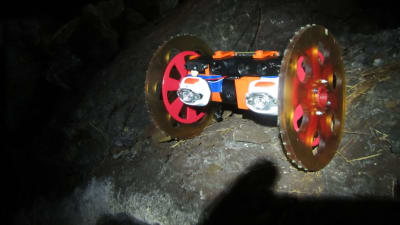
Carolyn Parcheta, a NASA postdoctoral fellow based at NASA's Jet Propulsion Laboratory in Pasadena, California, and JPL robotics researcher Aaron Parness are developing robots that can explore volcanic fissures.
Question of the Week: Energy
Will we deliver electricity from space?
This Week's Question: Scientists are exploring the possibility of utilizing space solar power for Earth-bound purposes. The United States, China, India and Japan all have projects at various stages of development that would see robots assemble solar arrays that could provide the Earth with clean, renewable...
INSIDER: Robotics, Automation & Control
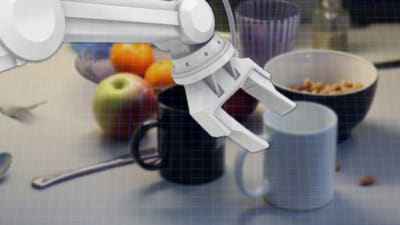
Researchers at MIT’s Computer Science and Artificial Intelligence Laboratory believe that household robots should take advantage of their mobility and their relatively static environments to make...
INSIDER: Materials
Exploiting mechanics principles similar to those found in children’s ‘pop-up’ books, researchers at the University of Illinois at Urbana-Champaign have developed a unique process for...
INSIDER: Nanotechnology
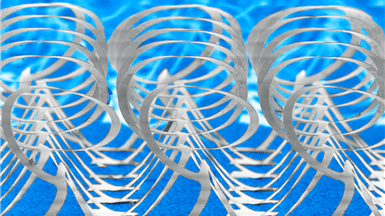
Scientists have developed a novel nanowire coating that can both generate heat and trap the heat from our bodies better than regular clothing.

INSIDER: Test & Measurement
NASA’s Cloud-Aerosol Transport System (CATS) team designed and built a new cloud and aerosol measurement instrument. The instrument will measure clouds, volcanic ash plumes, and...

INSIDER: Test & Measurement
Forensic Tracers Identify Contamination in Water
Duke University scientists have developed new forensic tracers to identify coal ash contamination in water and distinguish it from contamination coming from other sources. The tools can be used by regulatory agencies to monitor the environmental effects of coal ash, and determine whether it has or...
INSIDER: Electronics & Computers
New optical diagnostic technology developed at Tufts University School of Engineering promises new ways to identify and monitor brain damage resulting from traumatic...

Question of the Week
Are you optimistic about artificial intelligence?
This week's Question: In a BBC interview last year, renowned physicist, cosmologist, and author Stephen Hawking warned of the dangers of artificial intelligence. Hawking said AI "would take off on its own and re-design itself at an ever-increasing rate," passing the limited abilities of humans. A...
INSIDER: Materials
A new coating exploits interference effects in thin films, creating a range of vivid colors.

INSIDER: Materials
Scientists at NASA's Jet Propulsion Laboratory in Pasadena, California, are working on adhesive gripping tools that could grapple objects such as orbital debris or defunct satellites that would...

Question of the Week
Will we build a floating city above Venus?
This week's Question: NASA recently proposed a mission that one day may send astronauts, via a balloon, toward Venus' upper-atmosphere to research the possibility of a "cloud city community." Although the waterless planet has an unforgiving temperature of 1,000 degrees Fahrenheit, the clouds of Venus...
Briefs: Materials
Magnetic Thermometer for High-Resolution 10-mK Scale Thermometry
A thin-film magnetic thermometer with integrated, superconducting quantum interference device (SQUID) readout has been designed for fast, precision temperature measurements in the 10-mK range. The compact magnetic thermometer consists of a miniature DC SQUID susceptometer with a...
Briefs: Test & Measurement
This ultrasonic, pulse-echo probe can sustain as high as 250 °C, and uses a piezoelectric transducer to generate and receive the ultrasonic pulses. The...

Briefs: Materials
Low-Weight, Durable, Low-Cost Metal Rubber Sensor System for Ultra-Long-Duration Scientific Balloons
Large axial load forces and extreme temperature ranges are typical for scientific balloon missions. Therefore, a durable, flexible, and thermally stable sensor material is needed. In this innovation, sensors have been designed to be integrated onto...
Briefs: Sensors/Data Acquisition
Low-Power Charged Particle Counter for Space Radiation Monitoring
A miniature, low-power, solid-state detector for ionizing radiation was developed for use in more locations, and requiring less space and lower power than current technology. An accepted way of counting high-energy charged particles common in space radiation is to detect the light...
Briefs: Photonics/Optics
Ground-to-Space Laser Calibration System
The accuracy of spaceborne sensors measuring reflected solar radiance can be affected by multiple factors. First, instruments with complex optics are sensitive to polarization. The response of such instruments is characterized before launch; however, sensitivity to polarization can change on orbit...
Briefs: Sensors/Data Acquisition
Process-Hardened, Multi-Analyte Sensor for Characterizing Multiple Rocket Plume Constituents in a Test Environment
Stennis Space Center (SSC) is one of three government-operated rocket engine test facilities in the United States and is the primary center for testing and flight-certifying rocket propulsion systems for future space vehicles. Safety...
Briefs: Electronics & Computers
PATTERNS: Panoptic Aspect Time Triggered Ethernet Robust Network Scheduler, Version 1.0
The PATTERNS scheduling tool was created to test the multi-plane concept of a Time Triggered Ethernet (TTE) network. The TTE network interface cards used in the Orion vehicle contain three physical network ports, referred to as planes. Each plane exists to serve...
Briefs: Electronics & Computers
Electromagnetic Waves Transformed from a Coherent to a Quasi-Coherent Nature
The transformation of naturally occurring electromagnetic waves called “chorus” from a coherent nature to a quasi-coherent nature when propagating a distance from its source was demonstrated. The aim of the mission was to study the energizing of electrons by the waves...
Briefs: Electronics & Computers
An Earth-Observing, Frequency-Agile Radar Receiver for RFI Mitigation
The Soil Moisture Active Passive (SMAP) mission will have the first L-band radar/radiometer sensor suite dedicated to global measurements of soil moisture. For the radar sensor, the requirements for achieving high backscatter measurement accuracy from low-Earth orbit present a...
Briefs: Sensors/Data Acquisition
Wireless Electrical Devices Using Floating Electrodes
A wireless, connection-free, open circuit technology can be used for developing electrical devices like sensors that need no physical contact with the properties being measured. At the core of the technology is the SansEC (Sans Electrical Connections) circuit that is damage-resilient and...
Briefs: Sensors/Data Acquisition
Web-Enabled and Automatic Ground Processing Infrastructure Servicing the UAVSAR Airborne Missions
The UAVSAR (Uninhabited Aerial Vehicle Synthetic Aperture Radar) ground data processing infrastructure facilitates a wide range of mission operational processes through a centralized database, Web-enabled interfaces, and background automation. By...
Briefs: Aerospace
Variable-Sweep-Wing Aircraft Configuration
Efficient aircraft designs are increasingly desired in order to support the continued growth of the air transportation industry. Continued expansion of this vital mode of transportation is threatened due to concerns over ever-increasing emissions, noise, and the demand for fuel. Current airport runway,...
Briefs: Test & Measurement
Automated Table Lookup Solution Algorithm of the Optimal Powered Descent Guidance for Planetary Landing
A novel automated table lookup method is developed to compute the near-fuel-optimal powered descent guidance trajectories, in real-time, for planetary soft landing. The main advantage of this algorithm is that it can be executed autonomously in...
Top Stories
 Blog: Power

My Opinion: We Need More Power Soon — Is Nuclear the Answer?
 Blog: AR/AI

Aerial Microrobots That Can Match a Bumblebee's Speed
 News: Energy

 Blog: Electronics & Computers

Turning Edible Fungi into Organic Memristors
 Blog: Robotics, Automation & Control

Microscopic Swimming Machines that Can Sense, Respond to Surroundings
 INSIDER: Sensors/Data Acquisition
Webcasts
 Upcoming Webinars: Power

Hydrogen Engines Are Heating Up for Heavy Duty
 Upcoming Webinars: Automotive

Advantages of Smart Power Distribution Unit Design for Automotive...
 Upcoming Webinars: Automotive

Quiet, Please: NVH Improvement Opportunities in the Early Design...
 Upcoming Webinars: Test & Measurement

From Spreadsheets to Insights: Fast Data Analysis Without Complex...
 Upcoming Webinars: Automotive

Battery Abuse Testing: Pushing to Failure
 Upcoming Webinars: Connectivity