Stories
0
1380
30
White Papers: Motion Control
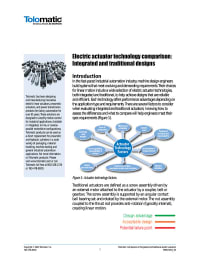
Explore the Advantages of Integrated Electric Linear Actuator Designs
Both traditional and integrated electric actuator technologies offer their own performance, reliability and efficiency advantages. Machine designers building systems in...Q&A: Medical
Professor Saptarshi Das and his team at Penn State University learned that when it comes to mating, two things matter for Heliconius butterflies: the look and the smell of their potential partner. This led them to think about how multiple sensory inputs could enable more efficient use of AI.

Quiz: Manned Systems
How much do you know about MOSA? Test your knowledge with this quiz.

Application Briefs: Test & Measurement
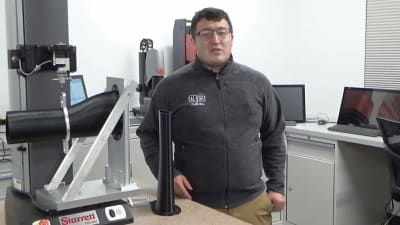
A group of graduate students used a force measurement system to test the structural capacity of custom profile stings during high-threshold testing in a wind tunnel.
Blog: Materials
A research team has developed a new generation of lithium metal batteries, representing a significant advancement in the field. Their innovation centers on microcrack-free polymer electrolytes which promise extended lifespan and enhanced safety at elevated temperatures.

INSIDER: Robotics, Automation & Control
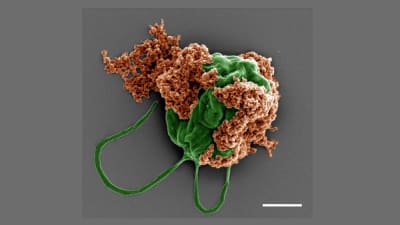
Engineers at the University of California San Diego have developed microscopic robots, known as microrobots, capable of swimming through the lungs to deliver...
INSIDER: Unmanned Systems
An estimated 100 earthquakes worldwide cause damage each year. This damage includes collapsed buildings, downed electrical lines and more. For first responders, assessing...

INSIDER: Electronics & Computers
Pick-and-place machines are a type of automated equipment used to place objects into structured, organized locations. These machines are used for a variety of applications — from...

Blog: Robotics, Automation & Control
URDFormer takes images of real environments from the internet and quickly creates physically realistic simulation environments where robots can train.

Podcasts: Medical
AI is optimizing manufacturing efficiency, quality control, and supply chain management.

Quiz: Software
With advancements like large language models, we are seeing increased integration of artificial intelligence (AI) into engineering processes. Design engineers of advanced machines and systems such as robots, medical devices, automotive components, and manufacturing lines, are already using AI to streamline design and production processes. How much do you know about AI adoption in engineering? Test your knowledge with this quiz.

Blog: Robotics, Automation & Control
A team developed a pinhole compound vision system by adopting new materials and structures. This system features several key characteristics, including an inherent hemispherical perovskite nanowire array imager with high pixel density to enlarge the imaging field and a 3D-printed lens-free pinhole array.

NASA Spinoff: Aerospace
The Eyegaze Edge system developed in collaboration with NASA is an eye-tracking technology that makes 'talking' possible for people who can’t.

5 Ws: Materials
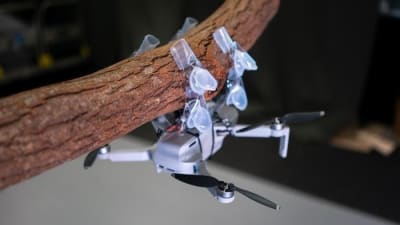
A novel fabrication approach enables lightweight, untethered operation of soft robots with advanced biomimetic locomotion capabilities.
Products: Software
See the product of the month: Idec Corporation's expanded SmartAXIS touch family, including the new FT2J Series combined PLC+HMI.

Articles: Photonics/Optics
See the products of tomorrow, including a new type of glass with unique and even contradictory properties, a novel approach for actively controlling Dutch-roll oscillations of an eVTOL aircraft by using existing outboard propellers to dampen oscillations, and the world’s first practical titanium-sapphire laser on a chip.

Products: Manufacturing & Prototyping
See what's new on the market, including the latest wafer inspection system from PI Americas, Remcom's XFdtd ® 3D Electromagnetic Simulation Software, ASM's high-resolution measurement system, NOVOSENSE Microelectronics' 16/24-channel driver IC for automotive LED applications, Advanced Energy Industries' NavX™ impedance matching network, the QUINT HP AC UPS from Phoenix Contact, Precision Glass & Optics' new double-sided polishing (DSP) capabilities, and more.
Briefs: Robotics, Automation & Control
A team of researchers at Delft University of Technology has developed a drone that flies autonomously using neuromorphic image processing and control based on the workings of animal brains.

Briefs: Robotics, Automation & Control
Getting 800 robots in a warehouse to and from their destinations efficiently while keeping them from crashing into each other is no easy task. So, a group of MIT researchers who use AI to mitigate traffic congestion applied ideas from that domain to tackle this problem. Read on to learn what they built.

Briefs: Robotics, Automation & Control
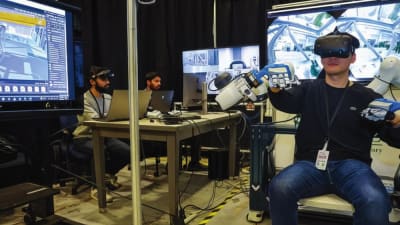
Because they can go where humans can’t, robots are especially suited for safely working with hazardous nuclear waste. Now, scientists at the U.S. Department of Energy’s (DOE) Argonne National Laboratory have designed and tested a remote-controlled, dual-arm telerobotics system with human-like capabilities that has the potential to revolutionize hazardous waste clean-up and holds potential for broader applications.
Briefs: Physical Sciences
Researchers have developed a new way to produce and shape large, high-quality mirrors that are much thinner than conventional space-telescope mirrors. The final product is even flexible enough to be rolled up and stored compactly inside a launch vehicle. Read on to learn more.

Briefs: Photonics/Optics
Researchers have developed standards and calibrations for optical microscopes that allow quantum dots to be aligned with the center of a photonic component to within an error of 10 to 20 nanometers (about one-thousandth the thickness of a sheet of paper). Such alignment is critical for chip-scale devices that employ the radiation emitted by quantum dots to store and transmit quantum information. Read on to learn more.

Briefs: Communications
Researchers at Chalmers University of Technology have developed an optical amplifier that they expect will revolutionize both space and fiber communication.
Briefs: Electronics & Computers
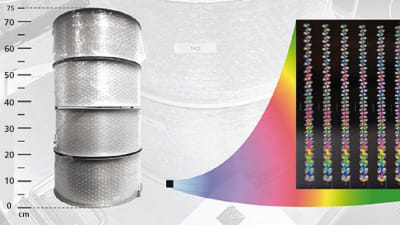
Penn Engineers have developed a new chip that uses light waves, rather than electricity, to perform the complex math essential to training AI. The chip has the potential to radically accelerate the processing speed of computers while also reducing their energy consumption. Read on to learn more.

Briefs: Manufacturing & Prototyping
Eva Baur, a Ph.D. student, used 3D-printed double network granular elastomers (DNGEs) to print a prototype ‘finger,’ complete with rigid ‘bones’ surrounded by flexible ‘flesh.’ The finger was printed to deform in a pre-defined way, demonstrating the technology’s potential to manufacture devices that are sufficiently supple to bend and stretch, while remaining firm enough to manipulate objects. Read on to learn more.

Briefs: Materials
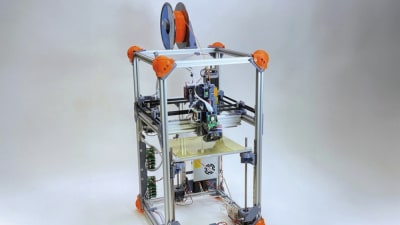
This research could help to reduce the environmental impact of additive manufacturing, which typically relies on nonrecyclable polymers and resins derived from fossil fuels. Read on to learn more.
Briefs: Materials
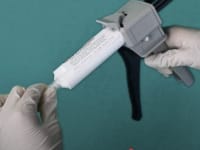
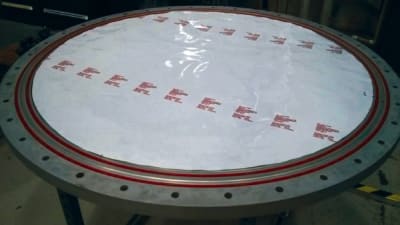
The RTV sealing method may benefit terrestrial applications that may demand cure-in-place internal seals. The method could also innovate manufacturing processes for components by enhancing the speed of assembly while increasing seal integrity. Read on to learn more.
Briefs: Materials
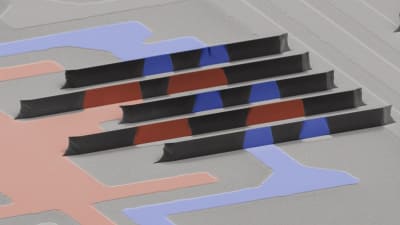
After announcing a ferroelectric semiconductor at the nanoscale thinness required for modern computing components, a University of Michigan team has demonstrated a reconfigurable transistor using that material. Read on to learn more.

Briefs: Software
Scientists have pioneered a method for using semiconductor technology to manufacture processors that significantly enhance the efficiency of transmitting vast amounts of data across the globe. The innovation is poised to transform the landscape of wireless communication. Read on to learn more.
Top Stories
 Blog: Power

My Opinion: We Need More Power Soon — Is Nuclear the Answer?
 Blog: AR/AI

Aerial Microrobots That Can Match a Bumblebee's Speed
 News: Energy

 Blog: Electronics & Computers

Turning Edible Fungi into Organic Memristors
 Blog: Robotics, Automation & Control

Microscopic Swimming Machines that Can Sense, Respond to Surroundings
 INSIDER: Sensors/Data Acquisition

Webcasts
 Upcoming Webinars: Power

Hydrogen Engines Are Heating Up for Heavy Duty
 Upcoming Webinars: Automotive

Advantages of Smart Power Distribution Unit Design for Automotive...
 Upcoming Webinars: Automotive

Quiet, Please: NVH Improvement Opportunities in the Early Design...
 Upcoming Webinars: Test & Measurement

From Spreadsheets to Insights: Fast Data Analysis Without Complex...
 Upcoming Webinars: Automotive

Battery Abuse Testing: Pushing to Failure
 Upcoming Webinars: Connectivity