Sampling cores requires the controlled breakoff of the core at a known location with respect to the drill end. An additional problem is designing a mechanism that can be implemented at a small scale, yet is robust and versatile enough to be used for a variety of core samples.
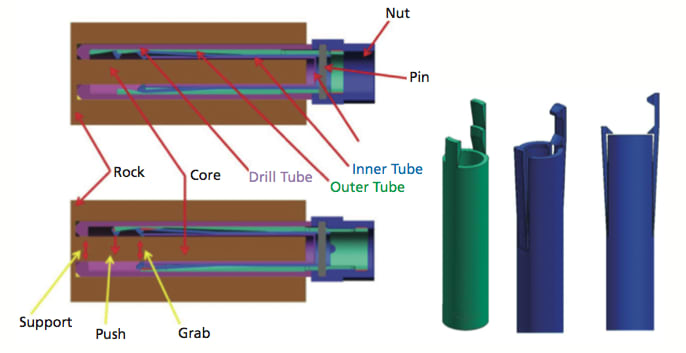
The praying mantis that is disclosed herein is an active core breaking/retention mechanism that requires only one additional actuator other than the drilling actuator. It can break cores that are attached to the borehole bottom as well as broken cores, and it also acts as a core retention device. The cores are broken at the bottom of the sample tube with a clean cut. The invention uses a core bending principle and does not induce additional axial load on the drill/robotic arm.
This invention is potentially applicable to sample return and in situ missions to planets such as Mars and Venus, moons such as Titan and Europa, and comets. It is also applicable to terrestrial applications like forensic sampling and geological sampling in the field.
This work was done by Mircea Badescu, Stewart Sherrit, Yoseph Bar-Cohen, Xiaoqi Bao, and Randel A. Lindemann of Caltech for NASA’s Jet Propulsion Laboratory. NPO-47356
This Brief includes a Technical Support Package (TSP).
Praying Mantis Bending Core Breakoff and Retention Mechanism
(reference NPO-47356) is currently available for download from the TSP library.
Don't have an account?
Overview
The document outlines the Praying Mantis Bending Core Breakoff and Retention Mechanism, a novel invention developed by NASA's Jet Propulsion Laboratory (JPL) aimed at improving core sampling techniques for both terrestrial and extraterrestrial applications. This mechanism is particularly relevant for future Mars Sample Return missions and other planetary exploration efforts.
The core of the invention is a mechanism that allows for the controlled break-off of cores at a predetermined location relative to the drill bit. It consists of a set of four concentric tubes: a drill tube, an outer tube, an inner tube, and a sample tube. The inner tube features two lamellae with opposing grabbing teeth and a pushing tooth, which work together to create a bending force that cleanly breaks the core without inducing additional axial load on the drilling apparatus.
The mechanism is designed to handle both intact cores attached to the borehole bottom and previously broken cores, acting as both a core breaking and retention device. The relative axial motion of the inner and outer tubes is crucial for the operation, allowing the mechanism to grab the core and apply lateral force to facilitate the break. This design not only enhances the efficiency of core sampling but also minimizes the risk of damaging the samples.
The document emphasizes the novelty of this invention, highlighting that it integrates features not previously implemented in core-breaking mechanisms. It addresses specific challenges in core sampling, such as the need for robustness and versatility in various environments, including geological and forensic applications.
Furthermore, the Praying Mantis mechanism supports NASA's exploration goals by enabling effective sample acquisition and caching, which are essential for in-situ analysis and potential return missions to Earth. The technology is positioned to play a critical role in future missions to Mars, Venus, and other celestial bodies, contributing to the advancement of space exploration and scientific research.
In summary, the Praying Mantis Bending Core Breakoff and Retention Mechanism represents a significant advancement in drilling technology, with broad implications for both space missions and terrestrial applications, showcasing NASA's commitment to innovation in aerospace technology.