An arc-jet source of chemically active nitrogen atoms has been developed for use in molecular-beam epitaxy (MBE) to grow such III-V semiconductors as nitrides of gallium, aluminum, and indium. This apparatus utilizes a confined arc to thermally excite N2 and to dissociate N2 into N atoms. This apparatus is compatible with other, ultrahigh-vacuum MBE equipment commonly used in growing such materials.
The key technical challenge in the MBE of nitrides of metals in group III in the periodic table is to devise a source of incorporatable nitrogen. Unlike in the growth of the other III-V compound semiconductors by MBE, direct reaction of N2 with excess group-III metal is not feasible because of the strength of the bond between the N atoms in N2. To generate incorporatable nitrogen, it is necessary to excite N2, forming a beam of N atoms, active nitrogen molecules (N*2), or N ions. Previously developed radio-frequency- and electron-cyclotron-resonance-based sources utilize electron-impact excitation to obtain monatomic nitrogen and, in so doing, also generate a variety of excited ions and neutrals. Experiments have shown that the ions in the beam from such a source degrade the microstructure of the epitaxial layer and generate electrically active defects. Recent theoretical studies have predicted that ground-state monatomic nitrogen could be incorporated into growing GaN, while monatomic nitrogen in either of its excited doublet states would lead to etching.
Addressing these issues, the present apparatus is designed to generate a beam characterized by a relatively high flux of monatomic nitrogen with selectable electronic and translational energies.
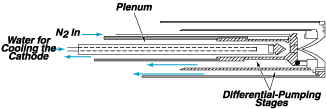
When the arc is ignited, an electron column passing through the nozzle is confined to the very center of the channel by the laminar flow. At the outlet of the nozzle, the pressure changes abruptly, and the electron arc expands radially, attaching to the grounded outer surface of the nozzle, forming an arc foot. The flowing gas is radiatively and convectively heated by the arc plasma during its transit through the nozzle.
The side walls of the nozzle are insulated from convective heating by the boundary layer formed between the nozzle and the high-velocity gas. Depending on the current sustaining the arc and the duration of contact of the gas with the arc plasma, the gas within the nozzle can be heated to temperatures in excess of 7,500 °C. The flowing gas is exposed to possible electron-impact excitation in the region of the cathode and the arc foot as it passes through the arc; however, the duration of this excitation is quite short, so that the generation of ionic species is minimal.
The materials, constrictor and nozzle geometry, pressure, and power levels are chosen to minimize the ion yield and maximize the flux of monatomic nitrogen. The cathode is replaceable and cooled by water, and its active part is made of thoriated tungsten. The nozzle is also replaceable and is made of rhenium. The interior plenum near the cathode is made of rhenium. The supporting chamber that contains the nozzle is made of tantalum; the structure that supports the skimmer stages, of molybdenum; and the skimmers, of rhodium. The apparatus is connected with the vacuum chamber through a bellows/manipulator and a gate valve to provide for maintenance and precise alignment to the sample.
The apparatus has been found to be stable and robust and to operate reproducibly from day to day. It has been operated successfully at the lowest power levels (10 to 300 W) reported for an arc jet. Initial experiments have shown that the current density of positive ions in the beam formed by this apparatus is relatively low. It has also been shown that through variation of the parameters of the nitrogen flow and the arc current, one can vary the relative amounts of N*2 and monatomic nitrogen. With control of the translational energies and electronic-excitation levels of these active nitrogen species, it should be possible to systematically study the fundamentals of heteroepitaxy of group-III nitrides.
This work was done by Frank Grunthaner and Paula Grunthaner of Caltech; C. Bryson of Surface/Interface, Inc.; and R. Laferla of Ultramet, Inc., for NASA's Jet Propulsion Laboratory. For further information, access the Technical Support Package (TSP) free on-line at www.nasatech.com/tsp under the Physical Sciences category.
NPO-20899
This Brief includes a Technical Support Package (TSP).
Ultrahigh-Vaccum Arc-Jet Source of Nitrogen for Epitaxy
(reference NPO-20899) is currently available for download from the TSP library.
Don't have an account?
Overview
The document presents a technical report on an ultrahigh-vacuum arc-jet source of nitrogen developed for molecular-beam epitaxy (MBE) applications, particularly for the growth of group-III nitrides, such as gallium nitride (GaN). This technology addresses a significant challenge in the MBE growth of these materials: the difficulty of incorporating nitrogen due to the strong bond of dinitrogen (N₂). Traditional methods of nitrogen incorporation often lead to the generation of unwanted ionic species that can degrade the quality of the epitaxial layers and introduce electrically active defects.
The apparatus described operates stably and reproducibly at low power levels (10 to 300 W) and has been shown to produce a beam with a relatively high flux of monatomic nitrogen, which is essential for successful incorporation into the growing semiconductor layers. The design includes a constricted nozzle that forms a free jet of nitrogen gas, which is seeded with argon to facilitate spectroscopic analysis. A cathode strikes an arc within the nozzle, creating a high-speed laminar flow of gas that transitions from a high-pressure zone to a low-pressure outlet in the vacuum chamber, minimizing pressure and enhancing the quality of the nitrogen beam.
Initial experiments indicate that by varying the nitrogen flow and arc current, researchers can control the relative amounts of active nitrogen species, including N₂ and monatomic nitrogen. This control over translational energies and electronic-excitation levels allows for systematic studies of the fundamentals of heteroepitaxy of group-III nitrides.
The work was conducted by a team from Caltech and Surface/Interface, Inc., in collaboration with NASA’s Jet Propulsion Laboratory. The report emphasizes the novelty of this approach, highlighting its potential to improve the growth processes of III-V semiconductors, which are critical for various electronic and optoelectronic applications.
The document also includes a disclaimer regarding the use of trade names and the lack of endorsement by the U.S. Government. For further details, readers are directed to access the Technical Support Package (TSP) online. Overall, this report outlines a significant advancement in the field of semiconductor manufacturing, with implications for future technologies.