

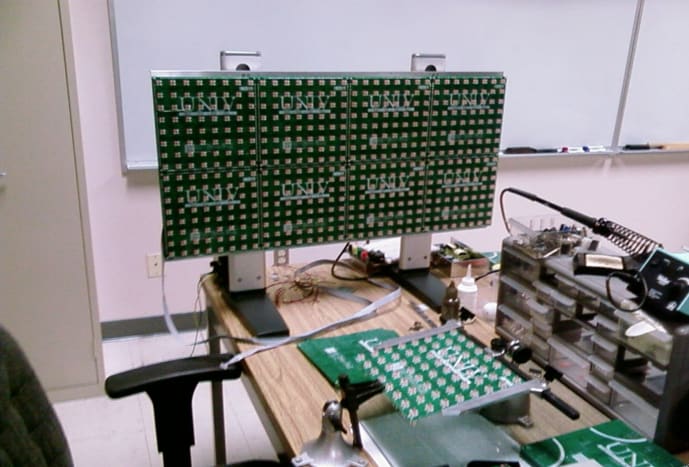
The pixel consisted of four LEDs — red, green, blue, and white — placed in a square configuration. Two different RGBW geometrical pixel configurations were implemented and compared against traditional LED configurations. These configurations were analyzed for energy efficiency while keeping the quality of the display the same. Power savings for the white was higher than any other color. As demonstrated, using the new RGBW pixel architecture saves power in most cases predominantly in case of the color which has more white content.
This work was done by the University of Nevada, Las Vegas .
This Brief includes a Technical Support Package (TSP).
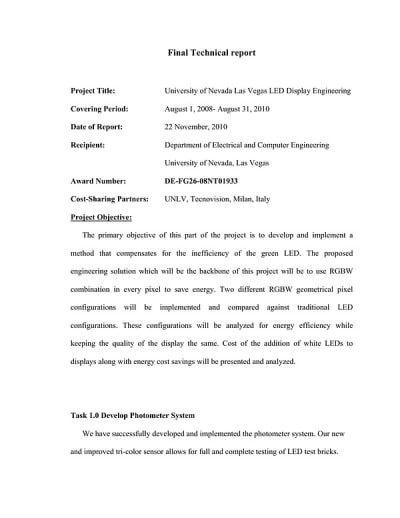
LED Display Engineering
(reference GDM0015) is currently available for download from the TSP library.
Don't have an account?
Overview
The document is a final technical report on the University of Nevada Las Vegas (UNLV) LED Display Engineering project, covering the period from August 1, 2008, to August 31, 2010. The primary objective of the project was to develop and implement a method to enhance the energy efficiency of LED displays by utilizing a combination of red, green, blue, and white (RGBW) LEDs in each pixel, as opposed to traditional RGB configurations.
The report outlines several key tasks undertaken during the project. Task 1 involved the development of a photometer system, which was successfully implemented to allow for comprehensive testing of LED test bricks. The photometer achieved 12-bit digital accuracy and a sampling rate of over 120 Hz. Task 2 focused on creating a self-diagnostic reconfigurable system, but this was ultimately dropped as the project evolved and the need for it diminished.
Task 3 centered on brightness and grayscale linearity, where a 32” x 16” RGBW display was designed and tested for energy efficiency and human perception. The display featured a pixel configuration that included four LEDs (red, green, blue, and white) arranged in a square layout. The report emphasizes the importance of analyzing energy efficiency while maintaining display quality.
The document also details human perception experiments conducted to compare the traditional RGB and the new RGBW LED display technologies. A total of 76 subjects participated in the study, where they evaluated color and intensity differences between the two technologies. The experimental design included control and experimental groups to assess the reliability of the results.
The findings from the experiments and analyses are discussed, highlighting the potential benefits of RGBW configurations in terms of energy savings and display quality. The report concludes with a disclaimer regarding the information presented, clarifying that it does not imply endorsement by the U.S. Government or any of its agencies.
Overall, the report provides a comprehensive overview of the project's objectives, methodologies, and outcomes, showcasing the advancements made in LED display technology and the potential for improved energy efficiency in future applications.











