A cost-competitive solution for increasing the light extraction efficiency of organic light-emitting diodes (OLEDs) with efficient and stable color rendering index (CRI) for solid-state lighting (SSL) was developed and demonstrated. Solution-processable quantum dot (QD) films were integrated into OLED indium tin oxide (ITO)-glass substrates to generate tunable white emission from blue-emitting OLED devices.

This QD light-enhancement substrate (QD-LES) technology simultaneously increased OLED light out-coupling, improved external quantum efficiencies, and provided > 80 CRI white light that is readily tunable and inherently stable for any diffuse lighting application.
The efficacy of a light source is given by the product of the electrical-to-optical conversion efficiency (ηe-o = Po/Pe) and the luminous efficacy of radiation (LER),
Efficacy [lm/W] = LER [lm/W(optical)] ηe-o [%],
where Po and Pe are the optical output power of the light source and the electrical input power (voltage times current). ηe-o is directly proportional to the internal quantum efficiency (IQE), extraction efficiency, ηe, and inversely proportional to the driving voltage. In light of the equation above, the research work directly addressed improving OLED lamp efficacy and reliability in the following ways:
- The IQE of the blue OLED can be optimized for blue light generation.
- ηe-o > 40% is possible by using a combination of internal and external out-coupling layers.
- Higher LER values > 350 lm/W are possible by leveraging the narrow band emission of green-yellow-red QDs in combination with bluer, broader OLED emission; current OLED LER values are limited to 350 lm/W due the inherently broad emission of OLEDs resulting in lost photons outside the visible spectra.
- High CRI due to customizable narrow QD emission profiles.
- Higher operational lifetimes are possible due to the single-emitter architecture, reducing the color drift failure mode common in mixed-emitter and tandem OLED devices.
- Improved color stability as a function of drive current by using a single blue-emitting OLED.
- Simpler construction due the single-emitter OLED architecture and solution-processable QD-LES.
Assuming an LER of 350 lm/W, an average blue phosphorescent OLED (PhOLED) wavelength of 490 nm, an operating voltage of 3.3 V, an IQE of 100%, and an extraction efficiency of 40%, the QD-LES-based PhOLED would have an efficacy ranging 100-110 lm/W (electrical-optical power conversion of approximately 31%). With further improvements in LER and extraction efficiency, OLED lamp efficacies can exceed 150 lm/W using the new approach. Lifetime improvements can be expected, since the stable downconverters will essentially eliminate color shift over time, causing lifetime to be limited solely by the blue OLED, not the color shift experienced by all mixed-emitter OLED systems.
This work was done by Sean Evans, James M. Perkins, Ph.D., Matthew Stevenson, Gagan Mahan, Seth Coe-Sullivan, Ph.D., and Peter Kazlas, Ph.D. of QD Vision, Inc.
This Brief includes a Technical Support Package (TSP).
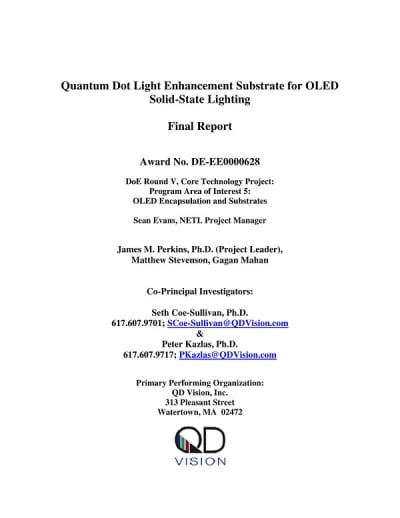
Quantum Dot Light Enhancement Substrate
(reference GDM0020) is currently available for download from the TSP library.
Don't have an account?
Overview
The final report for the project titled "Quantum Dot Light Enhancement Substrate for OLED Solid-State Lighting," funded under DOE Award No. DE-EE0000628, outlines the development and demonstration of a novel technology aimed at improving the light extraction efficiency of organic light-emitting diodes (OLEDs). The project focuses on creating a cost-competitive solution that enhances the performance of OLEDs while maintaining efficient and stable color rendering.
The core innovation involves the integration of solution-processable quantum dot (QD) films into the ITO-glass substrates of OLED devices. This integration allows for the generation of tunable white light from blue-emitting OLEDs and facilitates the outcoupling of light from the ITO film. The technology, referred to as the QD light-enhancement substrate (QD-LES), achieved a significant 60% increase in forward light out-coupling, which rises to 76% when considering the total increase in multi-directional light output. The project's initial objective was to achieve an 80% increase in light output, indicating that while the target was not fully met, substantial progress was made.
The report details the project's accomplishments against its objectives, highlighting key performance metrics. The QD film down-conversion efficiency exceeded expectations, reaching between 65% and 75%, while the color rendering index (CRI) achieved values between 80 and 91, surpassing the target of 85. The correlated color temperature (CCT) was also successfully tuned, ranging from 2350K to 7600K, compared to the specified range of 3000K to 5500K.
In addition to performance metrics, the report discusses the advantages of the QD-LES technology, including its simpler construction due to the single-emitter OLED architecture and the solution-processable nature of the QD films. This innovation not only enhances light output but also improves external quantum efficiencies, making it suitable for various diffuse lighting applications.
The report concludes with a summary of the project activities, technical approaches, and milestones achieved throughout the duration of the project. Overall, the findings indicate that the QD light-enhancement substrate technology holds significant promise for advancing solid-state lighting solutions, contributing to more efficient and versatile lighting applications.