Light Emitting Diode (LED) driver ICs associated with specific (uniquely operated) switching power supplies that optimize performance for High Brightness LEDs (HB-LEDs) have been developed. The LED drivers feature fewer external components and high power efficiency.
This project developed new Light Emitting Diode (LED) driver ICs associated with specific (uniquely operated) switching power supplies that optimize performance for High Brightness LEDs (HB-LEDs). The drivers utilize a digital control core with a newly developed nonlinear, hysteretic/sliding mode controller with mixed-signal processing. The drivers are flexible enough to allow both traditional microprocessor interface as well as other options such as “on the fly” adjustment of color and brightness.

Some other unique features of the newly developed drivers include:
- AC Power Factor Correction;
- High power efficiency;
- Substantially fewer external components should be required, leading to substantial reduction of Bill of Materials (BOM).
Thus, the LED drivers developed in this research optimize LED performance by increasing power efficiency and power factor. Perhaps more remarkably, the LED drivers provide this improved performance at substantially reduced costs compared to the present LED power electronic driver circuits. Since one of the barriers to market penetration for HB-LEDs (in particular “white” light LEDs) is cost/lumen, this research makes important contributions in helping the advancement of SSL consumer acceptance and usage.
The U.S. Department of Energy projects that a potential reduction of electricity used for illumination could be up to 50% by 2025 if SSL becomes widespread. Benefits of this would be >1015 Wh of electrical power savings, which would lead to a reduction of an almost 1 billion tons of carbon dioxide emission (among many other significant emission reductions). Presently, however, the cost/lumen for SSL is prohibitively high for market penetration into the general white light illumination market. This project aids in reducing the cost of SSL High Brightness white lighting systems. LED driving, pulsed average sliding mode digital controllers were developed. The drivers require no additional expensive circuits that are currently being used for systems with similar features.
Analytical and mathematical simulations showed that for two operational input voltages, DC and AC, Pulse Current Averaging Hysteretic Control works to drive HB LED’s. SynDiTec Inc. considers this to be a theoretical contribution to Automatic Control Theory by investigating and developing a new digital pulse current averaging controller. That allows dropping traditional PWM or PFM feedback techniques and coming up with new suitable to digital implementation IC architecture. As the result, this controller is simple, low-cost, and feasible for driving HB LED’s as well as traditional switching power supplies loads. Some other advantages of this method appear to be:
- Inherent pulse-by-pulse current limiting, making the power converter nearly immune to damage from overload.
- No external compensation needed (low parts count).
- Fast response of the inductor current.
- Automatic power factor correction in off-line drivers
- Robustness and increased noise immunity
- Programmable output current for brightness regulation and different compensation of drifting LED parameters.
This work was done by Dr. Anatoly Shteynberg of SynDiTec Inc, San Jose, CA. DE-FG02-05ER86261
This Brief includes a Technical Support Package (TSP).
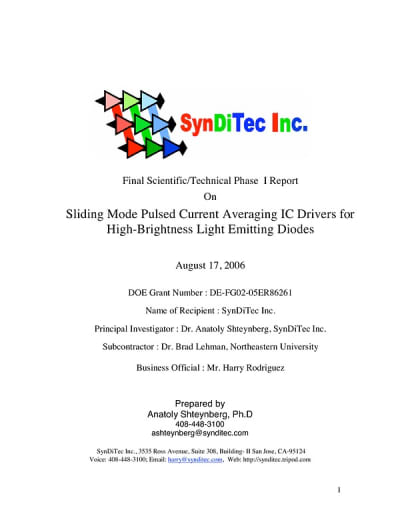
Sliding Mode Pulsed Current Averaging IC Drivers for High-Brightness Light Emitting Diodes
(reference GDM0001) is currently available for download from the TSP library.
Don't have an account?
Overview
The document outlines the achievements of a Phase I research project focused on developing advanced driver integrated circuits (ICs) for High Brightness Light Emitting Diodes (HB-LEDs). Conducted by SynDiTec Inc. under the leadership of Dr. Anatoly Shteynberg, the project aimed to create innovative LED drivers that optimize performance through a digital control core utilizing a nonlinear, hysteretic/sliding mode controller with mixed-signal processing.
Key accomplishments include the design, analytical validation, and simulation of digital hysteretic/sliding mode pulse averaged adaptive controllers specifically tailored for HB-LED applications. The project successfully developed a block diagram and analytical design for an IC driver system compatible with both DC voltage and AC mains input sources. The drivers were modeled and verified using VHDL on the Simplorer simulator, ensuring their functionality and effectiveness.
The newly developed LED drivers feature several unique attributes, such as AC power factor correction, high power efficiency, and a significant reduction in the number of external components required. This reduction leads to a lower Bill of Materials (BOM), making the drivers more cost-effective. The project addresses a critical barrier to the market penetration of HB-LEDs, particularly in the white light segment, where cost per lumen remains prohibitively high.
The research highlights the potential for substantial energy savings, estimating that widespread adoption of solid-state lighting (SSL) could reduce electricity consumption for illumination by up to 50% by 2025. This shift could result in over 10^15 watt-hours of electrical power savings and a reduction of nearly 1 billion tons of carbon dioxide emissions, contributing significantly to environmental sustainability.
In summary, the project not only advances the technology behind LED drivers but also plays a crucial role in promoting the acceptance and usage of SSL in the general lighting market. By enhancing performance while reducing costs, the developed drivers are positioned to facilitate the transition to more efficient and environmentally friendly lighting solutions. The findings and innovations from this research represent a significant step forward in the field of power electronics for lighting applications.