

This actuator design allows the extension and contraction of turnbuckle assemblies. It can be operated manually or remotely, and is extremely compact. It is ideal for turnbuckles that are hard to reach by conventional tools. The tool assembly design solves the problem of making accurate adjustments to the variable geometry guide vanes without having to remove and reinstall the actuator system back on the engine. The actuator does this easily by adjusting the length of the turnbuckles while they are still attached to the engine.
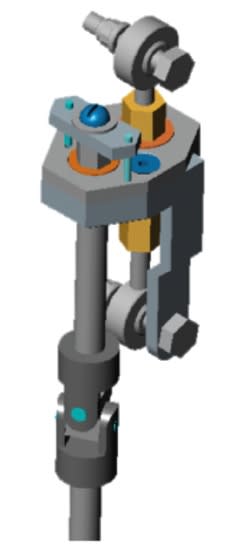
To prevent gear movement due to vibration, a locking mechanism secures the gears once adjustments are made. Tool operation is straightforward — the driver bar is turned either clockwise or counterclockwise to lengthen or shorten the turnbuckle. The angle of the guide vanes is read out using encoders mounted on the engine. When the desired offset angle is reached, the locking mechanism is engaged, thus securing the length of the turnbuckle. What would originally have taken a day to accomplish is now done in approximately ten minutes, and with greater accuracy, because the turnbuckle is never removed. The effectiveness of this tool is best appreciated when one considers a typical engine, with four or more turnbuckles, where each turnbuckle requires several configurations to make vane readings.
This work was done by Ricky N. Rivera of Glenn Research Center. For more information, download the Technical Support Package (free white paper) at www.techbriefs.com/tsp under the Mechanics/Machinery category.
Inquiries concerning rights for the commercial use of this invention should be addressed to NASA Glenn Research Center, Innovative Partnerships Office, Attn: Steve Fedor, Mail Stop 4–8, 21000 Brookpark Road, Cleveland, Ohio 44135. Refer to LEW-18427-1.







